Big Trash Pick-Up: Volunteers to Clean Connecticut's Shoreline

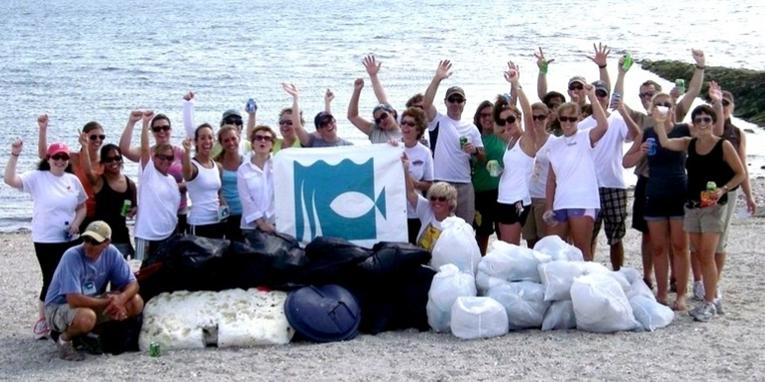
A year ago, 2,450 volunteers in Connecticut removed 16,310 pounds of trash from Long Island Sound’s shoreline and Connecticut waterways. This weekend, the effort continues, as bird watchers, fishermen, sailors, scuba divers, students, citizen groups and businesses will be cleaning up trash from Connecticut’s beaches, islands, and rivers as part of the International Coastal Cleanup (ICC).

Save the Sound, the Connecticut coordinator for the ICC for the past 11 years, has worked with cleanup captains to organize public clean-ups at 25 locations across the state this weekend. (See partial list below.)  The cleanups will continue throughout September and October.  Interested volunteepeoplecleanrs should check the calendar for listings of clean-ups and to register.
ICC, created by the Ocean Conservancy, is now in its 28th year and has participation in all 55 U.S. states and territories and 100 countries around the world. It is a unique event in that volunteers tally up all garbage they pick up on data cards, which are sent to Ocean Conservancy for analysis. They use the information to track trends in marine debris and help stop it at its source. Last year, more than 550,000 people picked up more than 10 million pounds of trash along nearly 20,000 miles of coastline worldwide.

Bank of America is Lead Sponsor of Save the Sound’s ICC Cleanups in Connecticut, and employees from the company are leading and participating in a cleanup at Jennings Beach in Fairfield on Saturday, as well as co-leading a cleanup with the New Haven Rotary club at Lighthouse Point Park.

Working in both New York and Connecticut, Save the Sound has established a 40-year track record of restoring and protecting the waters and shorelines of the Sound.  A program of Connecticut Fund for the Environment, Save the Sound recently received a $50,000 grant from the Fairfield County Community Foundation to support its green infrastructure work in partnership with the City of Bridgeport and the Bridgeport Water Pollution Control Authority. The grant will further Save the Sound's efforts to work with towns to implement innovative installations that act like sponges to absorb and filter stormwater runoff, thereby reducing flooding and improving the water quality of Long Island Sound.

For a complete list of the over 43 ICC cleanups happening in Connecticut throughout September and October, please visit http://www.ctenvironment.org/geshoret-involved/calendar.cfm. A Facebook page has additional information.

Saturday, September 21

NEW HAVEN, 9:00 AM – 12:00 PM

Bank of America, New Haven Rotary Club, and Save the Sound executive director Curt Johnson at Lighthouse Point Park.

FAIRFIELD,  9:00 AM – 12:00 PM

Bank of America cleanup at Jennings Beach.

NEW LONDON,10:00 AM – 11:30 AM

Local citizen cleanups at Ocean Beach and Alewife Cove Tidal Creek.

 Sunday, September 22

WESTPORT, 11:00 AM – 12:00 PM, 11:00 AM – 2:00 PM

 Friends of Sherwood Island State Park and National Charity League of Ridgefield will hold cleanups at Sherwood Island.

MILFORD, 4:00 PM – 5:30 PM

The Boy Scouts will hold two cleanups at Audubon Coastal Center and Gulf Beach.

CT Residents Are Driving Less, Reflecting National Trend

Connecticut residents have cut their per-person driving miles by 3.45 percent since 2005, while the nation’s long term driving boom appears to have ended, according to a report by the ConnPIRG Education Fund. The decline in driving is a national trend, with 46 states including Connecticut having reduced per-person driving since the middle of the last decade.

The 31-page report, “Moving Off the Road: A State-by-State Analysis of the National Decline in Driving,” is based on the most current available government data. The average number of miles driven by Americans is in its eight consecutive year of decline, led Moving Off the Road Thumbnailby declines among Millennials. Connecticut has had the slowest decline in driving in New England, but has the second lowest vehicle miles traveled per person in region, behind Rhode Island. The national trend in driving peaked in 2005.

“It’s time for policy makers to recognize that the driving boom is over. We need to reconsider expensive highway expansions and focus on alternatives such as public transportation and biking—which people increasingly use to get around,” said Abe Scarr, Director of the ConnPIRG Education Fund.

“The Millennial generation is leading the decrease in driving and will be using and paying for our transportation system for years to come.  It is critical that Connecticut plans a system that reflects how people are getting around and want to get around,” said Scarr.  The report noted that “the evidence suggests that the nation’s per-capita decline in driving cannot be dismissed as a temporary side effect of the recession.”

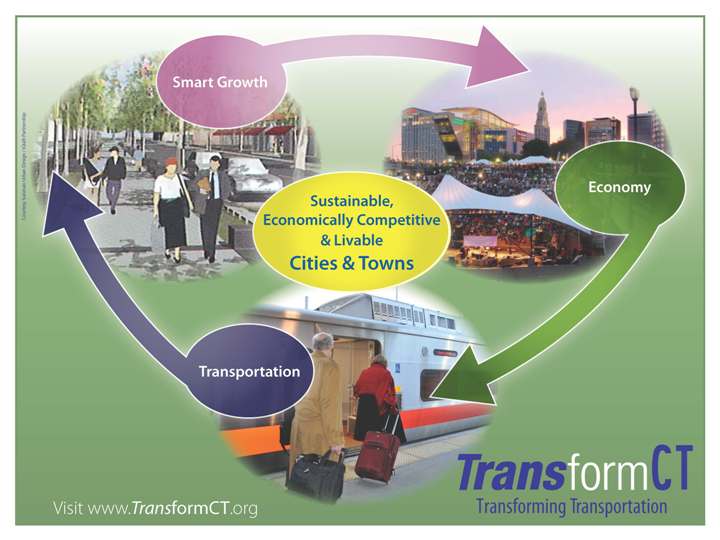
Earlier this year, Governor Malloy and Department of Transportation Commissioner James Redeker launched a multi-year strategic planning process, Transform CT, which aims to “improve economic growth and competitiveness, build sustainability, and provide a blueprint for a world-class transportation system.”  TransformCT_published_Cycle_Small

Transform CT has established an interactive website to gather public input which has collected nearly 300 comments, suggestions or ideas to date, and will be updated with topics and polls regularly as the strategic plan is developed over 18-20 months. In addition, a series of events will be held throughout the fall to engage the public on the future of transportation in Connecticut.

 “Connecticut’s investment in critical transit projects like CTfastrak and the New Haven-Springfield commuter rail line show that transportation decisions better reflect changing travel preferences of residents,” said Ryan Lynch, associate director for the Tri-State Transportation Campaign, a non-profit policy organization.

The Tri-State Transportation Camcars on hwaypaign, a 501(c)(3) non-profit organization dedicated to reducing car dependency in New York, New Jersey, and Connecticut, celebrates its 20th anniversary with a fundraising benefit in New York City on November 7.  The Campaign was formed in the early nineties as a response to the mounting economic and environmental costs of automobile and truck dependence and promising reforms in federal transportation policy. Among the organization’s board members is Norman Garrick, Director of the Center for Transportation and Urban Planning at the University of Connecticut.

North Dakota, Nevada, Louisiana and Alabama are the only states in the nation where driving miles per capita in 2011 were above their 2004 or 2005 peaks, the ConnPIRG report found.  Meanwhile, since 2005, double-digit percent reductions occurred in a diverse group of states: Alaska, Delaware, Oregon, Georgia, Wyoming, South Carolina, the District of Columbia, Pennsylvania, Indiana and Florida.

The states with the biggest reductions in driving miles generally were not the states hit hardest by the economic downturn, according to the ConnPIRG report. The majority—almost three-quarters—of the states where per-person driving miles declined more quickly than the national average actually saw smaller increases in unemployment compared to the rest of the nation, according to the report.

High School Ambulance Corps Gains Prominent Supporter, Urges CPR Training

Local resident Scott Pelley is prominently featured in efforts to alert Darien neighbors  of an upcoming opportunity to learn how to save a life.  Pelley, widely known as the anchor of the CBS Evening News and a lead correspondent on 60 Minutes, has recorded a video in support of Darien Emergency Medical Services Post 53, which is presenting Hands for Life, a day of training in hands-only CPR, open to local residents on September 29.

In the video that appears on the Post 53 website, Pelley notes that the local ambulance service, founded in Darien in 1970, is “possibly the only one in the country” staffed predominantly byscott pelley high school students.  Post 53 and the Darien YMCA are coordinating the training day.

Each year approximately 20 high school students, at least 14 years of age, are selected to be members of Post 53 from53 a large pool of applicants. Over the course of their four-year career at Post 53, members progress through five roles: Candidate, Radio Roomie, Rider, State-Certified EMT, and then Driver, usually by their senior year, according to the organization’s website.

The mission of Post 53 is to provide emergency medical services to the Darien community at the highest level of excellence, using Darien High School students and adult volunteers. The members of Post 53 are committed to achieving and maintaining the highest level of training and skill in providing pre-hospital care and transport to the citizens of Darien.

The young aduHFL-DARIEN_logo_Hlts staff the ambulance on a 24-hour/day, 7-day/week basis, except during regular school hours (7:30 AM - 2:30 PM, Monday-Friday during the school year).  During those times, the adult advisors staff the first response ambulance and are the primary support unit for Darien.  In the event that two calls occur which overlap during the school day, the second response young adult crew is paged out.  Darien High School supports the commitment of the Post 53 young adults and there is a mutual obligation to support the emergency medical needs of Darien while minimizing the impact on the school work of the young adults.

Post 53 is considered one of the finest emergency ambulance services in the United States for its consistently high quality pre-hospital emergency care, accambulanceording to the website.  In total, over 550 Darien High School students have served their community as members of Post 53 since its inception four decades ago.  Darien EMS-Post 53 does not rely on any government funding for the annual operating budget.

Each year, nearly 785,000 Americans suffer from a heart attack. Nearly 300,000 of these people suffer sudden cardiac arrest at the time of their heart attack, outside of a hospital setting. Less than one in four receive CPR from a bystander, and only about 5 percent of cardiac arrest victims survive, the Post 53 website points out.

Studies show that survival rates fall 10 percent each minute without CPR before emergency medical assistance, often with a fatal outcome. The Post 53 website points out that if more people knew how to provide effective, simple-to-apply Hands-Only CPR, more victims could be helped, doubling or even tripling their chances of survival.

The September 29 day of CPR training for members of the community is free of charge and open to people of all ages. It is being held, 10AM – 4PM, at the YMCA in Darien.  No appointment is necessary.

Warning: Be Wary of State Economic Development Rankings, Study Finds

New analysis from a national research organization is casting considerable doubt on the validity of the steady stream of state economic development rankings that routinely appear in the media.  State economic rankings cannot be taken at face value, according to an article published online by the Journal of Applied Research in Economic Development.

"How Can I Create My Favorite State Ranking?" points out that such rankings typically are subjective and often offer little meaningful information, despite their pervasiveness in the media, government and among economic analysts.

"Often, these ranstateskings are plagued by lack of clarity about what is being measured or whether the ranking accurately assesses what it claims to measure," said Yasuyuki Motoyama, Ph.D., senior scholar at the Ewing Marion Kauffman Foundation, who wrote the article with Jared Konczal, a senior analyst. "Further, the connection between these indexes and actual economic growth and performance at the state level is ambiguous, at best."

The proliferation of state rankings, the authors point out, can lead policymakers and economic development consultants to misuse them, either celebrating a conveniently positive ranking or initiating efforts to address a poor ranking, when neither action may be based on valid economic indicators.  The Kauffman Foundation website points out that the authors conducted a series of exercises to demonstrate how such rankings can be manipulated, using eight state-level indicators:

  • Self-employment rate
  • Kauffman Index of Entrepreneurial Activity
  • Business startup rate
  • Ratio of science and engineering bachelor degree holders to the total population
  • Patents per science and engineering workforce
  • Venture capital investment over Gross State Product
  • Research and development expenditures
  • Number of high-growth Inc. 500 firms  

The indicators were chosen because they typically are used to measure entrepreneurship and innovation, two vital indicators for every state's economic health. The subjectivity and limitations of state economic rankings led to four observations, according to the article:

  1. Policymakers should not rely on a single indicator to gauge economic conditions.
  2. Aggregating indicators does not provide solutions because indicators are highly variable.
  3. Policymakers should not focus on improving their states' rankings because the rankings lack meaning.
  4. Rather, they should employ a scorecard approach, which does not create a normative, quantified measure, but descriptively assesses various conditions of each state.  

Demonstrating that rankings can be developed in ways that favor any given state, the Kauffman researchers created a simulation analysis with randomly generatedkauffman-details-logo weights, which revealed that, among 1,000 different scenarios, five states were eligible to be No. 1, 16 were eligible for the Top Five and 22 could be ranked in the Top 10.

Depending upon how a range of variables were weighted, Connecticut placed in the top 10 in 41 of the scenarios, 17th overall among the states.  (Just ahead of Texas; just behind Maine).  The full report can be viewed on Journal of Applied Research in Economic Development. website.

Sports Statistics Conference Features Sabermetrics As Part of National, Global Focus on Influences of Stats

Connecticut-based ESPN is among the sponsors for the upcoming New England Symposium on Statistics in Sports, to be held on September 21 at Harvard University, that will include a panel discussion to feature Eric Van, sabermetric baseball operations consultant for the Boston Red Sox, Ben Baumer, who handled statistical analysis for the New York Mets from 2004 through 2012, and Vince Gennnaro, a consultant to a number of Major League Baseball teams during the past decade.

Panel moderator is Andy Andres, head coach and lead instructor of the MIT Science of Baseball program and Fenway Park datacaster/stringer for mlb.com.    Featured speakers are Jim Albert of Bowling Green State University, on “Assessing Streakiness in Home Run Hitting,” and Richard Smith, of the University of North Carolina, who will present for the first-time a statistical model for predicting the finish times of individuals who were running in the 2013 Boston Marathon but were unable to complete the race, as previously reported by Connecticut by the Numbers.

NESSISThe Symposium is a meeting of statisticians and quantitative analysts connected with sports teams, sports media, and universities to discuss common problems of interest in statistical modeling and analysis of sports data. The symposium is part of a year-long series of programs and events around the world during the International Year of Statistics.

In addition to the featured presentations, the scheduled presentations at the Sept. 21 Symposium will focus on statistical research and analysis conducted in areas including:

  • statistics-based revisions to defensive alignments in the NBA,
  • how weather affects the knuckleball,
  • whether crossing helps or hurts scoring in premier soccer, and
  • trends such as match time and game duration in professional tennis.

Co-chairs of the conference are Mark Glickman, Senior Statistician at Boston University and Scott Evans, Senior Research Scientist at Harvard.   Registration is now open for the day-long symposium.

ESPN operates a Stats & Info blog that shares with fans the information that the ESPN Stats & Information Group provides to its production teams around the company. The Stats & Info blog's content is a must-read at ESPN - on-camera talent, producers, bloggers,ESPN stats & info columnists and editors use Stats & Info insight on a daily basis. Individuals can subscribe to the blog for around-the-clock notes, stats and trends, using a blend of traditional statistics and the advanced metrics that the network describes as  the "next level."

Industry sponsors Sports Data Hub, ESPN Stats & Info, RStudio and Revolution Analytics, as well as the Harvard Statistics Department, the Boston Chapter of the American Statistical Association, and the Section in Sports of the American Statistical Association are providing support for the conference.

National Outreach Symposium in November

Sports are but one aspect of the growing use of statistics throughout everyday life.  The U.S. government’s Bureau of Labor Statistics is working with other federal agencies to host an outreach symposium November 13 and 14, 2013 to celebrate the International Year of Statistics 2013.

The goal of IYSTATLogothis two-day event is to present an overview of statistical methodologies and how they can be applied to diverse applications in econometrics, demography, medicine, agriculture, energy, transportation, and more. The audience for the planned symposium, to be held in Washington, D.C., will come from a diverse background of users and consumers of government statistics, data, and analyses.

The objectives of the International Year of Statistics initiative and  awareness campaign are to increase public understanding of the power and impact of statistics on all aspects of society, and nurture statistics as a profession, especially among high school and college students.

Organizers of the year-long effort – with than 2,000 participating organizations world-wide - note that “statistics have powerful and far-reaching effects on everyone, yet most people are unaware of their connection—from the foods they eat to the medicines they take—and how statistics improve their lives.” In Connecticut, participating organizations include the University of Connecticut and Connecticut by the Numbers.

Student Debt Nationwide Shows Geographic, Income, Racial Divisions; CT in Debt-High Northeast

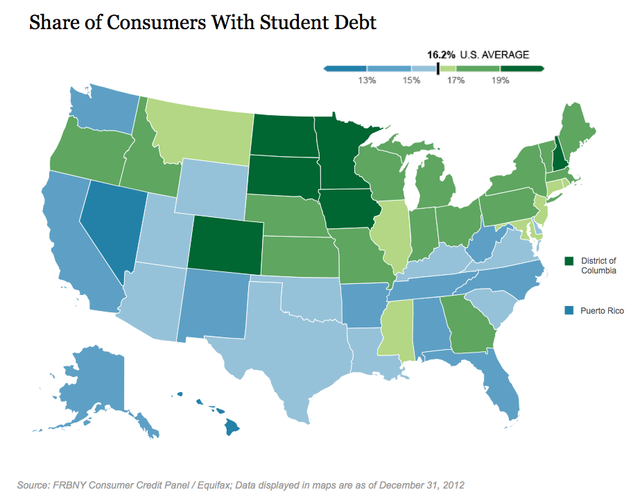
Across the country, an average 16.2 percent of consumers owe some amount of student debt. But if you look at the state level, the country appears split along the Mason–Dixon line, with a higher percentage of the population owing money in northern states than southern states, according to numbers published by the College Financing Group, citing data from the Federal Reserve Bank of New York.

Overall, Hawaii has the lowest share of consumers with student debt, just 12 percent. That’s less than half the rate in Washington, D.C., where 25 percent of the population in Washington, D.C. owes student loan money, according to data compiled through 2012. Connecticut’s rate hovers in the middle, within range of the national average.  Demos debt chart

According to the Federal Reserve Bank of New York, student loan debt is the only form of consumer debt that has grown since the peak of consumer debt in 2008. Balances of student loans have eclipsed both auto loans and credit cards, making student loan debt the largest form of consumer debt outside of mortgages.

The full report also shows that 11.9% of all borrowers are 90 days or more past due on their loans, and the average student debt per borrower stands at $24,810. Interestingly, despite Washington D.C.’s high percentage of people with student loans, it has a lower-than-average delinquency rate of only 7.3%.

In its most recently updated 2013 quarterly report, the Federal Reserve Bank of New York noted that outstanding student loan balances increased to $994 billion nationwide as of June 30, 2013, a $8 billion increase from the first quarter this year.  Other estimates have placed outstanding student debt in excess of $1 trillion.

Life on Hold, Especially Among Lower Income Families

According to a 2012 online web survey conducted by American Consumer Credit Counseling, over 35 percent of respondents reported that they have had to delay saving for retirement because of their student debt, while 27 percent also reported that their ability to buy a car has been impacted, and 29 percent said it has affected their ability to buy a house. Nine percent of respondents said student loan debt has even impacted their ability to get married.

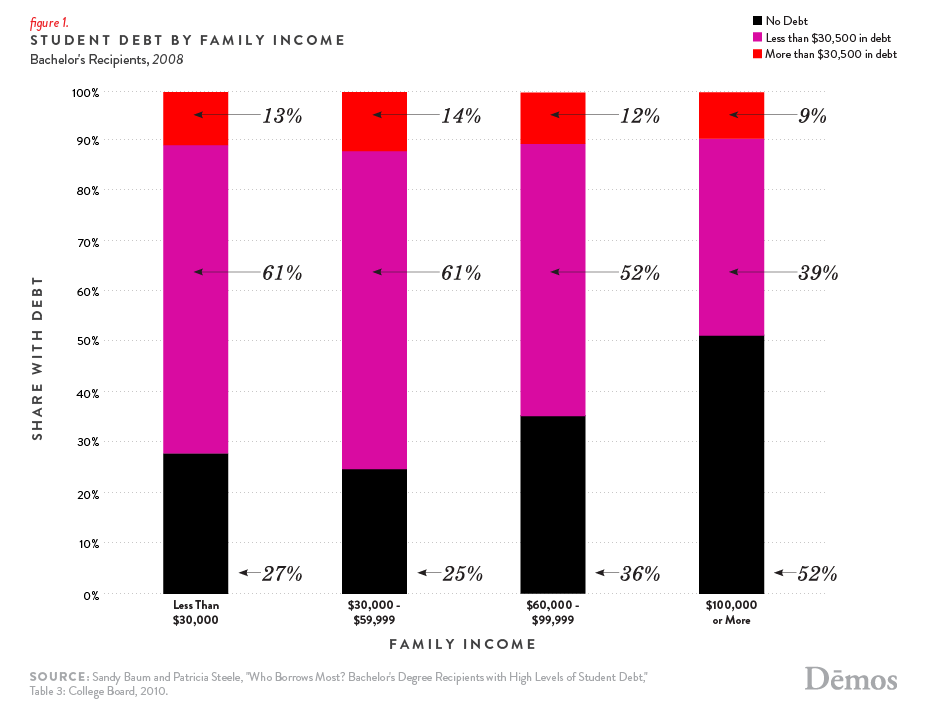
A report this year from Demos, “At What Cost:  How Student Debt Reduces Lifetime  Wealth,” stated that “though a college education remains the surest path to a middle-class life, evidence has begun to mount that student debt may be far more detrimental to financial futures than once thought, particularly for those with the highest levels of debt: students of color and students from low-income families.”  The data used was of 2008 bachelor’s degree recipients.

The Consumer Financial Protection Bureau has reported that the share of young consumers among first-time homebuyers is falling. According to the National Association of Realtors, Americans between the ages of 25 and 34 made up 27 percent of all homebuyers in 2011, the lowest share in the past decade. That percentage represestudent debt mapnts a 25 percent decline year-over-year from 2010.

Young borrowers with student debt are less likely to own a home than those with no debt. According to recent analysis by the Federal Reserve Bank of New York, young borrowers with student debt - historically an indicator of a college education and an accompanying boost in wages - demonstrate a lower rate of homeownership than their peers with no student debt, breaking a decade-long trend.

The demos report found that family income has a large impact on the debt levels of college graduates. Seventy-five percent of bachelor’s degree recipients from families with incomes of less than $60,000 graduated with some student loan debt in 2008, compared to just 48% of students whose families earned $100,000 or more. Students from poorer families were also much more likely to graduate with large amounts of debt: 14% of graduates from lower-income families had more than $30,500 in debt, compared to just 9% of students from families who earned $100,000 or more.

A report by the Project on Student Debt in October 2012, an initiative of the Institute for College Access & Success, indicated that Connecticut students graduating in the class of 2011 had the fifth highest average student loan debt in the nation, at $28,783.  That report also indicated that “high debt states are mainly in the Northeast and Midwest, with low debt states mainly in the West and South.”  The report found that 64 percent of graduating students in 2011 had student debt, which ranked Connecticut 15th in the nation that year.

Earlier this year, the Consumer Financial Protection Bureau indicated that 1 in 5 U.S. households have student loans, and the number of student loan borrowers increased 31 percent between 2007 and 2012.  Demos predicting that the “impact on the lifetime assets of indebted households will be nearly four times the amount borrowed.”

Benefit Corporations Find a Home in Delaware, Connecticut to Try Again Next Year

During the summer, progress was made on efforts to advance social benefit corporations – businesses that aim to impact their communities in addition to making a profit – but that progress did not come in Connecticut.

Delaware became the 19th state (plus the District of Columbia) to enact benefit corporation legislation in July.  Similar legislation did not make it through the Connecticut legislature in 2013, despite widespread support and no known opposition.

Delaware, as corporate home venture-backed businesses, 50 percent of all publicly-traded companies, and 64 percent of the Fortune 500, is considered by advocates to be among the most important states for businesses that seek access to venture capital, private equity, and public capital markets.

The goal of the legislation is to create in state law a new type of corporation—the benefit corporation—that best meets the needs of entrepreneurs alcertified B ogond investors seeking to use business to solve social and environmental problems.  Benefit corporations operate the same as traditional corporations but with higher standards of corporate purpose, accountability, and transparency, advocates say.  The new designation provides business leaders with legal protection to pursue a higher purpose than profit, and they offer investors and the public greater transparency to protect against pretenders, supporters point out.

In Connecticut, despite being introduced earlier this year with the backing of Governor Dannel Malloy, overwhelming support in the state House where it passed by a lopsided 128-12 on May 20, and co-sponsorship by the legislature’s four top leaders, legislation establishing the “benefit corporation” as a new type of corporate entity never came up for a vote in the State Senate, and thus it died when the session ended in June.

Among the leading advocates of the proposal in Connecticut, the reSET Social Enterprise Trust has vowed to renew the effort next year, a commitment echoed by a broad coalition of supporters in the private sector and in government economic development circles. “In the next legislative session, reSET will re-double its efforts to secure passage of tsocial benefit corp maphis much-needed legislation,” the organization emphasizes, pointing out that the bill “drafted in cooperation with the Connecticut Bar Association and BLab, is the most comprehensive of its type proposed in the United States.”

In recognition of the milestone achievement in Delaware, more than 600 businesses around the country signed an Open Letter inviting their peers to join the movement to redefine success in business.

The letter stated, in part, “we see this as a big market opportunity, because a large and increasing number of people want to support a better way to do business -- better for our workers, better for our communities, better for our environment.  Until recently, corporate law has not recognized the legitimacy of any corporate purpose other than maximizing profits. That old conception of the role of business in society is at best limiting, and at worst destructive. By serving a higher purpose and by meeting higher standards of transparency and accountability, we build our most important asset -- trust. This trust enables us to attract the best talent and turn customers into evangelists, helping us make money and make a difference.

Delaware Governor Jack Markell, writing in the Huffington Post, said “These new Delaware public benefit corporations will harness the power of private enterprise to create public benefit. In the short term, they will create high quality jobs and improve the quality of life in our communities. In the long term, as many enter the public capital markets, they will help combat the plague of short termism that we have seen over the last five years can undermine a shared and durable prosperity.”

Markell noted that the new public benefit corporations will “have three unique features that make them potential game changers” – “concern corporate purpose, accountability, and transparency.”  Prior to serving in government, Markell, now in his second term as Governor, was senior Vice President for Corporate Development for Nextel, having been one of the first fifteen people hired by the company.

Among those advocating for benefit corporation legislation across the country – including Connecticut - is the nonprofit organization behind the Certified B Corporation designation.  B Lab is a 501(c)3 nonprofit that serves a global movement of entrepreneurs using the power of business to solve social and environmental problems. B Lab serves these entrepreneurs through three interrelated initiatives that provide them the legal infrastructure and help them attract the customers, talent, and capital to scale.

Benefit Corporations and Certified B Corporations are distinct terms. They share much in common and have a few important differences. Certified B Corporation is a certification conferred by the nonprofit B Lab. Benefit corporation is a legal status administered by a state government, such as the case this summer in Delaware (and almost in Connecticut).  Benefit corporations do NOT need to be certified.

Certified B Corporations have been certified as having met a high standard of overall social and environmental performance, and as a result have access to a portfolio of services and support from B Lab that benefit corporations do not.  The B Lab website indicates more than 800 companies in 27 countries and 60 industries have earned the designation.


More People Working From Home in Connecticut, Nationally

“Technologically-enabled opportunities for telework could be one factor contributing to the reduction in driving,” according to a report issued by ConnPIRG which has identified a drop in driving frequency in nearly every state in the nation, including Connecticut.

The report, “Moving Off the Road: A State-by-State Analysis of the National Decline in Driving,” notes that “the internet and other communications technologies have enabled many people to perform work from home that could only be done in an office previously. Email, conference calls, videoconferencing, and shared digital files have made it far easier for people to “telecommute” from home. In this way, telework might reduce household driving by eliminating commuting trips.”

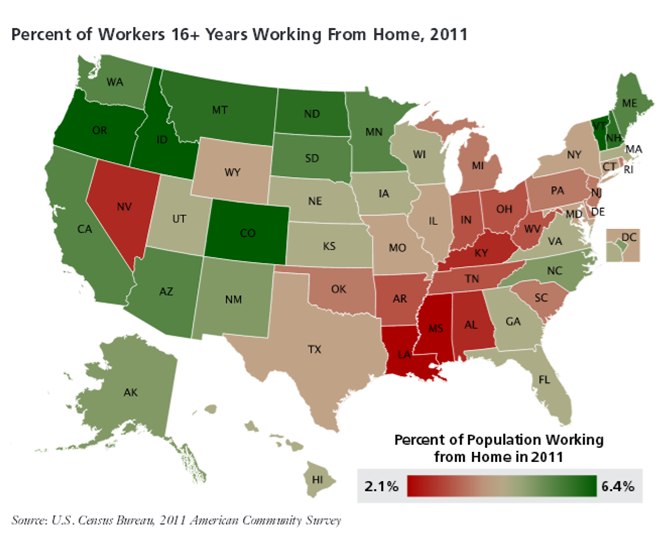
The number of people who work from home a majority of the time stood at 4.3 percent in 2011.Counting a broader measure of all workers who report that they perform some of their job from home at least one day a Home-iconweek, 9.5 percent did so by 2010, up from 7 percent in 1999.

The most recent National Household Travel Survey indicates that 9 percent of city commuters telecommute even once per month, compared to 14 percent of suburban commuters and 10 percent of rural and town commuters, the report indicated.

According to the report, it is more common for people to work from home in New England and the entire West, except Nevada. One reason for differences may be the industrial make up of states, since working from home is more feasible in some types of work than others. The following figure bears out the ambiguous relationship between working from home and the volume of driving.

 ConnPIRG Education Fund, a 501(c)(3) organization, works to protect consumers and promote good government. ConnPIRG Education Fund offers an independent voice that works on behalf of the public interest, investigating problems, crafting solutions, educating the public, and offering meaningful opportunities for civic participation.

The new ConnPIRG analysis and report found that after sixty years of almost constant increases iworking from home mapn the annual number of miles Americans drive, since 2004 Americans have decreased their driving per-capita for eight consecutive years. Driving miles per person are down especially sharply among Millennials, America’s largest generation that will increasingly dominate national transportation trends.

The website Global Workplace Analytics reports that regular telecommuting grew by 73% between 2005 and 2011 compared to only 4.3% growth of the overall workforce (not including the self-employed). Growth within different sectors of the workforce varied widely:

  • Federal employees - 424% growth
  • State government employees - 114% growth
  • Not-for-profit employees - 85% growth
  • For profit employees - 63%
  • Local government employees - 67%

While many conjectured that telecommuting would decline during the recession, it actually grew by 11.4% from 2008 to 2011.   Based on current trends, with no growth acceleration, regular telecommuters will total 4.9 million by 2016, a 69% increase from the current level, according to Global Workplace Analytics, which conducts independent research and consult on emerging workplace issues and opportunities.

CT Companies Among World’s Most Innovative, Forbes List Shows

Google was #47.  Apple was #79.  Ranked at #43, Danbury headquartered Praxair surpassed both, one of two Connecticut-based companies in the top 50 on the latest Forbes® World's Most Innovative Companies list. 

The highest-ranked company located in Connecticut, placing at #2 globally, was New Haven based Alexion, in the midst of a much-heralded move back to the city where it was founded.   It is the second consecutive year that Alexion was ranked at #2.Alexion-Logo-Official

Alexion Pharmaceuticals, Inc. is a biopharmaceutical company focused on serving patients with severe and ultra-rare disorders through the development and commercialization of life-transforming therapeutic products. Its marketed product Soliris is the first and only therapeutic approved for patients with two ultra-rare and severe disorders.

A specialized chemicals company with more than 26,000 employees worldwide, Praxair improved its “innovative” position on the Forbes list, up from #46 in 2012. Praxair, Inc. praxairproducts are oxygen, hydrogen, nitrogen, argon, carbon dioxide, helium, electronic gases and a range of specialty gases. Praxair Surface Technologies supplies coatings, which protect metal parts from wear, corrosion and heat. 

Ranked at #73 among the world’s 100 most innovative companies according to Forbes was Amphenol Corporation, with world headquarters in Wallingford.  Amphenol is a designer, manufacturer and marketer of electrical, electronic and fiber optic connectors, interconnect systems and coaxial and high-speed specialty cabAmphenol Corporationle. Amphenol systems are used primarily to conduct electrical and optical signals for a range of electronic applications.

Assa Abloy, at #78, is a Sweden-based company engaged in the secure door opening solutions. With operations in New Haven, the company's operations are divided into five divisions, including the supply of electronics security solutions worldwide. Assa Abloy provides secure identity solutions, contactless identification technology solutions, electronic lock systems and safes for hotels and cruise ships.

Based in Ireland, but with a strong presence in North Haven, Covidien Public Limited Company ranked at #67.  Covidien is engaged in the development, manufacture and sale of healthcare products for use in clinical and home settings. It operates its businesses through three segments: Medical Devices, Pharmaceuticals, and MedicForbes innovativeal Supplies.

The San Francisco Bay Area had three of the top 10 spots and six spots overall on the list of 100 companies.  Companies headquartered in Connecticut, or with a strong presence in the state, had a strong presence among the world’s most innovative. 

For the third year in a row, San Francisco-based Salesforce.com topped the Forbes’ list.  After Alexion, the remainder of the top five were U.S. companies VMware at #3, followed by Regeneron Pharmaceuticals and ARM Holdings. Amazon was # 7; Starbucks was #19. The complete ranking is featured in the September 2 issue of Forbes magazine.

In compiling the list, Forbes utilizes a detailed methodology.  Companies are ranked by their innovation premium: the difference between their market capitalization and a net present value of cash flows from existing businesses (based on a proprietary formula from HOLT/Credit Suisse), the magazine reported.  To be included, firms need seven years of public financial data and $10 billion in market capitalization.

CT is Among Leaders in Long Marriages, Less Popular for Divorcees

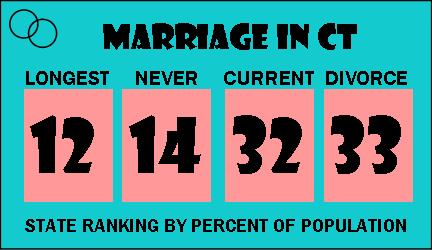
It seems that Connecticut is a great place for a long marriage and those who have never been married, and not so popular for divorced individuals.  Data indicate that Connecticut ranks #12 in longest married residents, #14 in never-married residents, #32 in currently married residents and #33 in divorced residents –as a percentage of population, comparing the 50 states and Washington, D.C.

Bloomberg Visual Data ranked the U.S. states and the District of Columbia based on the median duration of current marriages in years which was calculated by averaging the medians for males and females for each state, using the 2011 U.S. Census American Community Survey data.marraige stats

The top ten states for longest marriages, based on the median duration of current marriages in years, were South Dakota (23.1 years), West Virginia (23.0), Maine (22.8) , North Dakota, Pennsylvania and Vermont (22.4), Iowa (22.1) Montana, Wisconsin(21.8), Nebraska (21.7) and Delaware 21.5).  Tied with Connecticut at #12 is Michigan, at 21.4 years.

In every state in the nation, at least a quarter of residents ages 15 and older have never married.  Far outdistancing the field is the District of Columbia, where 58 percent have never married – the only instance where that number exceeds half the population.  Next highest is New York, with 37.7 percent, followed by California, Massachusetts, Rhode Island, Maryland, Illinois, Louisiana, New Jersey Mississippi, Delaware, Pennsylvania, Georgia.  Connecticut is next, with a third of the population – 33.1 percent – never having been married.Wedding_rings

When comparing the estimated percentage of those currently married, Connecticut ranks at #32, with 48.4 percent.  Topping the list is Utah with 56.2 percent, Idaho at 55.5 percent and New Hampshire at 53.6 percent.

New Jersey and New York have the lowest percentage of divorced people in the U.S., at #49 and #50 respectively in the estimated percentage of divorced residents.  Connecticut ranked at #33, with 10.7 percent of the population (age 15+) being divorced.  The most divorced residents?  Nevada at 14 percent, followed by Maine at 13.7 percent and Arkansas and New Mexico, tied at 13.4 percent.