CT Spending on Tobacco Prevention Goes Up in Smoke; E-Cigarettes Raise New Public Concerns

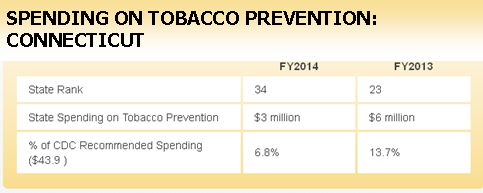
Fifteen years after the landmark state tobacco settlement in which Connecticut played a key role, the state now ranks 34th in the nation – down from 23rd a year ago - in funding programs to prevent youth from smoking and help smokers quit, according to a national report by a coalition of public health organizations.

In the current fiscal year, Connecticut is spending s $3 million on tobacco prevention and cessation programs, which is 6.8 percent of the $43.9 million recommended by the Centers for Disease Control and Prevention (CDC). Other key findings for Connecticut include:

  • Connecticut this year will collect $466.1 million in revenue from the 1998 tobacco settlement and tobacco taxes, but will spend just 0.6 percent of it on tobacco prevention programs. This means Connecticut is spending less than a penny of every dollar in tobacco revenue to fight tobacco use.
  • Connecticut has cut funding for tobacco prevention programs in half, from $6 million last year to the current $3 million; from 13.7 percent of the CDC recommended spending level down to 6.8 percent.
  • The tobacco companies spend $78.1 million a year to market their products in Connecticut. This is 26 times what the state spends on tobacco prevention.

The annual report on states' funding of tobacco prevention programs, titled "A Broken Promise to Our Children: The 1998 State Tobacco Settlement 15 Years Later," was released by the Campaign for Tobacco-Free Kids, American Heart Association, American Cancer Society Cancer Action Network, American Lung Association, the Robert Wood Johnson Foundation and Americans for Nonsmokers' Rights.

The report comes as evidence increases that tobacco prevention anstate spending CTd cessation programs work to reduce smoking, save lives and save money. Florida, which has a well-funded, sustained tobacco prevention program, reduced its high school smoking rate to just 8.6 percent in 2013, far below the national rate.  One study found that during the first 10 years of its tobacco prevention program, Washington state saved more than $5 in tobacco-related hospitalization costs for every $1 spent on the program.
In Connecticut, 15.9 percent of high school students smoke, and 2,900 more kids become regular smokers each year, the organizations in the coalition pointed out. Tobacco annually claims 4,700 lives and costs the state $1.6 billion in health care bills, officials said.

"Connecticut once again is one of the most disappointing states when it comes to protecting kids from tobacco and needs to increase its investment in tobacco prevention," said Matthew L. Myers, President of the Campaign for Tobacco-Free Kids. "Tobacco prevention is a smart investment that saves lives and saves money by reducing tobacco-related health care costs. States are being truly penny-wise and pound-foolish when they shortchange tobacco prevention programs."

In 1997, when the settlement was announced, then-Attorney General Richard Blumenthal - a key negotiator in the tobacco settlement talks – described the accord as “a sweeping public health initiative to protect children from the lure of tobacco, save lives, and reimburse states for billions of taxpayer dollars spent on tobacco-related illnesses.”
tobacco mapThe national report assesses whether the states have kept their promise to use a significant portion of their settlement funds – estimated to total $246 billion over the first 25 years – to fight tobacco use.  The states also collect billions more each year from tobacco taxes. Tobacco use is the number one cause of preventable death in the U.S., killing more than 400,000 people and costing $96 billion in health care bills each year.  Nationally, about 18 percent of adults and 18.1 percent of high school students smoke.

The report reveals that most states are failing to adequately fund tobacco prevention and cessation programs. Key national findings of the report include:

The states this year will collect $25 billion from the tobacco settlement and tobacco taxes, but will spend just 1.9 percent of it – $481.2 million – on tobacco prevention programs. This means the states are spending less than two cents of every dollar in tobacco revenue to fight tobacco use.

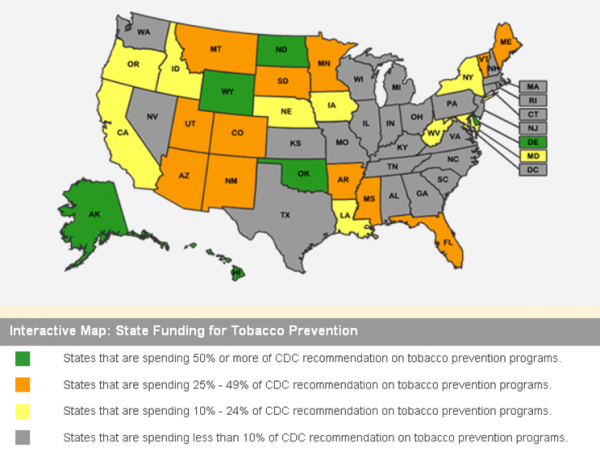
States are falling woefully short of the CDC's recommended funding levels ftobacco free kidsor tobacco prevention programs.  Altogether, the states have budgeted just 13 percent of the $3.7 billion the CDC recommends. Only two states – Alaska and North Dakota – currently fund tobacco prevention programs at the CDC-recommended level.

Public Expresses Concern Over E-Cigarettes

Within days of the report on tobacco prevention efforts, a national survey reflected public concerns about a new and increasingly popular alternative to traditional cigarettes, called e-cigarettes.  Adults nationwide are concerned about the use of e-cigarettes by children and teens, with 44 percent indicating worries that the devices will encourage kids to use tobacco products, according to a new poll from the University of Michigan.

According to the latest University of Michigan Mott Children's Hospital National Poll on Children's Health, nearly half of parents are concerned their child will try e-cigarettes, which are battery-operated devices that look like cigarettes but don't burn tobacco.  E-cigarettes have replaceable cartridges of liquid containing nicotine, which is inhaled as a vapor along with flavors like chocolate, fruit, candy or even tobacco.

"This poll shows high levels of concern about e-cigarettes and the possibility that kids who try them could start smoking tobacco," says Matthew M. Davis, M.D., M.A.P.P., director of the C.S. Mott Children's Hospital National Poll on Children's Health.

In the poll, which was administered in November 2013 to 2,124 adults age 18 and over, arguments were presented both for and against e-cigarettes.  Then adults were asked for their opinions about the devices and possible regulations and laws.

Advocates of e-cigarettes say they are a healthier alternative to tobacco smoking and argue it may help smokers to quit.  Critics counter that e-cigarettes may have health risks and may encourage people and kids or teens to smoke tobacco. Currently, e-cigarettes are not regulated by the U.S. Food and Drug Administration. Twenty-six states have regulations prohibiting sale to minors; Michigan's legislature currently has bills pending that prohibit those sales.UniversityofMichigan

In the poll, 86% of adults said they have heard of e-cigarettes, while only 13% have ever tried one. Among parents, 48 percent said they are very or somewhat concerned that their children will try e-cigarettes.  Meanwhile, 65% of adults think e-cigarettes should have health warnings like tobacco cigarettes and nicotine products.

Adults also expressed widespread support for new laws regarding e-cigarettes: 88% think manufacturers should be required to test e-cigarettes for safety and 86% favor prohibiting the sale of e-cigarettes to minors. 71% of adults support restricting the marketing of e-cigarettes on social networking sites.

"E-cigarettes are a relatively new product, with little information about safety or long-term health effects. However, the public is clearly aware of the devices and concerned about their impact, according to this month's poll results," says Davis, who is professor of pediatrics and internal medicine at the U-M Medical School and professor of public policy at U-M's Gerald R. Ford School of Public Policy. "In 2010, the poll also asked about e-cigarettes and at that time only one-third of adults had heard of the product. In this poll, that number jumped to 86 percent."

Earlier this year, CT by the Numbers reported that state Attorney General George Jepson and U.S. Senator Richard Blumenthal were among those calling for regulation of e-cigarettes.


Connecticut Skater Seeks Olympic Chance At U.S. Championships in Boston

Timing, as they say, is everything.  For Olympic hopeful Zachary Donohue of Madison, Connecticut, and his skating partner Madison Hubbell of Michigan, a lifetime of training, determination, resiliency and competition will be in full view at the U.S. Figure Skating Championships in Boston this week.

As U.S. national bronze medalists in 2012, and fourth place finishers at the 2013 U.S. Championships, the ice dance couple is at the cusp.  Three couples will earn U.S. Olympic team slots, to be announced on Sunday. The contest for those positions is expected to be extremely close.2014 USChampionships

For Donohue, it has been a long and winding road from New Haven and Madison, where he grew up, through New Jersey, Colorado, and Michigan where he trained and lived beginning at age 15, to the U.S. Championships in an Olympic year, just days after his 23rd birthday.

The journey began while visiting cousins in North Carolina, who took him along to go skating at a local spot.  “I was just messing around, imitating what they were doing.  One of my cousins said, “hey, you’re pretty good.”  Unbeknownst to 10-year-old Zach, his athletic ability on blades was mentioned to his mom, who promptly signed him up for a “Learn to Skate” program when they returned home to New Haven. He excelled, and skating soon evolved from a “cool outlet for all my energy” to a more serious interest.

Then at age 13, he grew a foot and a half in a year, and had to reduce his ice time to let his body catch up to itself.  The bones were outpacing the muHubbell_Donohue_FS_145scles, which made jumps and spins painful.  It was during that time that his love of music and interest in skating merged toward ice dance.

Now 6’2”, 195, Donohue is “tall, long and strong” – all attributes for a powerful yet graceful ice dancer.  Madison “Madi” Hubbell, at 5’8” is taller than many ice dance partners, and together they bring and impressive line to their skating.   The word most associated with their performances is “connection. “ They convey an emotional bond on the ice that is mesmerizing –earning the effusive admiration of commentators describing the fluidity, artistry and technical precision reflected in their routines.

In addition to training seven-days-a-week at the Detroit Skating Club, Donohue coaches skaters in nearby Troy, from 7 year-olds to young adults.  His coaching focuses on everything but dance, an understandable change of pace.  Through the years, he has discovered that he not only enjoys coaching, but choreography as well.  That is not only helpful with his students, but in developing the championship-caliber routines of Hubbell & Donohue.

Perseverance Through Injuries

It has been a stunningly successful and incredibly challenging, injury-riddled year.  Hubbell, out for two months recuperating from a concussion during which doctors precluded her from any exercise whatsoever, fought back and they not only competed effectively but won the coveted 2013 Nebelhorn Trophy in Oberstdorf, Germany, exceeding their personal best scores.  No small task in the best of circumstances; remarkable given the realities.  They had won the same competition two years ago, in their debut season together.

Barely back on the ice, and with pressure-packed competition as skating’s Grand Prix season intensifying, Hubbell has bravely forged through the current season despite a diagnosis of a labral tear, a hip-injury not uncommon in the sport, but incredibly painful, and at times, debilitating.  She has been forthright about the injury, describing the challenges and limitations on their blog, while remaining upbeat and positive.  And despite it all, they won their first-ever Grand Prix medal, and finished fourth at Skate America.

“They just focus, and they’re so supportive of each other.  It is the persistence of an athlete – I’ve worked so hard for this, I’m just not gonna stop.  They both have that,” observes Diane “Dee” Eggert, Donohue’s mother and biggest fan.  Their recent success, in the midst of trying times, comes built on a foundation of trust and confidence that is “essential to any partnership,” Donohue points out.  “Although still a relatively new team, just three years together, it was evident relatively quickly that “all the pieces fell into place” when they got together.  “It takes time to get the kinks out,” Donohue says, but “we have become that well-oiled machine, through a tremendous amount of hard work.”  Hubbell’s determination working through injuries has impressed not only Donohue, but the skating community.

It is an on-ice partnership that was unplanned, but clicked immediately.  Hubbell had skated with her brother at the lower rungs of the skating ladder, and excelled, winning championships and much notice.  When he opted to retire from skating, Donohue was simultaneously ending a previous partnership, which also had brought success.  They found themselves on the same Detroit rink, at the same time, in need of new partners, and a coach off-handedly suggested they help each other out that day by working together.  Hubbell and Donohue haven’t looked back.

Local Roads to National Acclaim

Donohue easily recalls time spent training and practicing at rinks in Cromwell, Newington and Simsbury, as his interest in and dedication to the sport grew.  It was his mom who drove endlessly through central Connecticut to get him to training sessions, coaches, and practice time.  “She’s always been by my side,” Donohue points out, appreciatively.  “Skating puts a lot of stress on parents.”  For those of modest means, especially so.

Employed by the security department at Yale University for nearly 15 years after a career in law enforcement, she added an extra job or skating imagetwo along the way to help meet the relentless expenses of a skating career.  She worked the overnight shift, so days could be spent with her son.  Because of his skating-centric life, Donohue was home-schooled through his teenage years, and college plans remain on hold for now.

Beyond the ever-present skating, he has interests – and talent - in music and culinary arts, in addition to coaching and choreography.  When Zach was 12 years old, he was selected as the singer to open a show at the Shubert Theater in New Haven, and his mom marveled at his ability to sing in front of an audience of nearly 500 people.  Entertaining crowds has always been something he’s comfortable with.  “He’s my cheering section, and I’m his cheering section,” she says proudly, recalling his growing success and relentless tenacity.

At every turn, she concluded “how can I stand in the way of his whole career,” as he proceeded to pursue the next step in the dream.  She recalls vividly when she once broached the subject of giving up skating, as a youngster.  “Well, there was just no way.  He said he’d run away from home, sleep on the ice, and drive the Zamboni if he had to.  That’s when I knew how much skating meant to him.”

At 15, he moved to New Jersey where he lived in his coach’s home and trained during the week, returning to Connecticut on weekends.  By 17, he was moving to Colorado to work with a new coach as his development and advancement continued.  While there, he had an opportunity to work with ice dance legend Christopher Dean, among his icons in the sport.

“It’s a sacrifice you make,” Eggert says, reminiscing about the Christmases, Thanksgivings and other holidays where Zach hasn’t quite been able to make it home.  Donohue’s mom and Hubbell’s mom talk regularly, provide support and encouragement as needed, and look ahead.  Whether or not they are selected for the Olympic team, other goals beckon, including the World Championships later this Spring, and noteworthy competitions thereafter.

“There are daymadi_zach_sc2013s it’s hard but then you get to the competition and you realize it’s all worth it,” said Donohue.  “There’s never a day I don’t love it.  I love being on the ice.”

Artistry and Athleticism

The music for their Short Program, to be skated on Friday, will be a “Big Bad Voodoo Daddy,” medley featuring the quickstep, foxtrot, and Charleston. For the free dance (long program) the next day, “Nocturne into Bohemian Rhapsody.” The music has been well received by audiences this year, and Donohue is pleased with his role assisting in the choreography.  “I’m stubborn and outspoken,” and thereby earns a say in choreography decisions.

“He and Madi both feel the music.  It’s a gift.  Even when he was young, when he was practicing and someone else’s music would start, he’d skate away to the music.  It’s been that way since day one,” Eggert recalled.

Four years ago, Donohue was in juniors, with a different partner on the ice.  Today, he is on the brink of the Olympic dream becoming reality.  What will fans see in Boston?  A “better-than-ever version” of performances that earned top honors in Germany, even as extremely talented American teams vie for coveted Olympic slots.

“We’ve been working on our lifts and elements, and becoming stronger, faster and lighter.” Donohue admits to some nervousness prior to skating competitions, but that is quickly eclipsed by confidence as the music begins.  The training regimen, from intense cardio to a relentless series of physically demanding exercises, is unending but essential.  Injuries have required adjustments, but no stoppage.

The contrasts in skating can take your breath away.  The unique combination of artistry and athleticism makes it a singular sport - also unique in that a man and woman are paired in competition.

Not to get ahead of the story, but the 2014 Olympics will have an attractive new feature – the first-ever figure skating team event, similar to the team competition in gymnastics.  That will provide Olympic skaters with an opportunity to medal not only in individual events, but as part of a team – and Team USA is expected to be very much in the running.  If all goes wonderfully in Boston, Madi and Zach – described by his mom as “two peas in a pod” - will be, too.

Exodus: Connecticut Ranked #1 in People Moving From State

Connecticut residents are on the move.  Out.

The state led the nation with the highest percentage of outbound moves in 2013, according to Atlas Van Lines’ annual report of moves throughout the U.S. and Canada. Of 2,055 residents' moves during the year, 1,230 of them, or 60 percent, were out of state – the highest percentage in the nation.  That's compared to 825 moves from other states into Connecticut.new_atlas_logo

A year ago, Connecticut was #7 in the nation in the ratio people moving out-of-state, with 1,123 outbound and 834 inbound moves, in a survey by United Van Lines.  This year, Connecticut led the nation in outflow of residents in the Atlas Van Lines survey.

us moving mapDuring the past five years, inbound moves peaked in 2010 at 1,009 – with a just slightly higher  1,160 outbound moves.  Since then, the numbers have skewed increasingly out-of-state, Atlas reported.

The 2013 year was the state's highest outbound percentage and highest total number of outbound moves since 2009.  Connecticut has been an outbound state for six of the past ten years, including the past three consecutively, according to Atlas.  An “outbound” state is defined as one that has more than 55 percent of moves outbound.

The remainder of the New England states were "balanced" in 2013, with the exception of New Hampshire, which was considered an inbound state in 2013. The data indicates that progressively fewer people were moving into Connecticut in the last three years, a pattern not consistent throughout New England.  None of the other New England states were outbound states in 2013.  In the previous year, Maine joined Connecticut as an outbound state in the United Van Lines survey.

States that saw the greatest percentage of inbound movers: North Dakota, North Carolina, and Texas.  States with the highest outbound move percentage after Connecticut were New York and Indiana, both at 59 percent.  Only 12 states were net outbound states:  Connecticut, New York, Indiana, Wyoming, Delaware, Nebraska, Minnesota, Illinois, Indiana, Ohio, Pennsylvania, and New Jersey.Connecticut

The Greenwich Time reported that the branch manager of Danbury's Certified Van Service of Connecticut say, his truckers – part of the United Van Lines company - relocated about 100 families from the Hartford area to Charlotte, N.C., and from Fairfield County to Atlanta. For Kevin Kaster, president and owner of Kaster Moving in Stamford, the study confirms one trend he's recently experienced.  "Texas has been a hotspot the last two years, no question," he said. "An inordinate amount of people from around here are going to Texas."  Brielle Sollinger, aoutboundssistant marketing manager at Fallon Moving and Storage in Windsor, agreed.   "Texas is big. We also do lots of Virginia, North Carolina and South Carolina," she said in a phone interview Friday afternoon.

Atlas reported that across the nation, most states were balanced evenly between inbound and outbound moves. The company also reported that the number of total moves increased during the year, something it said could be an indicator of an improving economy.  The data covered the period from January 1 through December 31, 2013.

Connecticut’s All-Time Coldest Temperature: -32 Degrees

The coldest temperature ever officially recorded in the State of Connecticut is -32 degrees, which occurred on February 16, 1943, in the rural town of Falls Village, located in northwestern Connecticut, about 50 miles from Hartford.

The average Connecticut temperature is 31 degrees in December, 26 degrees in January and 28 degrees in February, records show.  That ranks the state at #30 for average temperature. If you’re wondering, Rhode Island ranks #27, New York is #28, Massachusetts is #34.  No surprise here: Hawaii is #1; Alaska is #50.

The state Department of Energy and Environmental Protection reports:given day

  • January averages 3.5 inches of liquid precipitation; 12.3 inches of snowfall
  • 14th- Daylight increasing by 1.5 minutes each day
  • 16th- Record high this date 62o F in 1995; record low -8oF in 1994
  • 24th- Daylight increasing by 2 minutes each day
  • January 20-25 is the traditional January thaw

The coldest temperature ever officially recorded in Hartford is -26 degrees, which occurred on January 22, 1961. Weather temperatures have been officially kept in Hartford, Connecticut since 1905.  Below zero temperature readings are not at all rare in Hartford. Since 1905, the city has had 10 days when the temperature dropped below -15 degrees. Hartford averages 133 days a year when thecold weather temperature drops below freezing, according to a report published in Yahoo News.

In New Haven, the greatest chance of snow is around February 1st, according to data compiled by the website Weather Spark. It has snowed on that day 24 percent of the time since 1983. During the cold season overall, considered between December 3 to March 14, there is a 43% average chance that precipitation will be observed at some point during a given day. When precipitation does occur it is most often in the form of light snow (32% of days with precipitation have at worst light snow), light rain (28%), moderate rain (16%), and moderate snow (8%).

The difference between the all-time coldest temperature ever recorded in Hartford (-26) and the all-time coldest temperature ever recorded in the state of Connecticut (-32) is six degrees.   A difference without a distinction.

Connecticut Ranks #42 in Population Gain Between 2010 and 2013; New England Lags Nation

Connecticut’s population grew six-tenths of one percent between 2010 and 2013 according to estimates by the U.S. Census Bureau, ranking the state 42nd among the nation’s 50 states in population growth.  The state population, which was 3, 574,097 at the 2010 U.S. Census was estimated at 3,596,080 as of the official July 2013 estimate, announced at year’s end.

The 2013 estimates also show the nation's population grew by 2.4 percent in the three years since the 2010 Census, with the South and the West leading the expansion. The total for the 50 states, the District of Columbia and Puerto Rico rose from 308,745,538 in 2010 to an estimated 316,128,839 in July 2population graphic013.  Only Rhode Island lost population (1,056 people) during the period, and the Southern and Western states accounted for more than 80 percent of the growth nationwide.

The bottom twelve states in population growth – all under one percent - include five from New England:  Rhode Island, Maine, Vermont, New Hampshire and Connecticut.  The remainder are in the Mid-West.  Massachusetts population grew by 2.2 percent, New Jersey by 1.2 percent, and New York by 1.4 percent.

The South, the nation's largest population center, also had the highest percentage-point growth at 3.3 percent: CT populationfrom 114,555,744 in 2010 to an estimated 118,383,453 in 2013. The West was close behind, with a 3.2 percentage-point growth during the period, from 71,945,553 in the 2010 Census to an estimated 74,254,423 in July 2013.

The Midwest region had the smallest growth, at 0.9 percent: 66,927,001 people in 2010 to 67,547,890 in 2013, according to published reports. The population growth for the Northeast was 1.1 percent between 2010 and 2013, growing from 55,317,240 in 2010 to 55,943,073, according to the census estimates.

The bottom twelve, including Connecticut, saw increases of less than one percent, including Rhode Island’s drop in population, and Maine standing essentially even, adding less than 1,000 people.

  • Rhode Island -0.1people
  • Maine   0.0
  • Michigan 0.1
  • Vermont 0.1
  • West Virginia 0.1
  • Ohio 0.3
  • Illinois   0.4
  • New Hampshire 0.5
  • Connecticut 0.6
  • Pennsylvania 0.6
  • Mississippi 0.8
  • Missouri 0.9

The new figures from the Census Bureau shows Massachusetts is continuing to add to its population. The latest estimate as of July 1 puts the state's population at nearly 6.7 million, up by more than 47,000 from July, 2012.  Massachusetts' ranking is the 14th most populous state in the country.

New York remains the third most populous state in the nation -- behind California and Texas -- but the state's lead over fourth-place Florida continues to erode, according to 2013 population estimates. New York saw an increase of 1.4 percent from 19,378,102 people in the 2010 Census to 19,651,127 in the 2013 estimate, according to the bureau.

Florida's population in the 2010 Census was 18,801,310, about 576,000 fewer than New York's 2010 Census population. However, Florida's population rose an estimated 4 percent between 2010 and 2013, to 19,552,860 -- about 98,000 fewer than New York's 2013 population estimate.  Some have projected that Florida will overtake New York in population next year.

North Dakota, with its expanding oil and gas industry, led the growth chart between 2010 and 2013, at a 7.6 percent clip, including a 3.1 percent population increase in just the past year.

For the 12 months ending July 1, 2013, population growth nationwide was 0.71%, or just under 2.3 million people. That's the slowest since 1937, USA Today reported.  An aging Baby Boomer population and slower immigration combined for what the newspaper described as “nearly stagnant U.S. population growth,” the slowest pace since the Great Depression.

Maine and West Virginia were the only two states to lose population between 2012 and 2013.  The Census Bureau estimates that Connecticut picked up 4,315 residents in that 12-month period.

Small Business Friendliness in CT Improved to D+ in 2013, Data Shows

Connecticut’s small business climate is improving – slowly.  That’s according to the 2013 Small Business Friendliness Survey by Thumbtack.com, in partnership with the Ewing Marion Kauffman Foundation, which ranked the state #35 for overall small business friendliness.

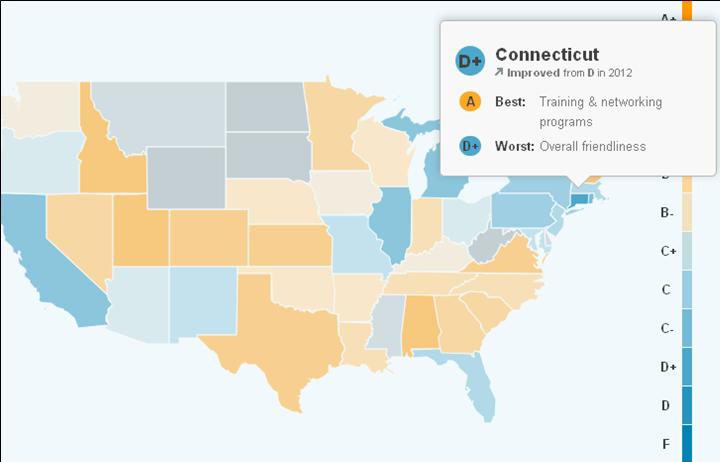
The 2013 study draws upon data from over 7,000 small business owners nationwide and shows that Connecticut improved its overall grade slightly, rising from a 'D' in 2012 to a 'D+' in state mapthis year's study.

Although the state struggled overall, the study authors reported, it received high marks in several categories. Some of the key findings for Connecticut include:

Connecticut earned an 'A' for the state's small business training and networking programs, which ranked among the top-5 nationally. Business owners were critical of Connecticut's regulatory systems, giving the state a 'C' in this category, although this was an improvement from the 'D+' grade received last year.

Among its neighbors, Connecticut ranked just behind New York (which had trailed Connecticut in last year's study) and Massachusetts, but ahead of Rhode Island for overall small business-friendliness.

The state’s overall grades, and comparison with last year, in the 11 categories compared in the survey:

D+         Overall friendliness (D last year)

D+         Ease of starting a business  (C last year)

B            Ease of hiring (C last year)

C             Regulations  (D+ last year)

B-            Health & Safety  (C+ last year)CT welcomes you

C-            Employment, labor & hiring  (D+ last year)

C-            Tax code (D last year)

C             Licensing  (D+ last year)

D+          Environmental (D+ last year)

C-            Zoning (C+ last year)

A             Training & networking program

The study aims to learn what small businesses believe constitutes a healthy political and regulatory climate by having them rate how it is to do business in their specific location along various metrics.

Over 99% of U.S. employer firms qualify as small businesses, and they employ half of all private sector employees. Over the past two decades, almost two-thirds of net new private sector jobs have come from small businesses, and that number has accelerated in recent years.

The thumbtack survey also compared the age and size of the businesses with those of the general business population. The Small Business Adkauffman-details-logoministration reports that 69% of small businesses are at least two years old, and 51% are at least five years old.  The survey sample is very close to these numbers, with 76% over two years old and 57% at least five years old.

According to US Census data, 91.6% of small businesses have between one and four employees. Another 3.8% have 5-9 employees, and 4.6% have 10 or more employees. The survey respondents followed a very similar distribution: 89.3% have between one and four employees, 6.7% have 5-9 employees, and 4% have 10 or more employees.

Some of the key findings at the national level include:

  • Professional licensing requirements were 30 percent more important than taxes in determining a state's overall business-friendliness, confirming the findings from last year's study. Furthermore, this year's research revealed that 40 percent of U.S. small businesses are subject to licensing regulations by multiple jurisdictions or levels of government.
  • Utah was the top rated state, and Austin, TX was the top rated city. At the other end of the spectrum, Rhode Island and Newark, NJ were the lowest rated state and city.
  • The ease of obtaining health insurance was an important factor for many businesses. One-third of small business owners rated obtaining and keeping health insurance as "Very Difficult," versus only 6 percent who rated it "Very Easy."
  • Small businesses were relatively unconcerned with tax rates – more than half of small business owners felt they pay about the right share of taxes.

The top 10 states were Utah, Alabama, New Hampshire, Idaho, Texas, Virginia, Kansas, Colorado, South Carolina, Georgia, Minnesota, Nevada and North Carolina. Professional/nonprofessional services make up a large share of Thumbtack’s clients, so fewer manufacturers and retailers were surveyed, which may have impacted the survey results.

"It is critical to the economic health of every city and state to create an entrepreneur-friendly environment," said Dane Stangler, director of Research and Policy at the Kauffman Foundation. "Policymakers put themselves in the best position to encourage sustainable growth and long-term prosperity by listening to the voices of small business owners themselves."

Task Force Report on State Response to Alzheimer’s Nears Completion

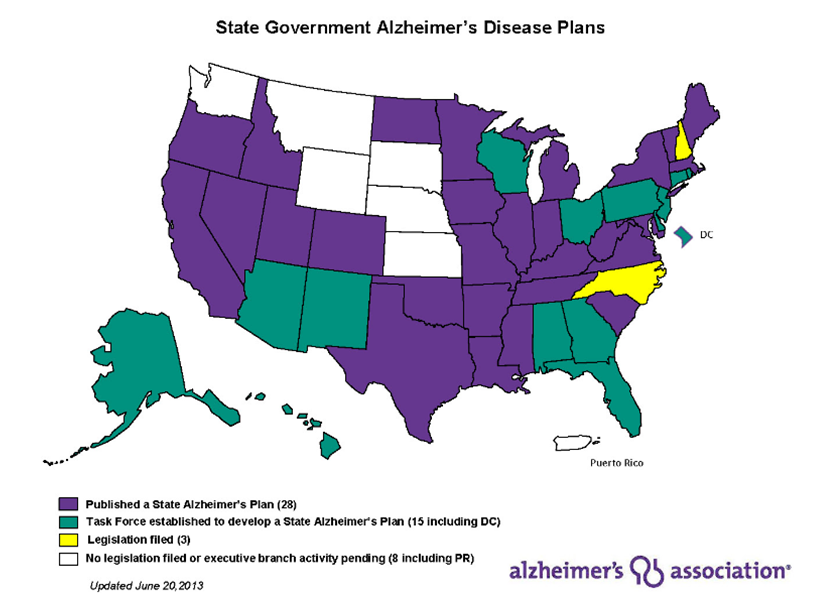
Thirty-one states have published a plan to respond to what advocates describe as the “escalating crisis” of Alzheimer’s Disease. Connecticut may be next, and is one of 13 states currently in the midst of developing plans.

The Connecticut Chapter of the Alzheimer’s Association was among the leaders in crafting and shepherding legislation in the 2013 General Assembly session to create a task force to study the care provided to persons diagnosed with Alzheimer's disease and dementia in the state.  That Task Falzheimers-wordsorce has been up and running throughout the fall, and is poised to announce its recommendations next month, just ahead of the start of the 2014 legislative session in February.

The 23-member task force of key agencies and community stakeholders convened in September, under the auspices of the Legislative Commission on Aging, to prepare findings and recommendations on ways to improve early detection, better coordinate health care services, set training requirements for health care providers and other professionals, services for early-stage and younger onset, and support to family caregialz mapvers.

The Task Force was co-chaired by State Commissioner on Aging Edith Prague and Rep. Joseph Serra of Middletown.  Members included Laurie Julian of the Alzheimer’s Association in Connecticut and other diverse community stakeholders appointed by legislative leadership and representatives from state agencies including the Department of Public Health, Department of Emergency Services, Department of Banking, Department of Labor and Department of Social Services, as well as six current legislators.

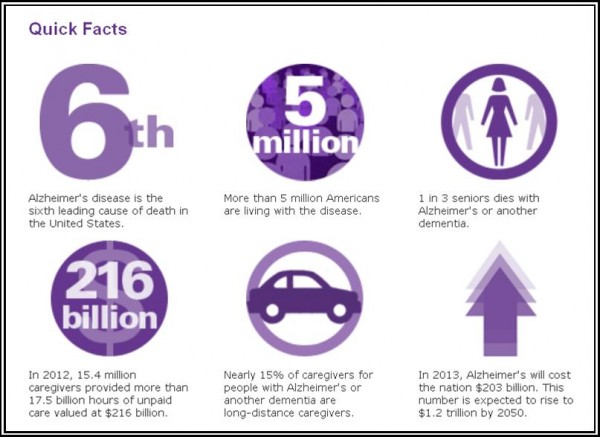
Over 5 million Americans are living with Alzheimer’s, and as many as 16 million will have the disease in 2050. Nearly one in every three seniors who dies each year has Alzheimer’s or another dementia. The cost of caring for those with Alzheimer’s and other dementias is estimated to total $203 billion in 2013, increasing to $1.2 trillion (in today’s dollars) by mid-century. Between 2000 and 2010, nationally, the number of people who died as a result of breast cancer, prostate cancer, heart disease, stroke and HIV all declined, while the number of people who died with Alzheimer’s increased by 68 percent.

In Connecticut, there were 820 deaths due to Alzheimer’s Disease in 2010, there are more than 63,000 individuals with Alzheimer’s in nursing homes in the state and it is estimated that 68% of nursing home residents have a cognitive impairment. As of 2010, there were an estimated 2,800 people between age 65-74 with Alzheimer’s in Connecticut, 30,000 between 75 and 84, and 37,000 age 85 or older.

The task force, in accordance with the legislation, will make recommendations in areas including:alz stats

  • services provided to persons diagnosed with Alzheimer's disease and dementia; including persons with early-state and early-onset of Alzheimer's disease, and such persons' family members and caregivers
  • legislative policy changes to better serve such persons, family members and caregivers;
  • coordination between state agencies and private community-based health care providers to serve such persons, family members and caregivers;
  • case management services for such persons, family members and caregivers;
  • the transition of such persons from one health care facility to another; and
  • the placement of such persons in community-based settings or health care facilities other than nursing home facilities, when feasible.

The state legislature acknowledged the growing numbers of residents impacted by the disease, passing the bill unanimously earlier this year, with 67 co-sponsors. It was signed into law in June by Gov. Malloy.  The Alzheimer’s Association has been actively involved in the effort. The organization’s   Connecticut chapter is based in Rocky Hill, with regional offices in Hamden, Norwalk, Norwich and New Milford.

In accordance with the legislation, the task force report is due to be published early next month, according to officials at the State Legislative Commission on Aging.


18 Connecticut School Districts Named to Advanced Placement Honor Roll

Eighteen Connecticut school districts have been named to The College Board’s 4th Annual AP District Honor Roll — a list of 477 districts across the U.S. and Canada being honored for increasing access to AP (Advanced Placement) course work while simultaneously maintaining or increasing the percentage of students earning scores of 3 or higher on AP Exams.

Reaching these goals indicates that these districtsAP district are successfully identifying motivated, academically prepared students who are likely to benefit from rigorous AP course work, according to The College Board.

The Connecticut school districts include public schools in Berlin, Brookfield, Cheshire, Clinton, East Hampton, Ellington, Enfield, Fairfield, Greenwich, Killingly, Monroe, Newtown, Southington and Wallingford, as well as Regional School Districts 8 (Hebron, Andover, Marlborough), 14 and 18 and the Diocese of Bridgeport.

Most of the districts had received similar recognition in previous years; new to the list are Wallingford, Regional Districts 14 (Woodbury and Bethlehem) and 18 (Lyme and East Lyme), Killingly, Greenwich, Clinton, Fairfield and Enfield and the Diocese of Bridgeport. A year ago, there were 26 Connecticut school districts recognized on the AP District Honor Roll.

 AP is a rigorous academic program that offers more than 30 courses in a wide range of subjects and college-level assessments developed and scored by college and university faculty members and experienced AP teachers. According to the College Board, a score of 3 or higher on an AP exam represents the score point that is predictive of college success and college graduation. The AP courses offered various by school dstudents hsistrict, but often include biology, chemistry, physics, Spanish, U.S. history, English literature, and calculus.

Helping more students learn at a higher level and earn higher AP scores is an objective of all members of the AP community, from AP teachers to district and school administrators to college professors, officials at The College Board point out. They noted that many districts are experimenting with a variety of initiatives and strategies to determine how to simultaneously expand access and improve student performance.

Inclusion on the 4th Annual AP District Honor Roll is based on the examination of three years of AP data, from 2011 to 2013, for the following criteria.

  • Increased participation/access to AP by at least 4 percent in large districts, at least 6 percent in medium districts, and at least 11 percent in small districts;
  • Increased or maintained the percentage of exams taken by African American, Hispanic/Latino, and American Indian/Alaska Native students, and;
  • Improved performance levels when comparing the percentage of students in 2013 scoring a 3 or higher to those in 2011, unless the district has already attained a performance level at which more than 70 percent of its AP students are scoring a 3 or higher.

In 2013, more than 3,300 colleges and universities around the world received AP scores for college credit, advanced placement and/or consideration in the admission process, with many colleges and universities in the United States offering credit in one or more subjects for qualifying AP scores.

Regional School District 14’s Superintendent, Jody Ian Goeler said, “It is wonderful to see so many of our High School students challenging themselves to take and succeed in our most rigorous courses. It is a strong indication our Board of Education’s advocacy for these programs is well placed and providing excellent opportunities and results for our students.”

Greenwich High School Principal Chris Winters recently commented that “Our participation in AP  classes is at a 10-year high, and the average score has remained unchanged and at very high levels. For the first time, over 50 percent of Greenwich High School have passed at least one AP exam during their four years.”

Nationwide data from 2013 show that among African American, Hispanic, and Native American students with a high degree of readiness for AP, only about half of students are participating. These 477 districts, The College Board indicated, are committed to expanding the availability of AP courses among prepared and motivated students of all backgrounds.

Hartford Hospital Will Devote Annual Fundraiser to Mental Health

The call to action regarding mental health awareness and treatment, which intensified in the aftermath of the Sandy Hook Elementary School murders a year ago, now has a strong local voice for the New Year.  Hartford Hospital is kicking off a campaign to end the stigma of mental illness at the annual Black & Red Gala on January 25, 2014 at The Bushnell Center for the Performing Arts in Hartford. The goal is to obtain 5,000 pledges, spreading the message that changing attitudes can begin to change minds.

Proceeds raised at this year’s Black &Red will benefit the Institute of Living (IOL) at Hartford Hospital. The IOL will be better able to respond to this national call to action with improved access to mental health care for adolescents and young adults –a critical need not only in Connecticut, but throughout the nation. Support will help carry out critically needed research, offer increased shhMainLogoSubervices and treatments, and provide much needed education to those impacted by mental illness.

An estimated 26.2 percent of Americans ages 18 and older — about one in four adults — suffer from a diagnosable mental disorder in a given year. In addition, mental disorders are the leading cause of disability in the U.S. and Canada. Many people suffer from more than one mental disorder at a given time.

Mental health stigma can be divided into two distinct types, according to the Hartford Hospital website:

  • social stigma is characterized by prejudicial attitudes and discriminating behavior directed towards individuals with mental health problems as a result of the psychiatric label they have been given.
  • perceived stigma or self-stigma, is the internalizing by the mental health sufferer of their perceptions of discrimination and perceived stigma can significantly affect feelings of shame and lead to poorer treatment outcomes.StopTheStigma_WordsMatter

The annual gala – Hartford Hospital's lead fundraising event - will feature entertainment by Barenaked Ladies, winner of two American Billboard Music Awards and two Grammy nominations.

Individuals attending the event will be asked to sign a “pledge” to...

  • Show compassion by reaching out to those in need of help. I will not let anyone suffer in silence.
  • Have the courage to speak up and challenge stereotypes and attitudes. I will not tolerate or perpetuate stigma.
  • Teach by sharing my own experiences with mental illness and encouraging others to share their stories with me. I will learn in order to change.
  • Demand a change in how we view and address mental illness. I will help lead the way.

The pledge, and additional information about mental illness and the Hartford Hospital initiative, is now available on a new webpage on the Hospital’s website, at www.stopthestigma.org   Individuals do not need to attend the event in order to sign the pledge – that can be accomplished directly on the website.

 “We will be looking to our employees of Hartford Hospital and across the Hartford HealthCare system to take the pledge. As a healthcare leader in the community and the state, it is our duty to set the example and stop the stigma associated with mental illness. Together, we can do it,” said Stuart Markowitz, M.D., President Hartford Hospital and Hartford Region, Senior Vice President Hartford HealthCare.

Harold (Hank) Schwartz, M.D., Hartford HealthCare Regional Vice President, Psychiatrist in Chief, Institute of Living at Hartford Hospital, says for some people, a mental illness iol_logo_300x175may be a lifelong condition, like diabetes. “However, as with diabetes, proper treatment enables many people with a mental illness to lead fulfilling and productive lives. By helping combat the stigma associated with mental illness, we can help increase the number of people that seek treatment.”

Examples of common mental illnesses include bipolar disorder, depression, PTSD, schizophrenia, OCD, anxiety disorders, eating disorders, ADD/ADHD, autism and Asperger’s.  CT by the Numbers has previously reported on research underway at the Institute of Living.

A year ago, over $1,000,000 in net proceeds was raised at the Black & Red gala for Hartford Hospital’s transplant services.

Connecticut is Nation’s Fourth Most Innovative State, Data Reveals

Connecticut is ranked as the nation’s fourth most innovative state, in a new analysis from Bloomberg Technology.  The state’s ranking was based on factors including education, professionals in science, technology, engineering and math (STEM) fields, state research and development spending, and technology companies.

The state’s overall score in the analysis, 76.45, is just behind top-ranked Washington’s 83.25, California’s 81.97 and Massachusetts’ 80.93. States were ranked on a scale of zero to 100 in six factors, and received an overall score that was an average of the six. Because productivity consisted of two sub-factors, each was weighted 50%.

 Connecticut’s ranking was based on the following factors:states of innovation

  • STEM professionals as a percentage of state population: 2.72% (CT ranked #7)
  • Science and tech degree holders as a percentage of state population: 10.2% (CT ranked #6)
  • Utility patents granted as a percentage of U.S. total: 1.74% (CT ranked #17)
  • State government R&D spending as a percentage of U.S. total: 2.79% (CT ranked #8)
  • Gross state product per employed person: $114,891 (CT ranked #5)
  • Three-year change in productivity: 0.88% (CT ranked #32)
  • Public tech companies as a percentage of all public companies based in the state: 17.65% (CT ranked #17)

Sources of the data include Bloomberg, Bureau of Economic Analysis, Bureau of Labor Statistics, National Science Foundation, U.S. Census, and the U.S. Patent and Trademark Office.  The analysis was updated in November 2013, and the rankings were published this month.

The remainder of the top 20 innovative states were:

5. Oregon 6. New York 7. New Jersey 8. Colorado 9. Maryland 10. Minnesotabloomberg technology 11. Virginia 12. Texas 13. Utah 14. Arizona 15. North Carolina 16.  Illinois 17. Pennsylvania 18. Kansas 19. New Hampshire 20. D.C.

At the bottom of the list of innovative states were Louisiana, Tennessee, Wyoming, Mississippi and Arkansas.