Who Knew? Northeast is Hotbed of Entrepreneurial Activity, For Some More than Others

Takes one to know one. Or, more accurately, know one and you may become one. That’s the bottom line of an exploration into entrepreneurship by a Kauffman Foundation researcher, who found that the Northeast is the best place to catch the entrepreneurial bug. As Connecticut sinks increasing dollars into initiatives to encourage entrepreneurship, develop jobs, and turn ideas into businessentrepreneurses (often with state financial incentives) the report offers guidance of factors influencing the frequency of entrepreneurial launches.  Connecticut Innovations,  established and supported by state government,  helps Connecticut businesses grow through creative financing and strategic assistance,  and is the nation's sixth most-active early stage investor.
The survey indicated that the likelihood of a person knowing entrepreneurs varied widely by location, income, gender, and age. Respondents were much more likely to know entrepreneurs if they were male, had modest income, or were middle-aged. And they were much less likely to know entrepreneurs (or be entrepreneurs) if they were female, had a higher income, or were located in the Midwest or South.

The study suggests that there could be “material increases in entrepreneurship simply through doing a better job of exposing people to existing entrepreneurs, especially peers or contemporaries.” Entrepreneurship grows, the study found, where it is planted.

Key factors to consider when attempting to encourage entrepreneurship, according to the study:

  • Women have less exposure to growth entrepreneurs than men
  • The young have much more exposure to growth entrepreneurs
  • People in lower income strata are much less likely to be exposed to growth entrepreneurs

The study concluded that “In all cases, an individual’s exposure to entrepreneurs—and to growth entrepreneurs in particular—may increase his or her likelihood of being one. Entrepreneurship can be viral, but must be introduced early and often in environments where it is least often seen.”

The study distinguished between entrepreneurial companies and “growth entrepreneurial companies,” those companies growing more than 20 percent a year and with more than $1 million in sales, generate more employment and contribute more to wealth and GDP than do slower-growing ventures.

The likelihood of a respondent reporting knowing an entrepreneur by Region in the United States was 36.7 percent. The likelihood of knowing a growth entrepreneur was considerably lower, at 15.4 percent.
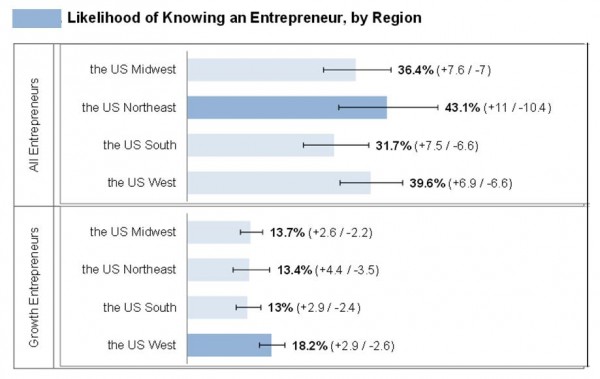
When broken down by gender, the likelihood of males knowing an entrepreneur was 39.9 percent, females 35.8 percent. For growth entrepreneurs, the gender gap was considerably wide, 24.8 percent to 12.1 percent.

A year ago, CTNext, Connecticut’s innovation ecosystem managed by Connecticut Innovations (CI), announced the launch of the Entrepreneur Innovation Awards (EIA), a competitive pitch process that provides awards up to $10,000 to entrepreneurs in Connecticut for growth-related activities. CI helps innovative companies in four key ways: by offering equity, debt, grants and strategic guidance.

A month ago CTNext announced the winners of the latest round of EIA awards; Connecticut-based companies and entrepreneurs, received $10,000 for their project ideas. CI also selected David Wurzer, formerly a senior managing director at CI, to be chief investment officer and executive vice president. As part of his new role, Wurzer will be responsible for the management of the investment function, staffing needs, portfolio and risk management, outreach to stakeholders, budget planning and performance measurement.

The study “Getting the Bug: Is (Growth) Entrepreneurship Contagious?” was conducted by Paul Kedrosky of the Kansas City-based Kauffman Foundation, and is aimed at providing data to guide efforts across the country to grow entrepreneurship. The survey, which categorizes responses of 2,000 individuals by age, income, gender, and location, was done via Consumer Google Survey.
Tolland County is Healthiest in Connecticut, Fairfield Next, Report Finds

The healthiest county in Connecticut is Tolland County, according to a new report analyzing health data from nearly every county in the country. The 2014 County Health Rankings & Roadmaps ranked Connecticut’s eight counties by health outcomes and health factors. According to the report, health outcomes represent how healthy a county is while health factors represent what influences the health of the county.

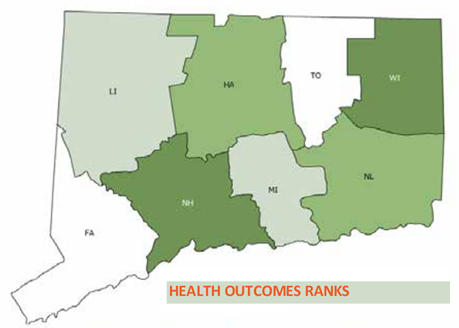
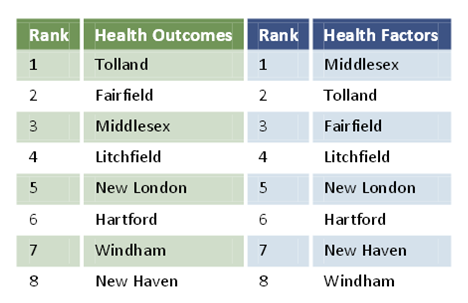
county_health_ranking_300In health outcomes, Tolland County led the way, followed by 2)Fairfield County, 3)Middlesex County, 4)Litchfield County, 5)New London County, 6)Hartford County, 7)Windham County and 8)health outcome ranksNew Haven County.

In health factors, Middlesex County ranked first, followed by Tolland County, Fairfield County, Litchfield County, New London County, Hartford County, New Haven County and Windham County.

The County Health Rankings & Roadmaps program helps communities identify and implement solutions that make it easier for people to be healthy in their schools, workplaces and neighborhoods, according to study authors. The Robert Wood Johnson Foundation collaborated with the University of Wisconsin Population Health Institute on the state-by-state analysis and report, which measured the health of nearly every county in the nation.

The report website includes “county snapshots” - detailed data for each county, in each of the health factors and health outcomes. Comparisons between counties, and the statewide numbers, are also available.ranks

Health factors data included in the analysis are health behaviors, such as tobacco use, diet and exercise, and alcohol and drug abuse; clinical care, including access to care and quality of care; social and economic factors, including education, employment, income, safety and family support; and physical environment, including air and water quality, housing and transit. Health outcomes date included length of life, and quality of life, with factors such as physical health and mental health.

The report website provides specific data in each of the categories, and ranks Connecticut’s eight counties in each factor. This year’s Rankings release marked the fifth anniversary of the first national release of the County Health Rankings.

44 Connecticut High Schools Among Best in US; Top School in State Is #15 Nationally

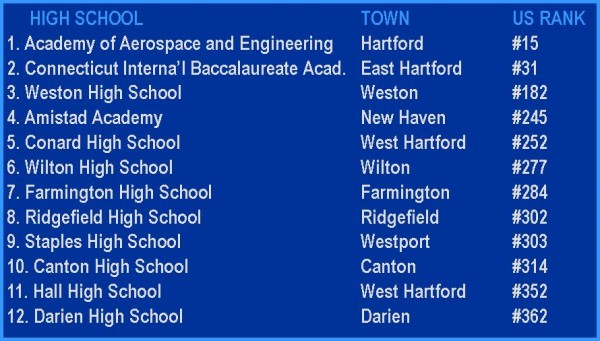
Forty-four Connecticut high schools have earned a slot on U.S. News & World Report’s list of the nation’s Best High Schools. The top school in Connecticut, according to the rankings, is Academy of Aerospace and Engineering, an inter-district magnet school run by the Capitol Region Education Council (CREC), which came in at number 15 in the U.S. rankings.

The title of number one school in the country went to School for the Talented and Gifted in Dallas, Texas.  The top ten nationally included schools in Arizona, Georgia, Virginia, Florida, Michigan and California.  TAmericas-Best-High-Schoolshe publication’s 2014 Best High School rankings, included a review of 19,411 public high schools.

According to U.S. News & World Report, Connecticut has 17 gold medal schools, 20 silver medal schools and seven bronze medal schools. In order to be eligible for a state ranking, a school must be awarded a national gold or silver medal.

CREC’s Academy of Aerospace and Engineering, at #15 nationally, was the only Connecticut school to make the top 30.  The school plans to move to a newly constructed school facility in Windsor next year. It is a grade 6 – 12 magnet school with programs that build upon each other to help students gain skills and unique experiences in science, technology, engineering and mathematics (STEM) that prepare them for college and high-demand professional careers. The diverse student body comes from more than 30 cities and towns in the Greater Hartford area.

The Connecticut International Baccalaureate Academy, in East Hartford, ranked #2 in Connecticut and #31 in the nation, according to the US News rankings.  The #3 high school in Connecticut ranked #182 nationally – Weston High School.

In addition to the top 12 high schools in Connecticut (see chart), those making the U.S. News list included Joel Barlow High School (Redding), Simsbury High School, Greenwich High School, Newtown High School, New Canaatop high school listn High School, Fairfield Ludlowe High School, Avon High School, Lyme-Old Lyme High School,  Brookfield High School, Fairfield Warde High School, Amity Regional High School (Woodbridge), Guilford High School, Glastonbury High School, Suffield High School, Litchfield High School, Metropolitan Learning Center (Bloomfield), and Bolton High School, all among the top 1,000 high schools nationally.

Also reaching the U.S. News list, were Valley Regional High School (Deep River), Bristol Central High School, South Windsor High School, Daniel Hand High School (Madison), Southington High School, Hill Regional Career High School (New Haven), Cooperative Arts and Humanities High School (New Haven), and Northwestern Regional High School (Winsted), which placed among the top 1,640 high schools nationwide.

Among the Connecticut high schools (see the full list of rankings) the top ranked school for college readiness was Lyme-Old Lyme High School, followed by Old Saybrook High School and Pomperaug Regional High School (Southbury).awards pie

The best student-teacher ratio in the state was 10:1, occurring in 13 high schools, including Bloomfield High School, Windsor High School, East Windsor High School and Windham High School.   Twelve schools were tied with the highest math proficiency in the state; four schools had the highest reading proficiency among their students – Newtown, Greenwich, Brookfield and Farmington high schools.

The US News site explains that "a three-step process determined the Best High Schools. The first two steps ensured that the schools serve all of their students well, using performance on state proficiency tests as the benchmarks. For those schools that made it past the first two steps, a third step assessed the degree to which schools prepare students for college-level work."

  • Step 1 determined whether each school's students were performing better than statistically expected for the average student in the state.
  • Step 2 determined whether the school's least-advantaged students were performing better than average for similar students in the state.
  • Step 3 judged college-readiness performance using Advanced Placement or International Baccalaureate test data as the benchmarks for success.

Gold medal designation went to the top 500 schools (about 3 percent) based on the highest college readiness, the silver medal to high performing schools with lower college readiness numbers (about 9 percent of schools), and the bronze designation went to high performing schools based on state examThe Changing Prairie performance (about 15 percent of schools).  Three-quarters of the schools whose data was analyzed did not earn a “best” designation.
When One CT Beer Week Is Just Not Enough

For Connecticut’s growing beer industry, a single beer week was just not enough.

The Connecticut Beer Wholesalers Association, which is comprised of six beer wholesalers in Connecticut and conducted the CT Beer Week marketing campaign for the first time last May, has decided to double down on the effort in 2014.  The second annual Beer Week later this month will be the first to two “weeks” planned for this year.

The first Beer Week ict-beer-week-2014s coming up during the week of May 12 – 18, the same week as American Craft Beer Week. The second one is slated for October 14-20, and coincides with CT Restaurant week. Consumers are asked to “join us as we celebrate the growth of an industry in partnership with craft brewers, restaurants and retailers.”

Organizers say the "Brew & Buy Local" campaign brings focus to the Connecticut organizations that work together to strengthen “a vibrant industry filled with cooperative spirit and a desire to brew something good for Connecticut!”

Among the events in Connecticut later this month will be the 4th Annual Rising Pint Brewfest, designed to kick off American Craft Beer Week. The event will be May 10, 2014 at Rentschler Field, featuring over 90 craft breweries, live bands and local restaurants.  Proceeds of the Rising Pint go to Folds of Honor, a foundation working to help the families of our fallen and severely injured soldiers.CTBeerWeekTshirts

A full calendar of beer week events has been developed, and features more than 40 events around the state.  Connecticut has 22 local breweries, with a dozen new breweries being developed including three slated to open later this year in Oxford and Glastonbury.

Top Main Street Revitalization Initiatives in Connecticut Named

Manchester, New Britain, Waterbury, Seymour and the Northwestern CT Regional Planning Collaborative are being highlighted by the Connecticut Main Street Center (CMSC) for their strategic downtown revitalization initiatives.

As recipients of the organization’s 2014 Awards of Excellence, the efforts include a community college partnering with the downtown and others to create a co-working space; connecting the Naugatuck River with the downtown through extended trails and a linear park; and regionalizing marketing for a collection of small village centers.

The annual  Connecticut Main Street AwardCT Main Street LOGOs of Excellence were created in 2003 to recognize outstanding projects, individuals and partnerships in community efforts to bring traditional downtowns and neighborhood commercial districts back to life, socially and economically. All of the award recipients continue the tradition of stimulating economic development and reinvigorating Connecticut's social centers, officials said.

"Our members continually inspire us with how creatively they respond to the needs of their community," said CMSC President & CEO John Simone. "They're deeply committed to every aspect of their downtown - the businesses, public spaces, local institutions, and above all, creating a place that people really enjoy living in and visiting. We couldn't be happier with how this year's winners represent all we stand for in downtown revitalization."

Submissions were judged on criteria which included innovation, replication, representation, partnerships utilized, and outcomes.  The awards will be presented at the 2014 Connecticut Main Street Awards Gala on June 9th at Roia Restaurant in downtown New Haven.  Award recipients, by category, are:

Events & Programming

Award of Excellence for Wine on Main St. to Main Street Waterbury, Terry Boyd, Braza Churrascaria, Courtyard by Marriott, Diorio's Restaurant, Shamrock Pub & Grill, Tryst Lounge, Signature's Restaurant, City Hall Café, Howland Hughes Center, and Nutmeg Fine Wine & Spirits.

Marketing & Communications

Award of Excellence for Discover NW CT to Northwestern CT Regional Planning Collaborative (representing the Towns of Sharon, Falls Village, Goshen, Cornwall, Canaan, Salisbury, Kent, and Norfolk), Studio Two, local business owners in the eight towns in the "Secret Corner", and local historical societies.

Public Space

Award of Excellence for Complete Streets Master Plan for Downtown New Britain to Downtown Streetscape Working Group, the City of New Britain (including the Mayor's Office, Public Works, Planning and Parks Departments), New Britain Downtown District, Polonia Business District, Central Connecticut State University/ITBE, Capitol Region Council of Governments, and Project Consultant Team.

Renewed Commitment to Main Street

Award of Excellence for Seymour Downtown Action Strategy to the Town of Seymour, Seymour Economic Development Commission, Seymour Downtown Committee, Greater Valley Chamber of Commerce, Naugatuck River Greenway Steering Committee, Naugatuck Valley Council of Governments, Downtown Merchants Association, Planimetrics, Milone and MacBroom; CT Department of Energy and Environmental Protection,and the National Oceanic and Atmospheric Administration.

Main Street Partnership

Award of Excellence for Axis901 and MCC on Main (Manchester) to First Niagara Bank, Manchester Community College (MCC) Foundation, and the Town of Manchester (Board of Directors and Staff).

Economic & Business Development

Award of Excellence to The Business Women of Grand Street (Waterbury) to The Dutch Flower Lady, Technology Forensics, John Bale Book Company, Fine Craft Jewelers, Dottie's 2, Princess Lingerie, Brass City Market on Field, and Fashion Addict.

Connecticut's #1 Athlete Search: LeBron James

Which athlete is Connecticut most interested in?  Not Shabazz Napier, not Stefanie Dolson.  At least not according to Google, which analyzed the frequency of searches in each of the 50 states during the past 12 months.  Number one in Connecticut:  LeBron James.  Popular-Players-Complete-Blu2

In fact, LeBron James dominates the competition, showing up as the most searched athlete in 23 of the 50 states. Next in line is Peyton Manning who claims seven states, then Adrian Peterson and Tom Brady who tie for 3rd with four states.

Andrew Wiggins (two states) and Johnny Manziel (one state) are the only athletes to win at least one state despite technically not having made the transition to professional sports yet. Tiger Woods (one state - Vermont) is the only athlete on the map who doesn’t play one of the “Big Four” North American sports.

Across New England, Tom Brady is number one in Rhode Island, Massachusetts, Maine and New Hampshire.

The website Best Tickets also indicated that Google research shows that the NFL is far and away the most popular league in the United States. In almost every state, the NBA was the second-most popular league, but MLB and the NHL did make a few appearances in the number two spot.

New York is the only state in which the NBA is the most popular league. In Florida, Oklahoma and Oregon, the NBA and NFL tie for first.

Yankees - Red Sox: Battle Extends Off the Field, Atop Baseball's Finances

The Yankees and Red Sox, always the focus of attention, argument and controversy across Connecticut, can each claim some victories - on the field and off.  The Red Sox are defending World Champions, having won the 2013 World Series.  They Yankees are the most valuable team in baseball, having won the 2013 monetary championship, just ahead of the Los Angeles Dodgers and Boston Red Sox, according to data compiled by Bloomberg News.MLB

The New York Yankees are worth $3.3 billion, making them the sport’s most-valuable enterprise. The Los Angeles Dodgers rank second with a value of $2.1 billion. Ten teams are worth more than $1 billion. The Boston Red Sox and New York Mets each are valued at more than $2 billion, the data shows.

The Yankees ranked first in overall team value, and 1st in the following categories:  Team Revenue ($570 Million), Gate Receipts ($265 million), Concessions $53 million), Sponsorship ($84 million), and Media Rights ($158 million).  The Yankees ranked 4th in attendance during 2013, at 3.3 million.

The Red Sox ranked third overall, just behind the Los Angeles Dodgers.  The Red Sox ranked 2nd in Team Revenue ($405 million), Gate Receipts ($174 million), Concessions ($36 million).  The team was third in Sponsorship ($40 million), seventh in Media Rights ($89 million), and 9th in Attendance (2.8 million).

In calculating team value, Bloomberg News examineMLB webd revenue from ticket sales, concessions, sponsorships and broadcast rights, as well as interests in TV channels, radio stations and real estate.

The Yankees ranked 1st in Team Value, 2nd in the value of their Regional Sports Network, 2nd in Related Business; the Red Sox ranked 3rd in Team Value, 3rd in Regional Sports Network and 3rd in Related Business.

Revenue from national TV contracts and merchandise is split evenly among the teams, as is the value of MLB Advanced Media, a subsidiary that supplies content to Internet and mobile subscribers.

Fourteen teams have stakes in regional sports networks, according to the report. Of the 10 teams valued at $1 billion or more, only the Philadelphia Phillies don’t have one. The team and Comcast are in negotiations for a new TV contract. Their current deal ends in 2015.

The average value of a team’s interest in a regional network is about $360 million, with the Mets’ 65 percent stake in SportsNet New York having the biggest valuation of almost $1.2 billion, according to data compiled by Bloomberg.

Hartford Ranked #35, New Haven #39 in Income Inequality Among US Cities; Bridgeport-Stamford-Norwalk Is Nation's Most Disparate Region

A new analysis ranking the cities with the greatest income inequality includes Hartford and New Haven in the top 50.– and the Bridgeport-Stamford-Norwalk metropolitan area is the metro region with the largest income disparity in the nation.

The major cities with the most dramatic income inequality in their population are, ranked in order:  Atlanta, New Orleans, Miami, Jackson (Mississippi), Gainesville (Florida), Tampa, Cincinnati, Athens (Georgia), Providence, Berkeley and Boston.  Seven of the top 11 are cities in the Southern U.S.

Among New England cities, Providence ranked #9, Boston at #11, Cambridge at #12, Hartford at #35, and New Haven at #39.  Among other major cities, New York ranked #13 and Washington, D.C. ranked #15.

Bloomberg ranked 300 U.S. cities with populations of at least 100,000income-inequality-shutterstock_146836310 based on their level of income inequality and identified the 50 with the greatest inequality. The media outlet also ranked the top 20 metropolitan areas with the greatest income disparity.

On that list, Bridgeport-Stamford-Norwalk ranked as the metro area with the most income inequality in the nation.  Among the 20 regions with the greatest disparity, one-quarter are in Florida – including Naples-Marco Island at #2 and Gainesville at #3.  College-Station-Bryan (Texas) was #5 and New York-Northern New Jersey was #5 on the list of metro areas. 

They methodology for the analysis was use of the “Gini coefficient,” which is calculated by the U.S. Census from household income share by quintiles, used to measure distribution of wealth. It ranges from zero, which reflects absolute equality, to one, complete inequality.

Hartford’s Gini coefficient was 0.5176, New Haven’s was 0.5144.  By comparison, Atlanta’s was 0.5882, and Providence 0.5445.  New Haven’s income inequality improved slightly, by 5.4 percent, since 2008, while Hartford’s disparity grew slightly, by just over 1 percent, according to the data.

The Bridgeport-Stamford-Norwalk region had a Gini coefficient of 0.5459.

It was reported that in New Haven, 26.1 percent of the population was living in poverty; in Hartford the figure was 38 percent.  In Hartford, 54 percent of household income was in the highest quintile, while 2 percent was in the lowest quintile.  In New Haven, 38 percent was in the highest quintile while 2.5 percent placed in the lowest.

In the ranking of the 50 cities with the most income inequality, Hartford was between Lafayette, Louisiana and Cleveland, OH.  New Haven ranked between Charleston, S.C. and Tulsa, OK on the list.

The average score for the United States was 0.4757. In 2013, a person living alone making less than $11,490 was classified as in poverty. The threshold increased by $4,020 for each additional household member, Bloomberg reported.

Encore Entrepreneurs – Over 50 and Building New Businesses

Mix a relatively slow economy and a shortage of jobs with a large number of aging boomers looking for meaning and purpose in their work. The result is a growing number of “encore entrepreneurs” seeking to launch income-generating ventures that make a positive difference in their communities.

That has led the U.S. Small Business Administration (SBA) and AARP to launching a strategic alliance to provide counseling and training to entrepreneurs over the age of 50 who want to start or grow a small business.   AARP

April is Encore Entrepreneur Mentor Month, and would-be “encore entrepreneurs” will have the opportunity to connect with a number of organizations and community leaders for advice and assistance in their endeavors as part of seminars held as part of the AARP-SBA initiative.

Next up in Connecticut:  a free seminar, Want to Start or Grow a Small Business?, at the Hartford Public Library on Wednesday, April 23, 2-4 PM, at 500 Main Street.  Space is limited. Interested individuals can register online or call toll-free 877-926-8300.   There will also be a session in New Haven on May 15.

For many Americans born between 1946 and 1964, retirement has a very different meaning than it did a generation ago.   According to a USA Today/Gallup poll, 63% of American adults plan to work in retirement; two-thirds say enjoyment of work is the key reason. With years of valuable work experience, maturity, and plenty of energy at their disposal, today's older workers are increasingly finding financial and personal fulfillment in running their own small businesses.entrepreneur

New research released by Encore.org (formerly Civic Ventures) and funded by the MetLife Foundation shows:sba-logo-300x121

  • Approximately 25 million people – one in four Americans ages 44 to 70 – are interested in starting businesses or nonprofit ventures in the next five to 10 years.
  • More than 12 million of these aspiring entrepreneurs are potential encore entrepreneurs who want to make a positive social impact as well as a living.  Potential encore entrepreneurs have realistic financial expectations and plan local, small ventures to meet needs in their communities.
  • These aspiring entrepreneurs bring a lot of experience to the table, including an average of 31 years of work experience and 12 years of community involvement. Additionally, five out of six report having management experience – 15 years on average.

A 2010 survey by the Kauffman Foundation found that Americans 55 to 64 start new business ventures at a higher rate than any other age group, including 20-somethings. Fully 23 percent of new entrepreneurs were age 55 to 64, up from 14 percent in 1996.

The first event in Connecticut was held in Bridgeport in late January, followed by Danbury in early April.  An additional program is slated for New Haven on May 15 (2 to 4 PM) at Gateway Community College.

In Search of Adventure: A Children’s Book Diversity Mystery

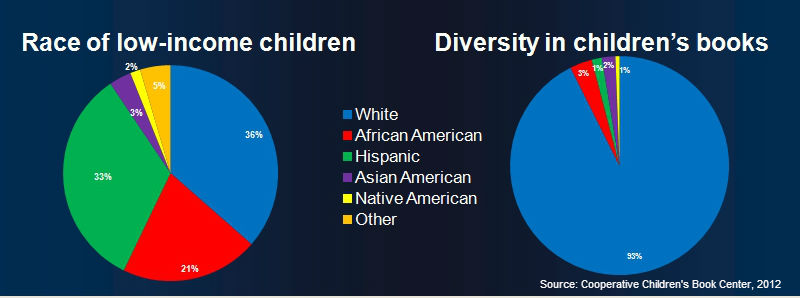
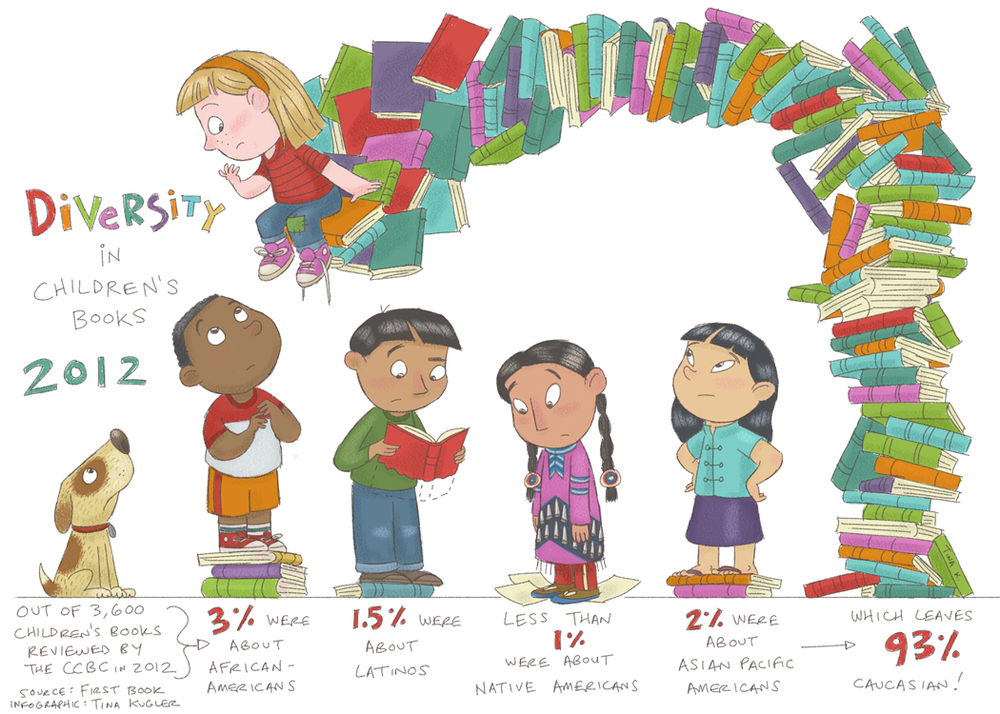
In 2012, 93 percent of children’s books written that year were written about white characters, according to a study by the Cooperative Children’s Book Center.  There were 3,600 children’s books written that year.

Apparently the hue and cry were insufficient to change the inertia of insensitivity to the range of skin colors on American children.  A similar study in 2013, recently highlighted in The New York Times, found the following:  of 3,200 children’s books published last year, just 93 were about black people and 57 were about Latinos.  The Cooperative Children’s Book Center is at the University of Wisconsin. PowerpointGraphic1

A well-circulated illustration by Tina Kugler, spurred by the 2012 numbers, highlighted them:

  •   3% were about Africans/African Americans; 1.8% were written by Africans/African Americans
  •   1.5% were about Latinos; 1.6% were written by Latinos
  •   Less than 1% were about American Indians; less than 1% were written by American Indians
  •   2% were about Asian Pacifics/Asian Pacific Americans; 2.3% were written by Asian Pacifics/Asian Pacific Americans

Back in 2008, a study by Brigham Young University found that “characters depicted in Newbery winners are more likely to be white, male and come from two-parent households than the average U.S. child,” according to published reports.  The Newberry Award is the annual top honor for children’s literature.

At the time, Bloomberg News reported the following:  The Chicago-based American Library Association has awarded the Newbery Medal to one book annually since 1922. All Newbery books remain in print, underscoring their enduring nature. Their popularity with teachers and parents means that for many younger children, Newbery medalists are a primary way they learn about the world and how to relate to others.

Writing in The New York Times, author and illustrator Christopher Myers pointed out last month that children “are much more outward looking.  They see books less as mirrors and more as maps.  They are indeed searching for their place in the world, but they are also deciding where they want to go.  They create, through the stories they’re given, an atlas of their world, of their relationships to others, of their possible destinations. … Children of color remain outside the boundaries of imagination.  The cartography we create with this literature is flawed.”

The National Education Association has added to its website “50 Multicultural books every child should read.”  The most recent title, for children from preschool to age 12, was written in 2009.diversity_tinakugler

Locally, Eastern Connecticut State University associate professor of English Dr. Raouf Mama is recipient of the 2008 National Multicultural Children's Book Award from the National Association of Multicultural Education.  The author of children’s books and master storyteller, a native of Benin, Dr. Mama performs African and multicultural stories, blending storytelling with poetry, song, music, and dance.   An orator out of the African oral tradition, he also lectures on African literature and African folklore and conducts workshops on storytelling and creative writing, and the power of folktales as multicultural teaching and learning tools, especially as tools for teaching literacy skills, creative writing, and public speaking.

When the American Association of School Librarians had their National Conference & Exhibition in Hartford last fall, the issue was on the agenda.  One of the conference session’s dealt specifically with multicultural children’s literature.  Led by acclaimed children’s book author Kelly Starling-Lyons and author Gwendolyn Hooks, the session was directed to “school librarians who want to build or expand their collections with multicultural titles.”

Conference attendees from across the country who were attending the biannual event were “invited to come celebrate a showcase of great books by African American children's book creators.”  Hooks and Starling Lyons saluted titles that have been featured on The Brown Bookshelf blog.

The conference theme during those November days in Hartford:  Rising to the Challenge.

image_race