Amtrak ridership breaks all-time records, local corridor sees increase

Amtrak ridership increased in the first six months of fiscal year 2013, with ridership in March setting a record as the single best month ever in Amtrak’s history.  Ridership grew 0.9 percent from October 2012 to March compared to the prior year, despite disruptions from weather, including Superstorm Sandy.  Amtrak said 26 of 45 routes had rider increases during the period and monthly records were set in October, December and January. Ridership on the New Haven – Springfield shuttle grew from 33,196 in March 2012 to 36,962 in March 2013, an increase of 11.3 percent.  Ridership from October 2012 through March 2013 grew by 5.2 percent from the same period a year earlier.  The Acela Express ridership dropped off slightly amid the record-breaking numbers, likely due to service interruptions due to Superstorm Sandy, down 2.5 percent last month compared with a year ago.NHHS

The numbers are encouraging as plans continue to move forward for dramatic improvements and expansions of service on the 62-mile New Haven-Hartford-Springfield (NHHS) corridor in the coming years.  Amtrak is continuing the installation of underground signal and communication cables, required to upgrade signal and communication systems for the NHHS rail corridor.

Work this month is scheduled in Newington, Hartford and Windsor.  The NHHS rail service project will connect communities, generate sustainable economic growth, help build energy independence, and provide links to travel corridors and markets beyond the region, officials say.

The new NHHS rail service will operate at speeds of up to 110 mph, cutting travel time between Springfield and New Haven to just 78 minutes. When the new service is launched in 2016, travelers at New Haven, Wallingford, Meriden, Berlin, Hartford, Windsor, Windsor Locks, and Springfield will board trains hourly during the peak morning and evening rush hours and every 90 minutes during off-peak periods. When all the planned improvements are completed, trains will operate every 30 minutes during peak periods. The full program also includes future, amtrak1new train stations at North Haven, Newington, West Hartford, and Enfield.

Nationally, long-distance routes with ridership growth in the October-to-March period included the New York City to Georgia route, the Palmetto, up 10.5 percent, and the Coast Starlight, which operates between Los Angeles and Seattle, up 10 percent.  Amtrak said ridership was up 9.8 percent on the Illini/Saluki, which operates between Chicago and New Orleans; 8.9 percent on the San Joaquin in California, 8.6 percent on the Piedmont in North Carolina and 8.2 percent on the Wolverine route in Michigan.

Amtrak officials say they expect to end the fiscal year at or above last year’s record of 31.2 million passengers.  The sixth annual National Train Day will be celebrated around the country on May 11.

Amtrak is America’s Railroad®, the nation’s intercity passenger rail service and its high-speed rail operator, with more than 300 daily trains – at speeds up to 150 mph (241 kph) – that connect 46 states, the District of Columbia and three Canadian Provinces. Amtrak operates intercity trains in partnership with 15 states and contracts with 13 commuter rail agencies to provide a variety of services.


Women-Owned Firms Propel Economic Growth, CT Ranked #22

Connecticut ranks 22nd in the “economic clout” of women-owned firms, according to a new study which averages each states’ ranking in the growth of the number, revenue and employment levels of women-owned firms between 1997 and 2013. The number of women-owned businesses in Connecticut increased 35 percent since 1997 and sales at those firms increased by nearly 67 percent,  in an analysis of U.S. Census data by American Express Open.  The review of state-by-state and national data estimates the number of Connecticut businesses owned by women increased to 97,800 this year. Those businesses will have $15.5 billion in sales and employ 92,200 workers in 2013, according to The 2013 State of Women-Owned Businesses Report.   Connecticut firms exceeded the national average in hiring employees (up 17 percent in the state vs. 10 percent nationally) and in sales growth (67 percent vs. 63 percent).

As of 2013, it is estimated that there are over 8.6 million women-owned businesses in the United States, generating over $1.3 trillion in revenues and employing nearly 7.8 million people. The American Express analysis showed Connecticut still lags behind the 59 percent national average in growth among women-owned businesses since 1997.women owned

Driving Growth

Between 1997 and 2013, when the number of businesses in the United States increased by 41%, the number of women-owned firms increased by 59%— a rate 1½ times the national average.

The report noted that in the six years since the beginning of the recession in 2007, private sector job growth in the United States has come from two main sources: large, publicly traded corporations, and privately-owned majority women-owned businesses.

Women of Color

In 1997, there were just under 1 million (929,445) firms owned by women of color, accounting for one in six (17%) women-owned firms. That number has skyrocketed to an estimated 2,677,700 as of 2013, now comprising one in three (31%) women-owned firms.


The number of firms owned by Latinas are estimated at 944,000 as of 2013, according to the analysis. These firms employ 408,100 workers and generate an estimated $65.5 billion in revenue. Latina women own 36% of all Latino-owned firms, employ 20% of the workers employed by Latino-owned firms, and contribute 16% of the revenue generated by Latino-owned businesses. While nationally 11% of women-owned firms are owned by Latinas, they comprise the greatest share of all women-owned firms in New Mexico (29%), Texas (25%), Florida (24%) and California (20%).

Across All Industries

The states with the fastest growth in the number, employment and revenues of women-owned firms are the District of Columbia, North Dakota, Nevada, Wyoming and Georgia. The states with the lowest growth in the number of women-owned firms between 1997 and 2013 are: Alaska (12%), West Virginia (23%), Iowa (23%), Ohio (27%) and Kansas (27%).  Among the nation’s 25 most populous metropolitan areas, the fastest growing for women-owned firms are San Antonio TX, Portland OR, Houston TX, Riverside CA, and Washington DC/MD/VA.

Women-owned firms continue to diversify into all industries. The industries with the highest concentration of women-owned firms are: health care and social assistance (53% of firms in this sector are women-owned, compared to a 29% share overall), educational services (45%), other services (41%), and administrative support and waste management services (44%).

The industries with the lowest concentration of women-owned firms (in industries contributing 2% or more of the business population) are construction (where just 7% of firms are women-owned), transportation and warehousing (11%) and finance and insurance (20%). All other industries are close to the 29% share in all industries—illustrating that women-owned firms are staking a claim in all sectors of the U.S. economy.

Connecticut's overall ranking at #22 falls between Pennsylvania and West Virginia.


Survey Reveals Teens Unprepared for Costs of College, Uncertain About Future

As prospective college students receive word this month on whether they’ve been accepted to their preferred institution – and how much financial aid they’ll be receiving - the greater challenge begins.  That’s the grueling exercise to crunch the numbers to try to come up with ways to afford the impending and imposing tuition bill. That reality makes the findings of the Junior Achievement USA® (JA) and The Allstate Foundation's 2013 Teens and Personal Finance Poll ring alarm bells for teens and their families, as they look ahead to the financial impact of college:

  • Only 9% of teens report they are currently saving money for college.
  • More than a quarter of teens (28%) haven’t talked with their parents about paying for college.
  • More than half (52%) of teens think students are borrowing too much money to pay for college.

JA is helping students understand the importance of saving and planning for future financial needs, working with students from kindergarten through 12th grade.  That’s at the core of JA’s work, driven by volunteers who provide a real-world view for students.  To meet the need reflected in the latest data and reach more students, JA has opportunities right now – often at a school close to home - for volunteers to participate.

The increasing cost of college, difficult job market and sluggish economy appear to be affecting teens’ views on the timetable for attaining financial independence, and the prospects for their long-term financial security.  According to the poll, during the past two years the percentage of teens who:

  • Think they will be financially dependent on their parents until age 25 has more than doubled – from 12% in 2011 to 25% in 2013.
  • Say they don’t know or are not sure at what age they will attain financial independence from their parents jumped from a mere 1% in 2011 to 11% in 2013.
  • Don’t know or who are unsure if they will be financially better off than their parents has risen significantly, from 4% to 28%.

Teens’ uncertainty about their financial future is also a reflection of their lack of financial knowledge and understanding.  More than one-third (34%) are somewhat or extremely unsure about their ability to invest money.  And of the 33% of teens who say they do not use a budget, 42% are "not interested," and more than a quarter (26%) think that "budgets are for adults."

“Today’s teens expect to be financially dependent on their parents longer, and the number who can’t even predict when they might gain financial independence has jumped ten-fold in just the past two years,” said Louis J. Golden, Pstudentsresident of JA of Southwest New England.  “The economy certainly plays a role, but part of the uncertainly is because far too many teens lack a fundamental understanding of how to manage their money.  JA delivers specific, effective programs directly to the classroom that respond to that knowledge gap.”

JA's unique delivery system provides the training, materials, and support necessary to build student skills in financial literacy, work readiness and entrepreneurship. Last year, more than 2,500 volunteers - business professionals, parents, retirees, and college students – offered JA programs to more than 34,500 students in schools throughout Hartford, Litchfield, New Haven, Windham, Tolland, New London and Middlesex counties.

The volunteers use their personal experiences to make the JA curricula practical and realistic. Providing children with positive adult role models, who illustrate ways to build self-confidence, develop skills and find avenues of success in our economic system, is a hallmark of Junior Achievement.  Individual interested in learning more about the JA volunteer program should contact 860-525-4510 or visit www.jaconn.net for details.

State Grant Backs Transforming UConn Research into Start-Up Companies

UConn Ventures and the University of Connecticut’s Office of Economic Development (OED) have been selected to receive a state grant to provide technical assistance and training for small and medium sized businesses.  The $220,000 grant was awarded by the Department of Economic and Community Development as part of the state agency’s Economic Development Grants Program. UConn Ventures will apply the state funding in support of its mission to seek out university-based research innovations, assess their commercial potential, and provide resources to address the management, market, and technology associated with launching a new venture.UV.Final2.notag

The initiative aims to help migrate technologies developed in UConn’s research labs, including the UConn Health Center, to support early-stage companies and small business expansion.  UConn Ventures will work with research faculty in providing technical assessments and direct support that result in product development, testing and creation as well as fundable plans to launch either a new business or a new product or process.   UConn Ventures will focus use of the grant funds on efforts to:

  • support work to develop data, prototypes and test both technical and market relevancy in order to deploy new technologies and processes,
  • expose academic scientists to industry processes, experts and needs, thus impacting the course of future research in ways that will support industry and the economy,
  • engage Connecticut entrepreneurs and industry members from small business who may be potential investors, owners, licensees, CEO’s, or champions,
  • establish and further relationships that will support and advance a culture of innovation in Connecticut.

Plans call for two levels of financial support to fledgling companies under the program: 1) to assess and mitigate technical and market risks of a technology, and 2) to commercialize projects that have established proof of concept and identified a commercialization path.

“Our work is all about innovation, entrepreneurship, and scale,” said R. Mark Van Allen, President of UConn Ventures.  “We seek out university-based research innovations, assess their commercial potential, and provide resources to address the management, market, and technology risks associated with new venture formation.  We appreciate the state’s support of our work, and the reinvigorated commitment of the University and the Department of Economic and Community Development to help us to accelerate business creation and development.”

UConn Ventures, aligned with the University’s Office of Economic Development, creates business start-ups by guiding the development process, soliciting funding and recruiting management based on technologies invented by UConn students, faculty and staff.  It is a subsidiary of the UConn Foundation.  Financial benefits accrue to the individuals whose research innovation is at the core of the start-up business, and UConn.

“The Office of Economic Development is committed to applying resources in ways that will better support technology transfer and industry partnership,” said Mary Holz-Clause, UConn Vice President for Economic Development.  “UConn Ventures offers precisely the expertise and experience that is essential to successfully commercialize great research and great ideas, and their organization will play a pivotal role in building future successes.”

More information about UConn Ventures and the Office of Economic Development is available at www.uconnventures.com.

Antiques Trail May Be Mapped Across Connecticut

State legislators are considering the establishment of a Connecticut Antiques Trail, an effort to highlight the state's numerous antique shops, and boost tourism and economic development along the way. The proposal, by Sen. Rob Kane of Watertown, follows a 2009 initiative in which he worked with the state Department of Transportation to erect signs along Interstate 84 to highlight a collection of antique shops in his district, the Associated Press reported.  As part of that effort,  the town of Woodbury was designated as the “Antiques Capitol of Connecticut," centered around a local trail that features more than 35 diverse shops.

Highlighting the scores of antique shops throughout the state has generated other initiatives. Ed Dombroskas,   the current executive director of the Eastern Regional Tourism District (billed as “Mystic Country” ) and a past state tourism director, supports the statewide plan.  His organization recently put together an antiques brocantiques_signhure for his region and received thousands of inquiries seeking copies.  The brochure Mystic Country Antiques Trail, includes 30 locations across Eastern Connecticut and is now available on-line.

Antiques shops – and some larger antique stores – blanket the Connecticut landscape, each noting their particular attributes and history.  The Connecticut Antiques Center, in Stamford, for example, touts its easy access to New York City.  Kane said it makes sense to expand the trail statewide to connect more antiques dealers with collectors, comparing the plan to the Connecticut Wine Trail.

Just this past weekend, the Hill-Stead Museum in Farmington held an antiques and heirlooms appraisal day featuring a regular from the PBS program “Antiques Roadshow,” telecast locally on Connecticut Public Television and a perennial viewer favorite.  And the Connecticut Spring Antiques Show, celebrating its 40th anniversary, was held earlier this month, March 16-17, at the Hartford Armory.

Efforts to Close the Digital Divide Prompts Company Move To Hartford

GreenShare Technology is a company that takes its mission – to bridge the digital divide by providing technology to those who cannot afford it – quite seriously.  That is plainly evident in their move from Farmington to new, larger headquarters at 1200 Park Street in Hartford. The new, 2,000 square foot location doubles the company’s space, allowing GreenShare Technology to bring more affordable computers and computer maintenance services to Hartford and surrounding areas. The company plans to provide basic computer training and computer recycling services on-site. The new location wilogo-greenshare-technologyll also contain a retail section where customers can try out computers before purchasing them.

“We’re excited to become a part of the Hartford community,” said Brenda Steigman, Executive Director of GreenShare Technology. “It is our goal to become a one-stop source for low-cost computer technology and repair. We hope this new location will make us more accessible to the people who can benefit from our services.”

GreenShare Technology will host an open house at its new location Thursday, March 28 from 5 to 7 p.m. The public is welcome to stop by to learn more about the company’s services and bring an unwanted computer to be re-purposed or recycled. For more information, visit www.greensharetechnology.org or call 860-724-3535.

A 501(c) (3) charitable organization and Microsoft® registered refurbisher, Greenshare Technology offers computer recycling services for businesses and families to discard unwanted technology, keeping working computers out of landfills and putting them into the hands of small businesses, schools, non-profit organizations, government programs, and other eligible customers who might otherwise not have access to this technology.

GreenShare Technology received the 2011 Social Entrepreneur Award and the 2010 Hartford Young Professionals & Entrepreneurs (HYPE) Award.  The company is a reSET incubator program.


CT Receives Recognition for Economic Development

The Connecticut Department of Economic and Community Development has received national recognition from a top site selector organization for its economic development efforts.  DECD was selected to receive the 2013 Site Selectors Guild Award for its work with Tronox Inc., a chemical company that announced in 2012 that it would be locating its world headquarters in Stamford.  The Site Sectors Guild is a professional association that includes some of the worlds most respected site consultants. The most recent recognition underscores ongoing efforts of DECD, which include highlighting Connecticut's strong position to attract and grow businesses.  Some of the noteworthy stats:

  • Connecticut is a leader in patents, ranking 8th in the nation.
  • Connecticut is a leader in business research and development, ranking #1 per capita.
  • Connecticut is a global competitor, ranking #6 in world GDP per capita.
  • Connecticut’s workers are among the most productive in the nation, ranking fourth among states.
  • Connecticut is a leader in venture capital deals, which are key to the development of small business, ranking #7.
  • The state ranks 9th in the nation as a leader in the New Economy.
  • Connecticut is a leader in finance and insurance, ranking #2 in total employment.
  • Connecticut is a leading exporter ranking tenth in per capita exports.
  • Connecticut has a highly educated workforce ranking third with an adult population with advanced degrees.
  • Connecticut ranks 6th in the number of scientists & engineers per 100,000 employees.

The data, provided by CL&P's Connecticut Economic Review 2013 and The Information Technology & Innovation Foundation, reflects a mix of widely known and virtually unknown stats about Connecticut workforce and global position in a range of industries.

Small Business Development Center is Re-launched At UConn Campuses, Chambers of Commerce

The Connecticut Small Business Development Center (CTSBDC), a collaborative initiative of the federal Small Business Administration (SBA), State of Connecticut and University of Connecticut, is being rebooted, redesigned and re-launched in an effort to be more responsive to the state’s small and newly-forming businesses. CTSBDC is a five-year, $11.6 million program to provide financial and technical assistance to businesses with 500 or fewer employees – which accounts for roughly 93 percent of Connecticut employers.

The initiative was announced by UConn’s Vice President for Economic Development Mary Holz-Clause and state Commissioner of Economic and Community Development Catherine Smith during Connecticut Business Day at the State Capitol.  They were joined by Gov. Dannel P. Malloy, President and CEO of the Business Council of Fairfield County Chris Bruhl, UConn Board Chair and Middlesex Chamber of Commerce President Larry McHugh and business leaders from across the state.

“The new SBDC is designed to focus more like a private sector business: close to its customers, interconnected, efficiently using scarce resources, and offering a slate of innovative new services,” Bruhl said. “With a statewide network of 11 local SBDC offices, the Center strives to build the local ecosystem, recognizing that small business begins at the local level.”

The program will fund 16 full-time positions and two part-time positions, with individuals located at each of the 11 service centers, including seven local Chambers of Commerce and four regional UConn campuses, as well as the UConn cSBDCampus in Storrs, and the Department of Commerce Export Assistance Center in Middletown.

During the news conference, Holz-Clause pointed out that the University is an ideal home for the SBDC, as the power of UConn’s network of more than 100,000 alumni can be tapped to serve as both mentors and connectors for small businesses to ensure they are successful. In addition, the six regional campuses provide the SBDC with an established network of satellite sites that are already engaged in local, state, and national business development efforts. She also noted the work of organizations such as UConn Ventures, which are helping to launch new businesses based on research and innovation at UConn.

“UConn is really focused on growing Connecticut’s economy from the ground up,” said Holz-Clause. “That’s why this partnership is such a perfect fit for us. It builds on some of our existing strengths and gives us a front-row seat for truly exciting developments in the state’s business community.”

Governor Malloy pointed out that “The reinvigorated Small Business Development Center takes our economic development strategy to a new level, combining the academic strength and resources of our flagship university with the knowledge and reach of our chambers of commerce, to bring technical and financial assistance to the sector responsible for the overwhelming majority of our jobs: small businesses.”

The Small Business Development Center program, administered by the federal government’s Small Business Administration, has been providing service to small businesses for more than 30 years and is one of the largest professional small business management and technical assistance networks in the nation with over 900 locations across the country.  In Connecticut, it had been based at Central Connecticut State University and the Connecticut State University System in recent years.  Previously, UConn had hosted the program.

For more information regarding the SBDC and its programs, please visit the newly designed  website at  www.ctsbdc.org. To learn more about UConn’s Office of Economic Development, please visit www.innovation.uconn.edu.


CT Ranked #5 in Green Job Creation in 2012

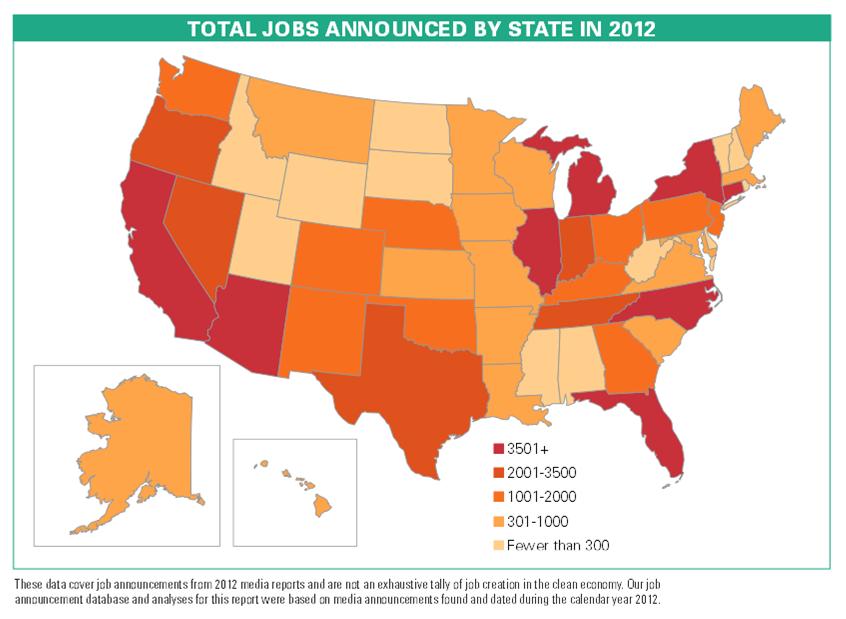
Connecticut ranked #5 in the U.S. for green job creation during 2012, according to a national business association compiling of media reports. Environmental Entrepreneurs, a New York City-based organization, ranked all 50 states for green job creation based on projects completed, in progress, or announced in 2012 and the estimated number of jobs created by those projects.  Nationwide, companies and communities announced more than 300 clean energy and clean transportation projects in 2012 that are expected to create 110,000 jobs, the report said.

Connecticut had four projects in 2012 expected to generate 4,958 jobs, the Hartford Business Journal noted in its reporting.  Those projects were the construction of the $97 million headquarters of North Haven construction parts manufacturer Sustainable Building Solutions; the opening of Scottish power company Renewable Resources in Stamford; the construction of the New Britain-to-Hartford busway; and the Plainfield Renewable Energy biomass plant.  The report indicated that Connecticut had 50 projects in progress.

Connecticut was the only New England state in the top 10. Leading the states was California with 25,354 jobs followed by Florida, North Carolina, Illinois, Connecticut, Arizona, New York, Michigan, Texas, and Oregon.map

As a region, the Southeast led the country in manufacturing-related clean energy job announcements, with more than 13,700 jobs announced last year, accounting for about 80 percent of the nation’s total. Solar, advanced vehicles and wind energy were the leading clean energy manufacturing industries in the Southeast.  Nationwide, clean transportation projects led the job growth last year, followed by clean power generation, manufacturing and energy efficiency projects.

The report was issued by Environmental Entrepreneurs (E2), described as “a national community of individual business leaders who advocate for good environmental policy while building economic prosperity.”

CT AARP Steps Up Focus on Entrepreneurs, Business Development

Next month, AARP and the U.S. Small Business Administration (SBA) are teaming up to host National Encore Entrepreneur Mentor Month, targeted at new business owners age 50 and over and those interested in starting a business.  The goal is to match these “encore entrepreneurs” with experienced business owners and community leaders for advice and assistance, and to link them to the resources they need to successfully start and grow their businesses and create jobs. Consistent with the organizations’ mission, the Connecticut AARP chapter views social enterprise as a valuable opportunity for age 50+ entrepreneurs – also known as “Encore Entrepreneurs” – and active retirees with sharp business and entrepreneurial acumen.  With one in four Americans ages 44 to 70 interested in becoming entrepreneurs, and a large majority planning to work during retirement, small business ownership is described as a solid option.

In addition to planned programs during April, the Connecticut AARP has announced support for legislation proposed by Governor Malloy’s (SB6356) which would help AARP members formalize their commitment to creating public good. The bill is designed to help address a variety of social concerns, through business rather than public funds or philanthropy, that are core to AARP’s mission, such as hunger, economic insecurity, housing and isolation.  AARP has ongoing partnerships with the U.S. Small Business Association (SBA), nationally and state-wide, and with co41592_130564031656_4369100_nmmunity partners in Connecticut including Social Enterprise Trust (reSET) and the Women’s Business Development Center (WBDC).

The bill before the legislature aims to help attract and keep social entrepreneurs and social enterprise investors in Connecticut and provides a heightened level of transparency and protection as compared to other states with similar legislation, according to AARP. Among the beneficiaries:  “Encore Entrepreneurs” seeking purpose beyond profit, community based organizations seeking to partner for social benefits, age 50+ workers seeking employment opportunities in a down economy, and the State by creating a new source of revenue through the payment of up-front incorporation filing fees and annual taxes.

National Encore Entrepreneur Mentor Month is part of a larger effort by AARP and SBA to promote entrepreneurship among individuals ages 50+.  It will consist of events across the country, including two in Connecticut, on April 16 in Waterbury and April 18 in Bridgeport, that will link individuals with local resources and mentor opportunities to help them successfully start and grow a small business.

The initiative includes AARP’s Work Reimagined, a unique new way for experienced workers to advance themselves in today’s tight job market.  Work Reimagined is a social network based jobs program that connects employers seeking experienced workers with qualified professionals searching for new or more satisfying careers.  The site, www.workreimagined.org, leverages the platform of professional networking site, LinkedIn, which is used by more than 15 million people aged 45-64.

AARP’s Work Reimagined and other resources for experienced workers over age 50 are slated to be highlighted in a segment on WTNH’s Connecticut Style program airing Wednesday, April 3, 2013 at 12:30 p.m.

The in-person AARP/SBA workshops in April will feature presentations by SBA, SCORE, reSET (Social Enterprise Trust), The Women’s Business Development Council (WBDC), People’s Bank and local economic development agencies.  Attendees will have the opportunity to ask questions and speak individually with representatives, as well as network with other small business owners and “would be” entrepreneurs. Registration is required.

April 16, 2013 in Waterbury   9 a.m. – 12 p.m. (noon)

Silas Branson Library, 267 Grand Street, Waterbury, CT

To register, call 1-877-926-8300 or register online

April 18, 2013 in Bridgeport   9 a.m. – 12 p.m. (noon)

City Hall Annex, 999 Broad Street, Bridgeport, CT

To register, call 1-877-926-8300 or register online.