12 Connecticut School Districts Named "Best Communities for Music Education"

Twelve Connecticut school districts have been named as being among the nation’s Best Communities for Music Education (BCME). The National Association of Music Merchants (NAMM) Foundation recognized 376 school districts across the country for exemplary music education programs. These districts and schools “set the bar in offering students access to comprehensive music education.”

The Connecticut school districts earning the recognition are: Avon, Canton, Cheshire, Glastonbury, Greenwich, Newington, Newtown, Southington, Torrington, West Hartford, Weston and Westport. school music

The BCME program applauds the efforts of teachers, administrators, parents, students and community leaders working to assure that music education is part of the core curriculum. More than 2000 schools and school districts participated in this year’s survey, according to the Foundation.

Now in its 15th year, the BCMbest music logoE program evaluates schools and districts based on funding, staffing of highly qualified teachers, commitment to standards, and access to music instruction. The NAMM Foundation with the assistance of researchers at The Institute for Educational Research and Public Service of Lawrence, Kansas (an affiliate of the University of Kansas) evaluate participants on these factors. Designations are made to districts and schools that demonstrate an exceptionally high commitment and greater access to music education.

“These schools and districts make a strong commitment to music education in the core curriculum supporting its essential value to a well-rounded education for every child,” said Mary Luehrsen, NAMM Foundation executive director.

A study published in 2007 by Christopher Johnson, professor of music education and music therapy at the University of Kansas, revealed that students in elementary schools with superior music education programs scored around 22 percent higher in English and 20 percent higher in math scores on standardized tests, compared to schools with low-quality music programs, regardless of socioeconomic disparities among the schools or school districts. Johnson compares the concentration that music training requires to the focus needed to perform well on a standardized test, according to an article published by the Public Broadcasting System.

Nina Kraus, a neuroscientist at Northwestern University and an author of a recent study that was published in The Journal of Neuroscience in November 2013, looked at 44 healthy adults ages 55 to 76, measuring electrical activity in a region of the brain that processes sound. The New York Times reported that they found that participants who had four to 14 years of musical training had faster responses to speech sounds than participants without any training — even though no one in the first group had played an instrument for about 40 years. sheet music

The BCME program is described as one of the NAMM Foundation’s foremost efforts to bolster support for school-based music education programs “that must be available for all children. Providing music education for all students is something any community can accomplish if it has the collective will to do so, regardless of size or affluence,” the organization points out.

The NAMM Foundation is a non-profit supported in part by the National Association of Music Merchants and its 9,000 members around the world. The NAMM Foundation works to advance active participation in music making across the lifespan by supporting scientific research, philanthropic giving and public service programs.

The full list of school districts is available on the NAMM Foundation website.


239 Towns in Connecticut Vie to Win State's "Fan Favorite" Tourism Contest

If you’re looking for your town on the drop down menu at the state’s tourism site as part of the second annual “fan favorite” contest, don’t be surprised if the list seems longer than you’d expect. The list of “towns” includes each and every one of the state’s 169 municipalities - plus 70 additional geographic entities that really aren’t towns at all. Some are familiar, many are not – except perhaps for the people who live or near their boundaries. Either way, they’re not towns or cities. Which could make it interesting as the votes are tallied.

Might “Woodstock” and “South Woodstock” divide the Woodstock vote? Or “Redding” and “Redding Ridge” the Redding vote? And where is Central Village, Oneco, Pine Meadow, or Quaker Hill? All are included on the list of towns.

That’s not even mentioning the back-to-back listings for “Barkhamstead” and “Barkhamsted” – presumably one is a misspelling, not a distinct geographic entity.monitor

Although the site asks for individuals to “vote for the town,” there are 239 choices available. Of course, after identifying a “town,” respondents need to indicate which “revolutionary place in town” has earned their vote for “fan favorite.”  No suggestions are offered there - entrants are on their own.

Voting opened earlier this month and continues on the agency's Facebook page through July 25. The winners will receive advertising and public relations support from the tourism office, and will also be featured in the 2015 Connecticut Visitor's Guide.fan favorite

The state’s tourism Facebook pages urges visitors to “Vote now for your chance to win a getaway to Niantic! The ZIP and ZEN prize package includes a four-night stay at the Inn at Harbor Hill Marina, $100 gift card to Grace boutique and a free all-day pass to Niantic Bay Bicycles.” Visitors are also asked to share a photo, presumably for posting on the state’s tourism web pages.

And if you’re wondering when it was founded – the state, not the Facebook page – the date listed is January 9, 1788.

The state’s tourism website, www.ctvisit.com, also provides a link to the contest, as well as the state’s visitors guide and a range of “52 getaways” and travel details and special offers. One can even sign up to be a “Connecticut Ambassador.” That web form does not include a drop down menu of towns – one simply just types in your town, without any suggestions or prompting.

Aging Bridges, Considerable Disrepair Are Significant Challenge in CT, Nationwide

It was in 1983 that three people died in Connecticut when a section of the Mianus River Bridge on Interstate-95 collapsed into the water below, and unsuspecting drivers drove off the end of the road in the middle of the Greenwich night. That tragedy launched a multi-million dollar infrastructure investment program in Connecticut, but now, three decades later, the age and condition of the state’s bridges is front and center again, as a poorly functioning, 118-year-old railroad bridge has disrupted commuter service on the nation’s busiest rail corridor by repeatedly refusing to close. Mianus River Bridge I95

The extent of the nation’s bridge-related challenge is daunting, and yet represents only a portion of the overall infrastructure needs. Less than a year ago, a study released by the American Society of Civil Engineers determined that:

  • over two hundred million trips are taken daily across deficient bridges in the nation’s 102 largest metropolitan regions
  • one in nine of the nation’s bridges are rated as structurally deficient,
  • the average age of the nation’s 607,380 bridges is currently 42 years.

The report also pointed out that “it is of growing concern that the bridges in our nation’s metropolitan areas, which are an indispensable link for both millions of commuters and freight on a daily basis, are decaying more rapidly than our rural bridges.”

bridgesCTOnce every four years, America’s civil engineers provide a comprehensive assessment of the nation’s major infrastructure categories in ASCE’s Report Card for America’s Infrastructure (Report Card). The most recent report was issued in 2013.

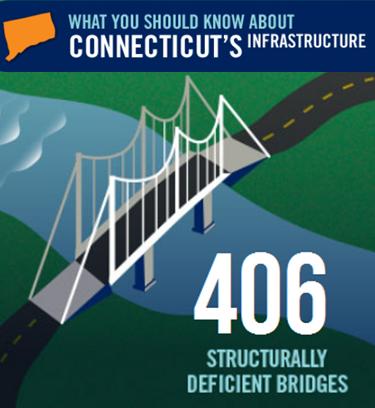
Connecticut, according to the data, has 406 of the state’s 4,208 bridges classified as structurally deficient and another 1,070 are considered to be functionally obsolete. The report also noted that Connecticut has 21,407 public road miles, and 73 percent of the state’s major roads are considered to be in poor or mediocre condition.

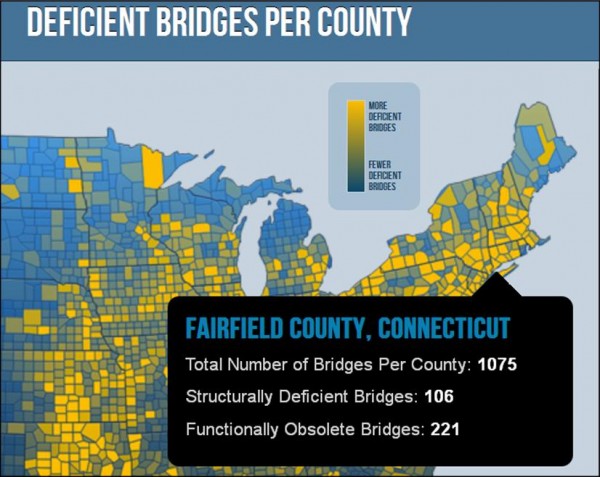
By county, the 406 structurally deficient bridges were: 106 in Fairfield County, 71 in Hartford County, 58 in New Haven County, 45 in New London County and Litchfield County, 27 in Middlesex County, 24 in Windham County and 14 in Tolland County. In addition, the report indicated that Connecticut had 1,023 functionally obsolete bridges in the state.

Structurally deficient bridges “require significant maintenance, rehabilitation, or replacement. These bridges, according to the report, “must be inspected at least every year since critical load-carrying elements were found to be in poor condition due to deterioration or damage.” Functionally obsolete bridges are those that “no longer meet the current standards that are used today. Examples are narrow lanes or low load-carrying capacity.” fairfield bridges

The Federal Highway Administration (FHWA) estimates that to eliminate the nation’s bridge deficient backlog by 2028, an investment of $20.5 billion annually would be needed, according to the report, while only $12.8 billion is being spent currently. The report stated that “the challenge for federal, state, and local governments is to increase bridge investments by $8 billion annually to address the identified $76 billion in needs for deficient bridges across the United States.”

The report indicated that 22 states have a higher percentage of structurally deficient bridges than the national average, while five states have more than 20% of their bridges defined as structurally deficient. Pennsylvania tops the list with 24.4%, while Iowa and Oklahoma are not far behind, each having just over 21% of their bridges classified as structurally deficient.

Overall, the nation’s grade for the condition of its bridges was C+, which was described as “mediocre” and in need of attention. “Some elements exhibit significant deficiencies in conditions and functionality, with increasing vulnerability to risk.” The 32-member Advisory Committee did not include any engineers from Connecticut, but did include two from Massachusetts and one from Maine, among the New England states.

Time magazine reported this week that the I-95 bridge over Delaware’s Christina River was quickly closed to all traffic on May 29, after “an engineer who happened to be working nearby noticed two of the span’s support pillars tilting.“ Officials hope to have the structure stabilized and reopened by Labor Day. The bridge had routinely handled about 90,000 vehicles per day.

The I-35W bridge over the Mississippi in Minneapolis collapsed during rush hour on August 1, 2007, plunging dozens of cars and their occupants into the river, killing 13 people and injuring 145. The bridge was Minnesota's fifth busiest, carrying 140,000 vehicles daily.asce-logo

The American Society of Civil Engineers, founded in 1852, is the country’s oldest national civil engineering organization. It represents more than 140,000 civil engineers in private practice, government, industry, and academia who are dedicated to advancing the science and profession of civil engineering. The first Report Card for America’s Infrastructure was issued in 1988.

Connecticut Students to Compete in National History Day Nationals in Maryland

Each year nearly 3,000 students and their parents and teachers from across the country gather at the University of Maryland - College Park for annual week-long finals of the National History Day competition. This year, 63 Connecticut students will be among them when the competition unfolds this week. After selecting a histori1389029213cal topic that relates to an annual theme, students conduct extensive research using libraries, archives, museums, and oral history interviews. Students analyze and interpret their findings, draw conclusions about their topic's significance in history, and create final projects that demonstrate their work.


National History Day is not a predetermined by-the-book program but an innovative curriculum framework in which students learn history by selecting topics of interest and launching into a year-long research project. NHD is a meaningful way for students to study historical issues, ideas, people and events by engaging in historical research.rights and respon

Following what organizers described as “tremendous participation” at this year's six regional district contests across Connecticut with over 4,000 students participating, and a culminating statewide competition at Central Connecticut State University in April, students in senior and junior divisions will be taking part in the 2014 Kenneth E. Behring National History Day Contest to be held June 15 – 19 in Maryland. (See list of 2014 State Contest Winners.)

Organizers also credited “an immense amount of support from sponsors, volunteer judges, staff and Connecticut legislators. The theme this year is Rights and Responsibilities.

History Day in Connecticut is a program for students in grades 6-12 that encourages exploration of local, state, national, and world historhistory day booky. Participating students come from all over the United States, Guam, American Samoa, Department of Defense Schools in Europe, and affiliates in China, Korea, and Jakarta.



More information about History Day in Connecticut, and the national competition, is posted at www.historydayct.org. In addition, WFSB-TV recently interviewed a Connecticut competitor. The national event at the University of MarylaGracend will be live streamed.

History Day in Connecticut is led by Connecticut's Old State House, with support from the Connecticut Historical Society, the Connecticut League of History Organizations and Connecticut Humanities' ConnecticutHistory.org website. Major funding is provided by Connecticut Humanities.


CPTV to Launch Third Season of Infinity Hall Live to National Audience, New Content-Rich Website

There was a time when Connecticut Public Television was most associated across the country with a purple dinosaur named Barney. Next it was the UConn women’s basketball team that became synonymous with CPTV. Now, a distinctive concert series has come to define the local network well beyond our state’s borders. Infinity Hall Live, the intimate concert series taped at historic Infinity Music Hall in Norfolk, returns in July to CPTV with a new season of five episodes. This season’s line-up includes: five-time Grammy-winning blues legends The Robert Cray Band, folk/pop artist Brett Dennen and his four-piece band, alt-country rockers Deer Tick, seven-time Grammy nominee singer-songwriter Joan Osborne and the band of brothers Los Lonely Boys. infinity

Co-produced by Connecticut Public Television (CPTV) and Infinity Music Hall, the third season of the series, airing on CPTV and public television stations across the country, features a lineup of diverse artists from a wide range of musical genres – rock, folk, blues and more – appealing to fans of every taste and generation.

Nationally, over 70 percent of public television stations nationwide have broadcast Infinity Hall Live, bringing fans from all over the country inside the cozy Victorian music hall. Major markets airing the new season beginning in July will include New York, Los Angeles, San Francisco, Boston, Washington DC, Phoenix, Portland, St. Louis, Cleveland and many more. A complete list of stations is available at www.pbs.org/tv_schedules/. Executive Producer is multiple regional Emmy Award winner Jennifer Boyd.

Known for its rustic style, the intimate 300-seat Infinity Hall, built in 1883, has a unique ability to offer fans a profound and personal way to not only enjoy their favorite artists’ songs, but also listen to interviews on their creative processes. In candid pre- and post-show interviews, the performers reflect on their motivations, their inspirations, and their unique style of songwriting and playing.

In addition to the new concert programming this season, Infinity Hall Live is offering a major relaunch of its website at www.ihlive.org. The website will feature more bonus content, a new design, extended interviews and videos not featured in the broadcast versions of the shows.

The new season of five episodes will be combined with 22 concerts from the previous two seasons of Infinity Hall Live and released online over the coming year for on-demand video streaming.

Every two weeks, a new concert will be released on the Infinity Hall Live website, www.ihlive.orginfinity hall website, for a limited time. The full programs will also be available for streaming online on PBS Video (http://video.pbs.org/program/infinity-hall-live/)and on TVs and mobile devices through the PBS apps for iOS (iPhone and iPad), Apple TV, Kindle Fire, Roku and Xbox.

Connecticut Public Television is one of the top presenting stations of public television programming in the U.S., with over two decades of experience producing programs that inform, educate, entertain and inspire – including a strong reputation and track record as a leader in performance programming


With Hockey History, North Carolina and Connecticut Look to Baseball, Attendance Growth

North Carolina and Connecticut – two states forever linked in the cross-currents of sports by the Hartford Whalers relocation to the Tarheel State in 1997, are both using 2014 to heighten their professional baseball credentials. The City of Hartford has announced that the Double A franchise currently in New Britain will be moving to the Capitol City in 2016 in a soon-to-be-built $60 million, nearly 10,000 seat stadium. Just two months ago, the Triple A Charlotte Knights opened their newly constructed 10,200 seat $55 million downtown stadium. The Knights are an affiliate of the Chicago White Sox. Ground was broken on the new stadium in September 2012, about an 18 month construction schedule.

BB_T_Ballpark_media_7suaxdjb_lv2jd5cuThe first Knights game took place on April 11, 2014. (photo at left) The stadium features a two-level club with skyline views as well as a VIP, climate-controlled club with full service bar. In addition to corporate suites, there are 987 club seats at the new Charlotte stadium. Of those, 170 on the upper level sell for $41.50 per game, or nearly $3,000 per season. The remaining 817 club seats, at $21 per game, sell for about $1,500 annually.  All of the club seats were sold out 10 months prior to the season opener, according to the Knights website.  Season tickets require either a two- or four-year commitment. Naming rights to the stadium were sold to BB&T Corporation in 2012. Published reports also indicate that multiple new hotels are expected to open in the area around the stadium in the coming years, along with restaurants and retail.

The Charlotte team’s website reports that “National ballpark consultants conservatively estimate that in its first year BB&T Ballpark should draw at least 600,000 fans just for baseball.” In addition to obtaining corporate sponsorships, among the fundraising initiatives along the way in Charlotte were commemorative bricks sold to be placed in the stadium’s entrance, at a cost of between $90 to $195, containing individual messages determined by purchasers. A portion of the sales went to local charities in Charlotte.

Comparing Attendance Numbers, Possibilities

The Rock Cats drew more than 307,000 fans to their 6,100-seat stadium in New Britain last year, ranking sixth in the 12-team Eastern League. The Knights were last in attendance in the Class AAA International League last year, with an average of 3,803 per game, down from a high of 4,736 in 2006, according to the Charlotte News Observer. In 2013, the New Britain Rock Cats averaged 4,653 fans per game, which ranked 59th among baseball’s minor league teams. Charlotte ranked 80th. The top team in the league - and in minor league baseball - the Columbus Clippers, drew 9,212 per game.

Knights website

The AAA Pawtucket Red Sox average attendance in 2013 was 7,827, ranked #10 in minor league baseball. The Double-A Portland Sea Dogs, also a Red Sox affiliate, ranked 47th, drawing an average of 5,096 per game. Among Double-A teams, Portland ranks tenth.

The top minor league teams, based on average attendance in 2013, are in Columbus, Lehigh Valley, Indianapolis, Sacramento, Dayton, Buffalo, Louisville, Round Rock (Texas) and Albuquerque. The top Double-A teams are in Frisco, TX (7,057); Richmond, VA (6,689); Reading, PA (6,321); Tulsa, OK (5,704); Birmingham, AL (5,669); Corpus Christi, TX (5,498); Trenton, NJ (5,373) and New Hampshire (5,125).

On July 12, 2008, the Rock Cats established a franchise record for single game attendance, with a crowd of 8,115 at New Britain Stadium. The record was broken on June 27, 2009, with a crowd of 8,212. The Rock Cats reached the 8,000 mark once again on May 31, 2014 with a crowd of 8,079.

For those who wonder if there is a Triple A future for a Hartford baseball stadium, the history of Pawtucket may be of interest. The first team to be named the Pawtucket Red Sox debuted in 1970 as a member of the Double-A Eastern League, according to Wikipedia. After three seasons as a Double-A Red Sox affiliate, Pawtucket's Eastern League franchise moved to Bristol, CT in 1973 to make room for the new Triple-A PawSox. And as most Connecticut sports fans recall, the Bristol franchise then moved to New Britain in 1983, first as a Red Sox Double-A affiliate (through 1994) and then as the farm team of the Minnesota Twins.IMG_6669

And might the presence of a stadium in Hartford, rather than New Britain, cause the Red Sox to return with an affiliate in Connecticut? Apparently not any time soon. The Sox appear set in Pawtucket and Portland.

In January 2013, the Portland Sea Dogs announced an extension of their affiliation with the Boston Red Sox as the Double A minor league team. Their contract was set to end after the 2014 season but the extension through the 2018 season was announced during the Portland Sea Dogs Hot Stove Banquet by Red Sox director of player development Mike Hazen and Sea Dogs president Charlie Eshbach. Eshbach served as Eastern League President for 11 years and is the league's longest serving active member  – dating back to his tenure as general manager of the Bristol Red Sox in Connecticut, not too many years after attending college at UConn.

“We are delighted to extend our relationship with the Portland Sea Dogs for an additional two seasons,” said Hazen at the time. “We are extremely fortunate to work with some of the best people in minor league baseball in Portland. The Burke family, Charlie Eshbach, and the entire Sea Dogs organization always go above and beyond to provide support to our players and staff. With the Sea Dogs, our minor leaguers experience the ideal environment to succeed and grow.”

The Sea Dogs are now in their 21st season at Hadlock Field, their 12th as an affiliate of the Boston Red Sox. The Red Sox originally entered into an agreement with the Sea Dogs following the 2002 season, when Portland changed affiliations from the Florida Marlins.

 (photo credit: Rob Kavaler)

rankings

CT Teacher Shortage Areas Identified For Next School Year

If you’re looking to pursue teaching in Connecticut schools, the State Department of Education (SDE) provides a road map of where the demand is likely to be greatest. SDE has announced the Certification Shortage Areas for 2014-15 for Connecticut schools, and virtually all reflect continued areas of shortage – with only one new entry on the list. The subjects identified are:Teacher-Classroom-Bing

  1. world languages, 7-12;
  2. bilingual education, PK-12;
  3. school library and media specialist;
  4. speech and language pathologist;
  5. technology education, PK-12;
  6. comprehensive special education, K-12;
  7. science, 7-12;
  8. Teachers of English to Speakers of Other Languages, PK-12;
  9. intermediate administrator;
  10. mathematics, 7-12;

Each year in the fall, SDE surveys certified educational positions to determine the number of teaching and administrative vacancies that existed before the state of the school year, and the vacancies that remained after the start of school. Results from the survey are used to determine the shortage areas for the following school year – in this case, for 2014-15. Nine of the 10 shortage areas identified for 2014-15 were also shortage areas in the previous year. TESOL (Teachers of English to Speakers of Other Languages), PK-12 will be the only new shortage area in the 2014-15 school year.

The shortages may get worse before they get better.

The SDE report also indicated that 18.2 percent of all certified staff who were employed as of October 2013 are eligible for retirement. Over the next five years, the report indicated, “this percentage will increase to 26.9 percent. It is significant that a number of the shortage areas also have particularly high percentages of teachers who will be eligible for retirement over the next five years.”

The survey noted that 61 percent of positions that remained vacant on October 1 were due to the lack of qualified candidates, a level that is unchanged from the previous year. The most frequent reason cited for not identifying a qualified candidate was “late postings that affected the size and quality of the applicant pool.”

The Data Bulletin that detailed the survey findings was developed by the Performance Office of the Bureau of Data Collection, Research and Evaluation within SDE.

Hartford’s Health & Fitness Ranks #12 Among Nation’s Top 50 Metro Regions

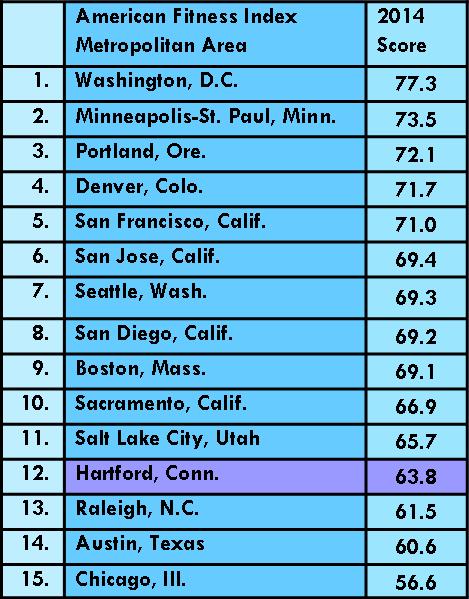
Apparently, Hartford is in better shape than many of us may have thought. In fact, a national analysis by the American College of Sports Medicine (ACSM), with support from the Anthem Blue Cross and Blue Shield Foundation, ranks the metropolitan statistical area (MSA) of Hartford-West Hartford-East Hartford as 12th in the nation in the annual American Fitness Index™ (AFI) report. The 2014 AFI data report, “Health and Community Fitness Status of the 50 Largest Metropolitan Areas,” reflects a composite of preventive health behaviors, levels of chronic disease conditions, and community resources and policies that support physical activity.

In the 2014 report metropolitan Hartford received a score of 63.8 (out of 100 possible points) to earn the overall #12 ranking. Hartford ranked #7 in Community Health and #17 in Personal Health, according to the data analysis.logo

Leading thwalkinge rankings is the Washington, D.C., metro area with a score of 77.3, followed by Minneapolis-St. Paul, Portland, Denver, San Francisco, San Jose, Seattle, San Diego, Boston Sacramento and Salt Lake City.
Researchers analyzed the data from the U.S. Census, the U.S. Centers for Disease Control and Prevention’s Behavioral Risk Factor Surveillance System (BRFSS), The Trust for the Public Land City Park Facts and other existing research data in order to give a scientific, accurate snapshot of the health and fitness status at a metropolitan level.

The data regarding Hartford-Westfitness chart Hartford-East Hartford indicate that 78 percent engaged in physical activity or exercise within the past 30 days, 35 percent eat two pieces of fruit per day, and 14 percent eat 3 or more vegetables per day. Just over 15 percent of the population are smokers. Overall, 60 percent are described as being in “excellent or very good health,” although 36 percent indicate they had days when their “mental health was not good” during the past month.

Among the “areas of excellence” cited for Hartford-West Hartford-East Hartford are a higher percent bicycling or walking to work, more farmers’ markets per capita, more golf courses and tennis courts per capita and a higher percent eating two or more fruits per day.

ACSM worked with the Indiana University School of Family Medicine and a panel of 26 health and physical activity experts on the methodology of the AFI data report. The 2014 edition uses revised methods from the first six full-edition reports released from 2008 to 2013.

New variables, including each community’s Walk Score ranking, have been added or modified and some variables have been removed to improve and enhance the 2014 data report.

“The AFI data report is a snapshot of the state of health in the community and an evaluation of the infrastructure, community assets and policies that encourage healthy and fit lifestyles. These measures directly affect quality of life in our country’s urban areas,” said Walter Thompson, Ph.D., FACSM, chair of the AFI Advisory Board.

The American College of Sports Medicine is the largest sports medicine and exercise science organization in the world. More than 50,000 international, national and regional members are dedicated to advancing and integrating scientific research to provide educational and practical applications of exercise science and sports medicine.

Higher Percentage of Part-time Workers in CT Than New York, New Jersey, Lower Than New England

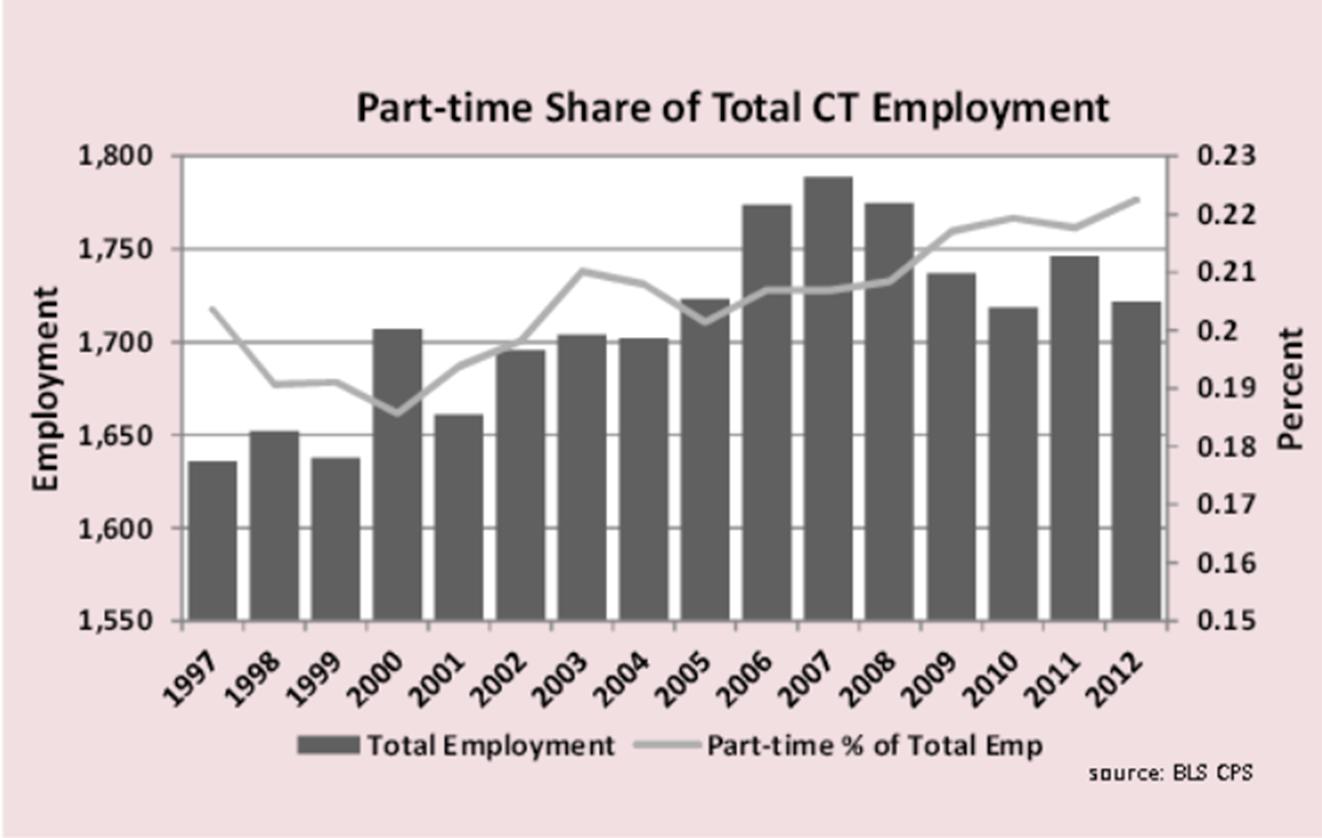
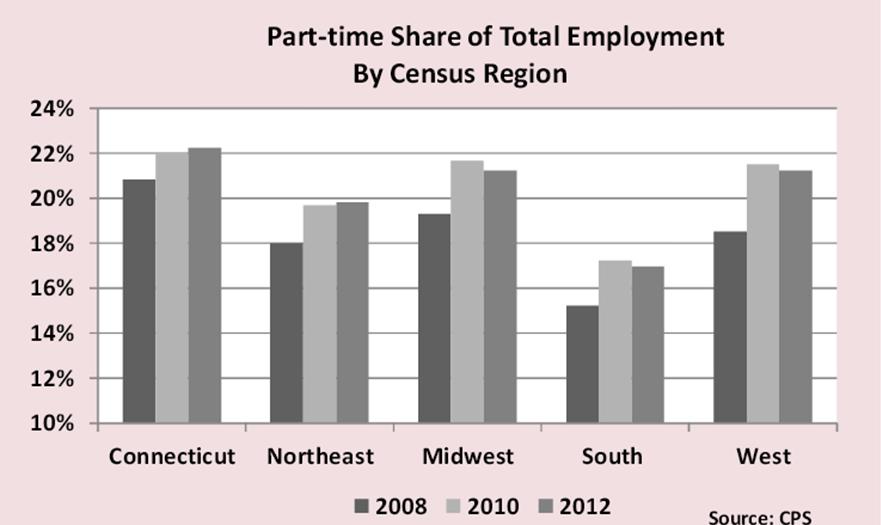
Connecticut's percentage of part-time workers (22.2 percent) outpaces much of the Northeast, South, Midwest and West, according to the latest Connecticut Economic Digest (CED), produced by the state Department of Labor and Department of Economic and Community Development. In the first examination of part-time employment in more than a decade, the publication noted that part-time employment in Connecticut numbered 383,000 - 69.5 percent of which (266,000) was women. This statewide share is among the highest in the country, which had a 50-state average of 64 percent.

part time chartConnecticut’s part-time employment share of 22.2 percent is the lowest in New England but considerably greater than neighboring states in the tri-state area, which have employment shares respectively of 17.6 percent (New York) and 17.9 percent (New Jersey), the analysis by the state Department of Labor indicated.

Part-time employment is all employment that amounts to less than 35 hours per week. Since 1997 it has averaged about 20 percent of total employment in Connecticut and fell to 18.6 percent in 2000, according to the CED, before climbing.

In recent years it has gradually trended upward and was 22.2 percent of employment in 2012, the most recent year of annual average datCEDa and the basis for the analysis. The breakdown of hours worked shows that Connecticut has less under 35 hours per week employment than other New England states but more than the Northeast region overall. Part-time employment was 23.3% of all New England employment in 2012, higher than any other census division in the country. The other eight census divisions averaged 19.3% with the West- South Central division lowest at 16.4%.
While those choosing to work part time remain the bulk of part-time workers, the number of those working less than full time has grown since 2005 as more workers have their hours cut by employers or were unable to find full-time jobs during or after the recession. From 2009 to 2011, the number of workers who wanted full-time employment but could only find part-time jobs rose 37.5 percent to 33,000 from 24,000, Hartford Business Journal reported. part time 2

The report points out, however, that a majority of part-time employment in Connecticut is due to voluntary reasons, and not a result of prevailing economic conditions. In 2012, voluntary part-time employment in Connecticut was 76.4 percent of all part-time employment, in line with the 50-state average of 76.8 percent.

The industries with the lowest average weekly hours worked are leisure and hospitality, other services, and education and health services. In 2013, these industries averaged 25.8, 30.9, and 31.2 work hours per week, according to the Connecticut Economic Digest report issued in May.


More Bicycling, Walking to Work; New Haven Leads the Way in Connecticut

Connecticut has the smallest percentage of people walking to work among states in the Northeast, and is one of two states with the smallest percentage of people who bicycle to work, according to newly released U.S. Census data.  Nationwide, both walking and bicycling to work are on the rise. Between 2000 and 2008–2012, the number of workers in the U.S. who traveled to work by bicycle increased by 60.8 percent, from about 488,000 in 2000 to about 786,000. This increase in the number of bicycle commuters exceeded the percentage increase of all other travel modes during that period, but the overall share of workers who commute bnew haveny bicycle remains low, according to the U.S. Census American Community Survey. In 1980, 0.5 percent of workers commuted by bicycle. This rate dropped to 0.4 percent in 1990, where it remained in 2000, before nudging upward in the latest survey.

The 2008–2012 5-year data show that, among the approximately 140 million workers in the United States during that period, 2.8 percent walked to work and 0.6 percent commuted by bicycle, compared with 86.2 percent of workers who drove alone or carpooled to work.

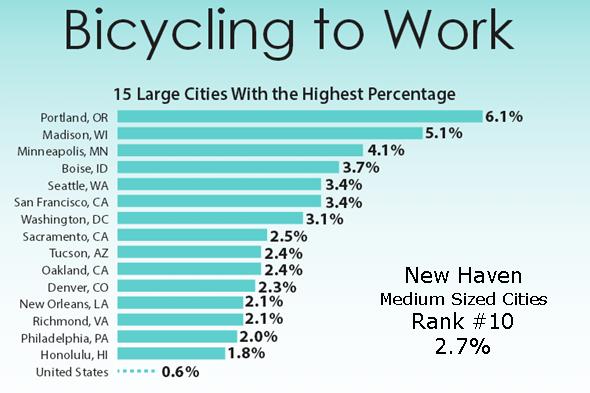
walk toAmong the nation’s medium sized-cities, (with pbike to workopulations between 100,000 and 199,999) New Haven ranks at #5 with 12.4 percent walking to work and at #10 with 2.7 percent of the population using bicycles to get to work. Hartford ranks at #10 among the top walk-to-work medium sized cities with 8.2 percent, and did not reach the top 15 in bicyclists.

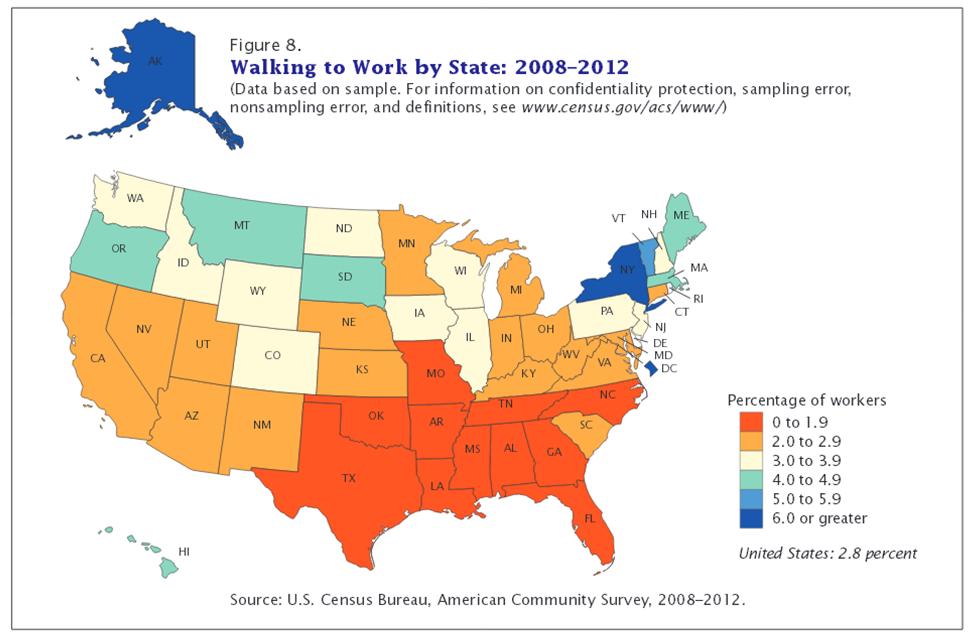
The top medium-sized cities for percent of the population walking to work were Cambridge, Berkley, Ann Arbor, and Provo, just ahead of New Haven. The top bicycle-to-work medium sized cities were Boulder, Eugene, Berkeley, Cambridge, and Fort Collins.

The nation’s #1 walk-to-work city is Boston (15.1 percent) followed by Washington, Pittsburgh, New York, San Francisco and Madison. For bicycling to work, the top cities are Portland (6.1 percent), Madison, Minneapolis, Boise and Seattle.

The nationwide data indicates that:

  • The combined rate of bicycle commuting for the 50 largest U.S. cities increased from 0.6 percent in 2000 to 1.0 percent in 2008–2012.
  • The Northeast showed the highest rate of walking to work at 4.7 percent of workers, while the West had the highest rate of biking to work at 1.1 percent. The South had the lowest rate of biking and walking to work.
  • Younger workers, those aged 16 to 24, had the highest rate of walking to work at 6.8 percent.
  • At 0.8 percent, the rate of bicycle commuting for men was more than double that of women at 0.3 percent.

The percentage of workers age 16 and over who carpool to work is below 10 percent in each of Connecticut’s eight counties, with the exception of Windham County, at 10.5 percent.

Fairfield County has longest commute, most use of mass transit

The walk to workaverage commute to work in Connecticut is about 25 minutes, ranging from 28 minutes in Fairfield County, 27 minutes in Litchfield County, 26 minutes in Windham County, 25 minutes in Middlesex County and Tolland County, to 24 minutes in New Haven County, 23 minutes in New London County, and 22 minutes in Hartford County.


The highest percentage of workers using public transportation to reach their place of employment each day is in Fairfield County, at 8.9 percent, more than double the percentage of the next highest county, New Haven County, at 4.1 percent.

The Census Bureau released a new commuting edition of the interactive map Census Explorer, which gives Web visitors easy click-and-zoom access to commuting statistics for every neighborhood in the U.S. It also shows how commuting has changed since 1990 at the neighborhood, county and state level — including how long it takes to get to work, commutes longer than an hour, and number of bikers. It uses statistics from the American Community Survey, the national source of commuting statistics down to the neighborhood level.