Population Growth Through 2025 Driven by New Haven, Hartford, Fairfield Counties

Connecticut’s population, which was just under 3.3 million in 1990 and just over 3.5 million two decades later, is projected to exceed 3.7 million by 2025, according to Connecticut Population Projections featured on the University of Connecticut’s Connecticut State Data Center website.CT Map The interactive site provides a breakdown of projections for each of the state’s eight counties – and all are expected to grow during the next dozen years.  The most dramatic growth is anticipated in New Haven County, which is seen to exceed 900,000 residents for the first time by 2025.  The state population is predicted to increase by slightly more than 100,000 residents between 2015 and 2025.

Overall, the state’s population is expected to reach 3.66 million by 2015 and grow to 3.74 million by 2025.  Litchfield County will likely see the slowest growth, with less than an additional 1,000 residents anticipated over the decade.  Middlesex County is expected to grow by about 2,000 residents; Tolland County by nearly 5,000.  Windham County is expected to grow at twice the rate of New London County, as both are anticipating adding between 6,000 and 7,000 residents, although New London County has more than twice the population.

Here’s the breakdown by county of the projections:

County                   2015                       2025                       Projected growth

Fairfield                 932,378                 954,479                 22,101

Hartford                 910,921                 936,811                 25,890

New Haven            881,371                 912,057                 30,686

New London         279,756                 285,773                 6,017

Litchfield               192,189                 193,113                  924

Middlesex             168,834                 170,976                  2,142

Tolland                   155,924                 160,760                  4,836

Windham               122,719                 129,526                   6,807

Connecticut          3,644,546              3,746,184              101,638

The ranking of the state’s eight counties by population is not expected to change:  Fairfield, Hartford, New Haven, New London, Litchfield, Middlesex, Tolland, and Windham.

The Connecticut State Data Center provides population projections to assist state agencies, non-profit organizations, businesses, governments, and centers/organizations to identify potential population changes into the future. These projections are created based upon several datasets and while these estimates are developed based on multiple data sources, actual population changes may vary from these projections.

Charter Oak Cultural Center Sees Opportunity in Dollar-for-Dollar Match

For those familiar with the remarkable work of the Charter Oak Cultural Center, time is running out on a unique opportunity to support the dynamic organization’s exceptional community initiatives.  An anonymous donor has agreed to match contributions made to support the work of Charter Oak, dollar for dollar, up to $100,000 - through the end of this month. That means every contribution made by January 31 will be doubled.  For an organization that is brimming with distinctive and impactful programming ideas but often scrambling for sufficient resources, it is a chance to see more dreams become reality.

Charter Oak Cultural Center, a magnificent and historic landmark and vibrant arts center on Charter Oak Avenue just off Main Street in Hartford, contributes to the revitalization of the city by bringing the community together through open and equal COCCaccess to the arts, through a deep commitment to social justice. The three main goals that characterize the organization’s mission are:

  • To provide wide access to the arts for all who wish to engage in them, regardless of income
  • To do the work of social justice through the arts
  • To celebrate the heritage of our historic building and to preserve it in perpetuity.

To realize that mission, Charter Oak provides over 1,000 underserved Hartford children with free, sophisticated arts classes and regularly makes professional performances – dance, theatre, concerts – and film and visual arts exhibits accessible to all.  In addition, Charter Oak recently started Connecticut’s first “street paper,” a newspaper written by people who are or were homeless. They’ve also introduced other educational and employment opportunities for those without homes. Their Youth Art Institute has been selected as a finalist by the President’s Committee on the Arts and Humanities, distinguishing it as one of the top arts and humanities-based youth programs in the country.

Charter Oak is seeking public support to allow them to take full advantage of what they’ve described as an “incredible offer” and “huge opportunity.”  Interested individuals can make a secure gift online, or mail a check to Charter Oak Cultural Center, 21 Charter Oak Avenue, Hartford, CT 06106.

There is more information about Charter Oak’s programming, which falls into four main categories, on the organization’s website.  The programs areas include:

  • Youth Arts Institute:   Reaches nearly 1,000 of Hartford’s inner-city children, ages 6 through 18, with arts and literacy-based classes held after-school, during-school, and in the summer, as well as evening programs for families.  The classes, along with nutritious meals and snacks, are provided free of charge. The youth programming successfully integrates the arts with academic subjects and assessments show that on average, participating students show a 54% improvement over the course of the semester in their ability to meet the state’s Arts K-12 Goals and Standards.
  • Professional Programming: Charter Oak hosts cutting-edge, thought-provoking visual and performing arts exhibitions and performances. As a matter of policy, they offer as many performances and events as possible for free, keep prices low and never turn anyone away who cannot afford the price of a ticket.  In the course of a year, they present over 100 professional events that include every variety of performing art—dance, film, theatre, concerts and more.  In two on-site galleries, both emerging and established artists from various cultural backgrounds exhibit their work.
  • Social Justice Programming: Charter Oak offers a number of programs that focus on social justice and equality- raising awareness about important issues and/or serving individuals in need- all through the lens of the arts.  For example, Charter Oak Cultural Center developed and launched Connecticut’s first “street paper,” entitled Beat of the Street, designed and sold by individuals experiencing homelessness.
  • Historic Preservation: When it was built in 1876, the temple on Charter Oak Avenue became the first building in Connecticut’s history to be constructed specifically as a synagogue.  Today, as the home of the Charter Oak Cultural Center, it is a vibrant hub for the community that provides programming for thousands of Hartford and Greater Hartford students, families and individuals each year.  The historic landmark is maintained and preserved as a vibrant resource for the community.

Learn more at www.charteroakcenter.org or 860.249.1207.


Three Cities Selected for Program to Bring Housing Downtown

Connecticut Main Street Center (CMSC) has selected Middletown, Torrington and Waterbury for its new pilot program, Come Home to Downtown. CMSC developed the mixed-use real estate planning pilot program to provide selected communities with new tools to strengthen economic health and restore vitality to their downtowns, facilitating the development of viable, interesting housing opportunities while improving downtown neighborhoods. The goal of the Come Home to Downtown program is to set the stage to attract developers and “mom and pop” building owners to redevelop vacant or underutilized buildings with a mix of uses and housing choices. CMSC will also provide local public and private champions and partners with strategic tools to aldowntownlow them to create or enhance a strong downtown management program.  The Come Home to Downtown pilot was created in partnership with the Connecticut Housing Finance Authority (CHFA), through a $250,000 investment using Community Investment Act (CIA) Program funding.

“Our Come Home to Downtown pilot communities were selected based on criteria we feel is vital for success, including local public and private sector leadership, a strong record of community engagement, success of previous downtown revitalization initiatives and multi-story buildings and property owners who are motivated to redevelop them,” said CMSC’s John Simone.

CMSC will work in concert with Middletown, Torrington and Waterbury, beginning with the collection of data, building analysis and the coordination of community engagement activities, exploring their downtown redevelopment issues in-depth and creating new strategies that respond to changing demographics and market dynamics.  Work will continue throughout the summer on consensus buiphoto_center_01lding, a downtown development audit for each of the towns, model building analysis, assistance to small-property owners who demonstrate a desire to redevelop their properties to include housing, and downtown management organizational development.

Connecticut Main Street Center is a statewide nonprofit that inspires great Connecticut downtowns, Main Street by Main Street. Its mission is to be the champion and leading resource for vibrant and sustainable Main Streets as foundations for healthy communities.

UConn Accounting Master’s Program Ranked in Nation's Top 10

The University of Connecticut is getting high marks for its online master’s degree in accounting, earning a spot in the top 10 nationwide among online business programs ranked by U.S. News & World Report. UConn’s program, run by the School of Business, was ranked No. 8 among 213 online graduate business degree programs that the publication’s editors reviewed at colleges and universities nationwide. UConn’s online master’s of science degree in accounting (MSA) received particularly high scores for the credentials and training of its faculty, along with factors that measure student engagement such as retention, selectivity, graduation rates, and class sizes.

U.S. News also praised the program last year in a broader review of online business school learning initiatives, though it did not issue overall rankings then. The rankings were released this month.

According to the U.S. Bureau of Labor Statistics, jobs for accountants and auditors are expected to grow by 16 percent between 2010 and 2020.  The U.S. Department of Labor agency reports that “Stricter laws and regulations, particularly in the financial sector, will likely increase the demand for accounting services as organizations seek to comply with new standards. Additionally, tighter lending standards are expected to increase the importance of audits, as this is a key way for organizations to demonstrate their creditworthiness.”

The UConn program is designed to give students the knowledge they need for successful careers in public and private accounting, allowing current CPAs to expand their skill set and helping aspiring accountants meet the 150-hour educational requirement to seek CPA testing and licensing in most states.

“There are exciting innovations planned for the next year to continue keeping the MSA on the cutting edge. New tools will increase interaction and continue to develop strong online community ties,” says Amy Dunbar, the MSA program’s faculty director and an associate professor of accounting.accounting

UConn’s MSA program started in 1999 and transitioned to a completely online program in 2003. It’s particularly popular with working professionals who want to boost their careers with advanced credentials. The average age of new entrants is about 28 years old, and the student body is split almost evenly between men and women.

New full-time students attend a one-week class in May at the Storrs campus to become familiar with the program, technology, instructors, and each other. They then take courses online during the following summer, winter, and spring semesters to complete the program’s requirements.

The course content is delivered through course-specific websites on a School of Business server. As a result, the activities do not have to take place at the same time for all students. That gives students flexibility to finish their work on their own timeframes, as long as it is completed by the assignment’s deadline. There are also several part-time options, including completing the degree over two summers or taking 10 courses over multiple semesters.

Recently, Robert Half, the world's first and largest specialized financial recruitment service, projected accounting salaries would grow 3.3 percent in 2013, while technology salaries will grow approximately 5.3 percent.

The UConn program has been recognized by the United States Distance Learning Association for best practices in the field, and it is accredited by the Association to Advance Collegiate Schools of Business (AACSB).


Connecticut Has 4th Highest Costs for Residents of Assisted-Living Facilities

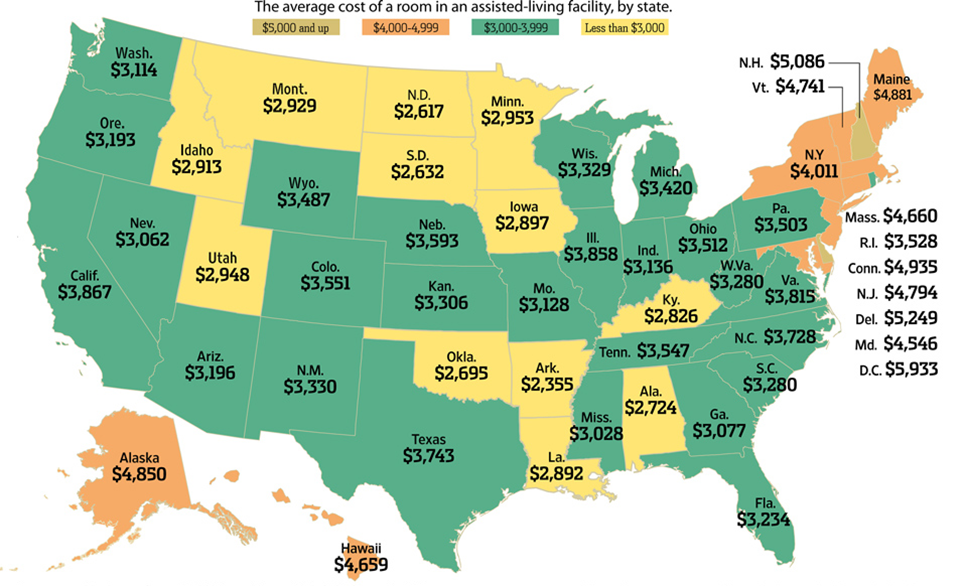
The average monthly cost of a room in an assisted-living facility is higher in Connecticut than in 48 states.  Only Delaware, New Hampshire and the District of Columbia, on average, have higher rates than the Land of Steady Habits. The top twelve, as reported by the Wall Street Journal:

  1. District of Columbia         $5,933
  2. Delaware                             $5,249
  3. New Hampshire                $5,086
  4. Connecticut                        $4,935
  5. Maine                                   $4,881
  6. Alaska                                   $4,850
  7. New Jersey                        $4,794
  8. Vermont                              $4,741
  9. Massachusetts                  $4,660
  10. Hawaii                                   $4,659
  11. Maryland                             $4,546
  12. New York                            $4,011

The data reported in the WSJ was compiled by the MetLife Mature Market Institute, based on a survey of nearly 6,700 long-term care providers nationwide. At the other end of the spectrum, 12 states had average monthly costs that were below $3,000.  Lowest rate?  Arkansas at $2,355 – less than half that of the eight most costly states, including Connecticut.


map assisted living


CT Dog Ownership Ranks 49th in the USA; More Cats than Dogs in State

Cats – not dogs – are reigning in Connecticut.  The state ranks a lowly 49th in dog ownership and 23rd in cat ownership, according to a new survey. The data revealed that 28.3 percent of households in the state own a dog, 31.9 percent own a cat, and 54.4 percent own a pet, slightly below the national average. The state is middle-of-the-pack for overall pet ownership - ranking 34th in the country, as reflected in newly released statistics from The American Veterinary Medical Association (AVMA) in its U.S. Pet Ownership & Demographics Sourcebook.  The survey indicated that 379,000 Connecticut households own at least one dog, while 427,000 own at least one cat.   The number of cats in Connecticut exceed the number of dogs by 289,000 (796,000 to 507,000).

The survey is conducted by the AVMA every five years and includes a breakdown of pet ownership by state. The most recent survey, conducted in 2012 based on December 31, 2011 numbers, indicates that nationally between 2006 and 2011:

  • the percentage of households that made no trips at all to the veterinarian increased by 8 percent for dog owners and a staggering 24 percent for cat owners. pet book
  • about 81 percent of dog owning households made at least one visit to the veterinarian in 2011, down 1.7 percent from 2006.
  • the decrease for cat owners was, once again, much higher, as only 55.1 percent of cat owners made at least one visit to the veterinarian in 2011, down 13.5 percent from 2006.

Connecticut’s dog ownership levels lagged in the 2006 survey was well, when the state ranked 47th.  The only state to rank in the top ten for cats and dogs in the latest survey was West Virginia, which ranked #5 in dogs and #6 in cat ownership.  The number one state for pet ownership, Vermont, also led the way in cat ownership.  Nearly half the households in the state – 49.5 percent – own a cat, according to the survey.  Vermont is the only state to exceed 70 percent in overall pet ownership, with 70.8 percent.

National statistics reflect the affection for, and costs of, having a pet:

  • Six out-of-ten pet owners, or 63.2 percent, considered their pets to be family members.
  • There are approximately 70 million pet dogs in the U.S. and 74.1 million pet cats.
  • The average veterinary expenditure per household for all pets was $375 (for 2011).

When it comes to veterinary visits, cats are feeling the pinch of the nation's economic downturn. Although 75 percent of cat owners believe check-ups are important, the number of households taking their cat to the veterinarian just once a year has dropped 13.5% in the past five years.  Of those surveyed, 22 percent said they didn’t take their cat to the vet because they couldn’t afford to do so.  Close to 30 percent of dog owners who didn’t take their dog to the vet in 2011 cited the same reason.

For more information about the AVMA or to obtain a copy of the U.S. Pet Ownership and Demographics Sourcebook, visit www.avma.org. To learn more about Dog Owners vs. Cat Owners, check out the infographic at topreveal.com 

Volunteering in Connecticut Above Average, But Declining

The percentage of Connecticut residents who volunteer has dropped slightly, but the state remains above the national average, ranking 22nd among the states.  The data, compiled by The Corporation for National and Community Service (CNCS) is the most comprehensive annual collection of information on volunteering and civic life in America, reflecting nation’s civic health. The National Conference on Citizenship is a partner on the project. The 2012 Volunteering and Civic Life in America report and website provide information allowing civic leaders, nonprofit organizations,and interested individuals to retrieve a wide range of information regardingdemographic trends and rankings for volunteering and civic engagement activities intheir regions, states, and metro areas.  The 2012 report is based upon data collected in 2011.  Overall, in Connecticut:

  • 28.5% of residents volunteer, ranking the state 22nd among the 50 states and Washington, DC.  That’s a drop from 31.1% and a #15 ranking the previous year
  • 793,710 volunteers.
  • 81.7 million hours of service.
  • $1.8 billion of service contributed.
  • 29.3 volunteer hours per resident.

The report also noted that 72.8% of Connecticut residents do favors for their neighbors, 88.8% eat dinner with their family a few times a week or more, and 53.3% discuss politics a few times a month or more.  In a generational breakdown,

  • Young adult volunteer rate ranked #16 (26.3%)
  • College age ranked #24 (27.8%) state_CT_129___2011
  • Older adults ranked #14 (29%)
  • Gen X ranked #23 (32%)

Among major cities, Hartford ranked #27 (just behind Boston at #26) in 2011, down from #15 in 2010.  (From 29.8% to 26.9%.)  The top three cities were Minneapolis-St.Paul, Rochester (NY), and Seattle.  The national volunteer rate was 26.8 percent.  Top states were Utah (40.9%), Idaho (38.8%) and Iowa (38.4%)  At the bottom were New York (20.7% ) and Louisiana (19.4%).

Nationwide, the number of volunteers reached its highest level in five years, as 64.3 million Americans  state_CT_113___2011 volunteered through an organization, an increase of 1.5 million from 2010.  Americans volunteered a total of almost 8 billion hours, an estimated economic value of roughly $171 billion.  A majority of Americans assisted their neighbors in some way and more than a third actively participated in a civic, religious, or school group.

The report also found that parents of school-aged children contributed more than 2.5 billion hours of their time to volunteer efforts nationwide in 2011, most of it to school-based projects, underscoring the pivotal role that schools play as hubs for local volunteer efforts.


Middletown, Bridgewater, Granby, Stamford Top Turnout List in 2012 Elections

In a presidential election year, high voter turnout is possible – it’s just not easy. Secretary of the State Denise Merrill has presented the 2012 “Democracy Cup” for the highest voter turnout percentage in the 2012 Presidential election in Connecticut to the town of Bridgewater (94.75%) and the city of Middletown (89.86%).   Overall, statewide voter turnout was 74%, slightly less than the last Presidential election turnout of 78.14% in 2008, in what may have been a result of difficulties in transportation and communication due to power outages and downed tree limbs from Hurricane Sandy.

The award is given annually to the small, mid-sized, large towns and city with the highest voter turnout on Election Day. The other winners of thSOTSe 2012 Democracy Cup for voter turnout are Granby (86.22%) and Stamford (71.6%).

Under Democracy Cup criteria, towns with fewer than 5,000 registered voters are considered small; municipalities with between 5,000 and 14,999 and voters are considered mid-sized, towns with 15,000 and 49,999 registered voters are considered large towns. Cities with more than 50,000 registered voters are their own category.

Each community awarded the Democracy Cup will be able to host and display a trophy through next year’s November elections. Trophy presentations were held for Middletown, Bridgewater, Stamford and Granby.

“The voters in Bridgewater, Middletown and the other communities who win the award this year really set an example for all of the voters in Connecticut of why elections and participating in democracy are important. I congratulate both Bridgewater and Middletown for doing such a wonderful job with 9 out of 10 registered voters participating in the 2012 election – it is some of the highest voter turnout in the nation!” Co-sponsored by the East Haddam Civic Association since 2000, the Democracy Cup was created as a way to encourage voter participation in each year’s elections. Merrill said Connecticut was seventh in the nation in voter turnout. Traditionally, she told the Middletown Press, Connecticut has placed 20th. “One week before a major storm, 100 of our 730 polling places were out of commission, so it took a lot of work by a lot of people to get us back online,” Merrill said.

Moving Vans Heading Outbound, Beyond Connecticut’s Borders

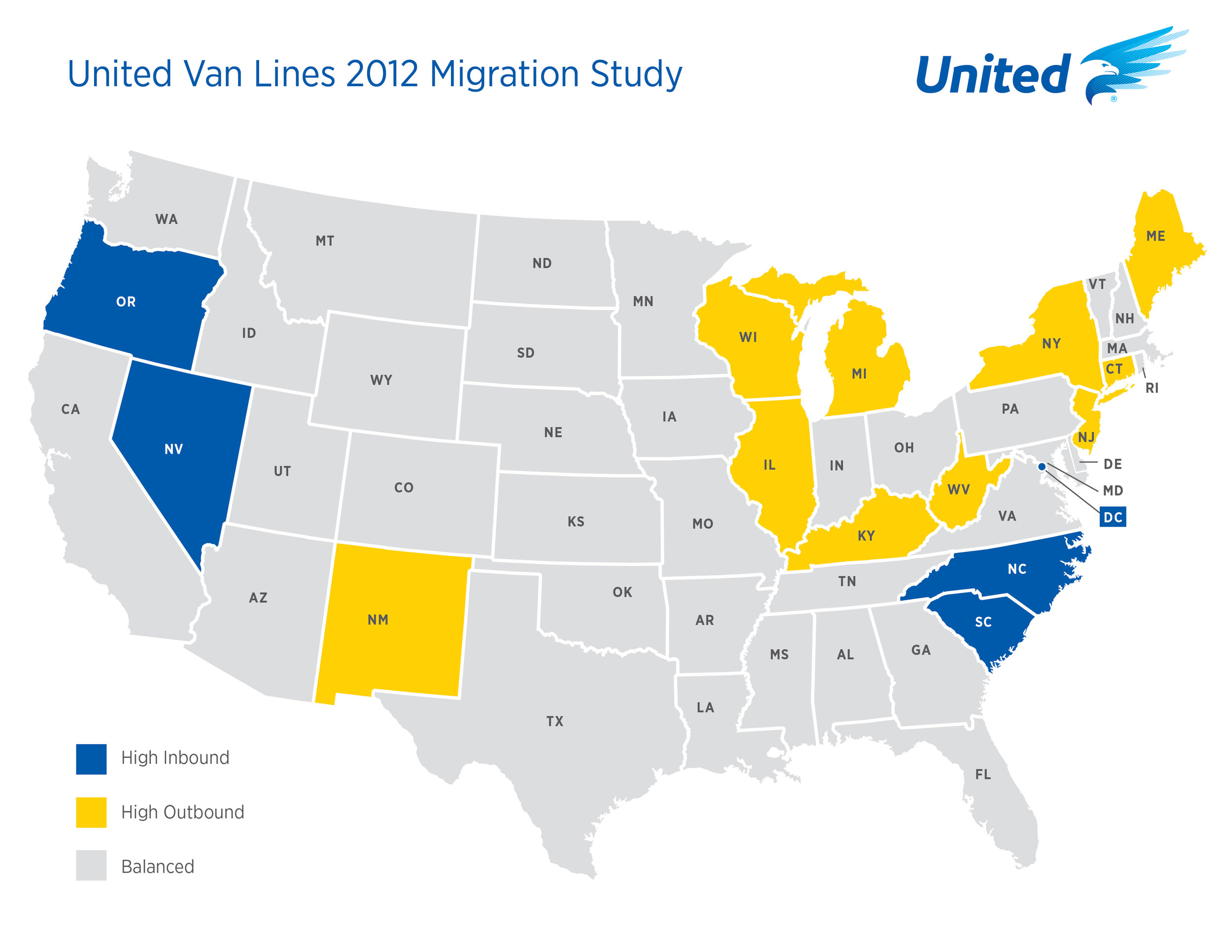
If it’s tough to tell sometimes if you’re coming or going, there is at least one well-known company that keeps close tabs on movement.  United Van Lines, long in the business of moving people from point A to point B, issues an annual “migration study” that tracks where people are moving to, and moving from. In 2012, more folks were going than coming to Connecticut, by a ratio of 56 percent to 44 percent, putting the state squarely among the top 10 outward bound leaders.  The pattern was similar throughout the Northeast.  New Jersey (62 percent) displaced the outbound leader from last year, Illinois (60 percent) reclaiming the top spot for high-outbound migration that it held in 2010.  In addition to New Jersey, New York (58 percent), Maine (56 percent) and Connecticut (56 percent) are also included.

Michigan (58 percent) and Wisconsin (55 percent) along with Illinois represented the Great Lakes region. Michigan fell to the No. 6 from the No. 4 spot it held in 2011. Previously, it had claimed the top outbound spot every year from 2006-2009.  Kentucky (55 percent) joined West Virginia (58 percent) as the only Southern states to appear on the high outbound list. New Mexico (58 percent) was the only Western state to appear on the list. The top 10 outbound states for 2012 were:

  1. New Jersey Migration Map
  2. Illinois
  3. West Virginia
  4. New York
  5. New Mexico
  6. Michigan
  7. Connecticut
  8. Maine
  9. Wisconsin
  10. Kentucky

That’s one list that states would prefer not to be included on.  United has tracked migration patterns  annually on a state-by-state basis since 1977. For 2012, the study is based on all household moves handled by United within the 48 contiguous states and Washington, D.C.  United classifies states as "high inbound" if 55 percent or more of the moves are going into a state and "high outbound" if 55 percent or more moves were coming out of a state or "balanced" if the difference of inbound and outbound is negligible.   The top-five inbound states of 2012 were 1) District of Columbia, 2) Oregon, 3) Nevada, 4) North Carolina and 5) South Carolina.

The Western United States is also represented on the high-inbound list with Oregon (61 percent) and Nevada (58 percent) both making the list. Oregon is number two for inbound migration for the third year in a row. Nevada returned to the high inbound traffic for the second consecutive year. The Carolinas each made the top five with North Carolina at 56 percent and South Carolina at 55 percent inbound moves.

Several states gained approximately the same number of residents as those that left. Those states include New Hampshire from the New England region, and the states of Louisiana, Iowa, Indiana, North Dakota, and Maryland.  This is the fifth consecutive year the District of Columbia (64 percent) was the top moving destination in the United States.  That trend may continue in 2013, what with members of Congress and the Cabinet coming and going.

Manufacturing Summit Planned to Accelerate Industry Growth

“Manufacturing is vital to Connecticut’s economic health and future. Now, after decades of uncertainty, the state’s manufacturers could be entering a new era of opportunity. Employment is rising, companies that moved overseas are returning and continuous improvement initiatives are helping many manufacturers hone their operations and enhance competitiveness.”  That assessment, from the Connecticut Business & Industry Association, is driving a Connecticut Manufacturing Summit on Friday, January 25 at the Trumbull Marriott. The program will include an overview of U.S. manufacturing from Steve Menaker, Partner,  McGladrey LLP, and a presentation of CBIA’s report, Connecticut Manufacturing: Building on the Past, Creating Our Future, issued in mid-2012, from Pete Gioia, Vice President and Economist at CBIA. Among the key stats manufacturingthat will inform the discussion:

  • Connecticut is home to nearly 5,000 manufacturing companies that employ approximately 165,000 people and produce a vast array of products.
  • A CBIA/ DataCore Partners index contained in the report, placed Connecticut as 30th in the nation for manufacturing competitiveness.
  • Connecticut ranked 9th in the nation in the Milken Science and Technology Index that measures states’ ability to support growing manufacturing industries. (The ranking is based on public investments in R&D, a well-educated and skilled workforce, and the availability of risk capital to help convert R&D into viable technology products and services.)
  • Citing manufacturing as a jobs driver, the report also said that for each manufacturing job created in the state, between 1.5 and 4 additional jobs are created in other parts of the economy.
  • Each dollar’s worth of manufactured goods creates another $1.35 of activity in other economic sectors – twice the multiplier effect of most of the services sector.
  • Each year, manufacturers purchase more than $21 billion in goods and services from other state businesses, according to the Connecticut Economic Resource Center.
  • According to a Connecticut Industrial Energy Consumers report, manufacturing contributed $25.9 billion to the gross state product and accounts for about 11.4 percent of the state’s total employment.

The Summit will also include manufacturing executives discussing approaches for achieving success, resources needed for sustaining success, and strategies for cost-control and streamlining operations.  Among the participants are Brian DiBella, Vice President and General Manager - Wiremold Electrical Wiring Systems Division, Legrand and Don Janezic, CFO, Bigelow Tea. Panel participants also include Jason Howey, President, Okay Industries, Dr. Karen Wosczyna-Birch, Executive Director College of Technology, Connecticut Community Colleges, Dave J. Tuttle, Department Head/ Manufacturing, Connecticut Technical High School System and Douglas Johnson, Vice President of Operations, Marion Manufacturing Company.

There will be a policy discussion on improving Connecticut’s manufacturing climate led by Joe Brennan, Senior Vice President of Public Policy, CBIA.

The Summit, coming at the start of the 2013 state legislative session and prior to the Governor’s presentation of the state budget, aims to build on efforts at the Capitol to focus on high-tech manufacturing as part of the state’s economic mix.  At a news conference last Many to announce the formation of a “manufacturing caucus,” Sen. Gary LeBeau, D-East Hartford, said that over the last 10 years Connecticut has lost 50,000 jobs in manufacturing, which equates to 419 jobs lost each month. The caucus includes Sen. Tony Guglielmo (R-Stafford Springs), Rep. Zeke Zalaski (D-Southington), Rep. Vincent Candelora (R-North Branford), and Rep. Jeffrey Berger (D-Waterbury).