UConn Accounting Master’s Program Ranked in Nation's Top 10

The University of Connecticut is getting high marks for its online master’s degree in accounting, earning a spot in the top 10 nationwide among online business programs ranked by U.S. News & World Report. UConn’s program, run by the School of Business, was ranked No. 8 among 213 online graduate business degree programs that the publication’s editors reviewed at colleges and universities nationwide. UConn’s online master’s of science degree in accounting (MSA) received particularly high scores for the credentials and training of its faculty, along with factors that measure student engagement such as retention, selectivity, graduation rates, and class sizes.

U.S. News also praised the program last year in a broader review of online business school learning initiatives, though it did not issue overall rankings then. The rankings were released this month.

According to the U.S. Bureau of Labor Statistics, jobs for accountants and auditors are expected to grow by 16 percent between 2010 and 2020.  The U.S. Department of Labor agency reports that “Stricter laws and regulations, particularly in the financial sector, will likely increase the demand for accounting services as organizations seek to comply with new standards. Additionally, tighter lending standards are expected to increase the importance of audits, as this is a key way for organizations to demonstrate their creditworthiness.”

The UConn program is designed to give students the knowledge they need for successful careers in public and private accounting, allowing current CPAs to expand their skill set and helping aspiring accountants meet the 150-hour educational requirement to seek CPA testing and licensing in most states.

“There are exciting innovations planned for the next year to continue keeping the MSA on the cutting edge. New tools will increase interaction and continue to develop strong online community ties,” says Amy Dunbar, the MSA program’s faculty director and an associate professor of accounting.accounting

UConn’s MSA program started in 1999 and transitioned to a completely online program in 2003. It’s particularly popular with working professionals who want to boost their careers with advanced credentials. The average age of new entrants is about 28 years old, and the student body is split almost evenly between men and women.

New full-time students attend a one-week class in May at the Storrs campus to become familiar with the program, technology, instructors, and each other. They then take courses online during the following summer, winter, and spring semesters to complete the program’s requirements.

The course content is delivered through course-specific websites on a School of Business server. As a result, the activities do not have to take place at the same time for all students. That gives students flexibility to finish their work on their own timeframes, as long as it is completed by the assignment’s deadline. There are also several part-time options, including completing the degree over two summers or taking 10 courses over multiple semesters.

Recently, Robert Half, the world's first and largest specialized financial recruitment service, projected accounting salaries would grow 3.3 percent in 2013, while technology salaries will grow approximately 5.3 percent.

The UConn program has been recognized by the United States Distance Learning Association for best practices in the field, and it is accredited by the Association to Advance Collegiate Schools of Business (AACSB).
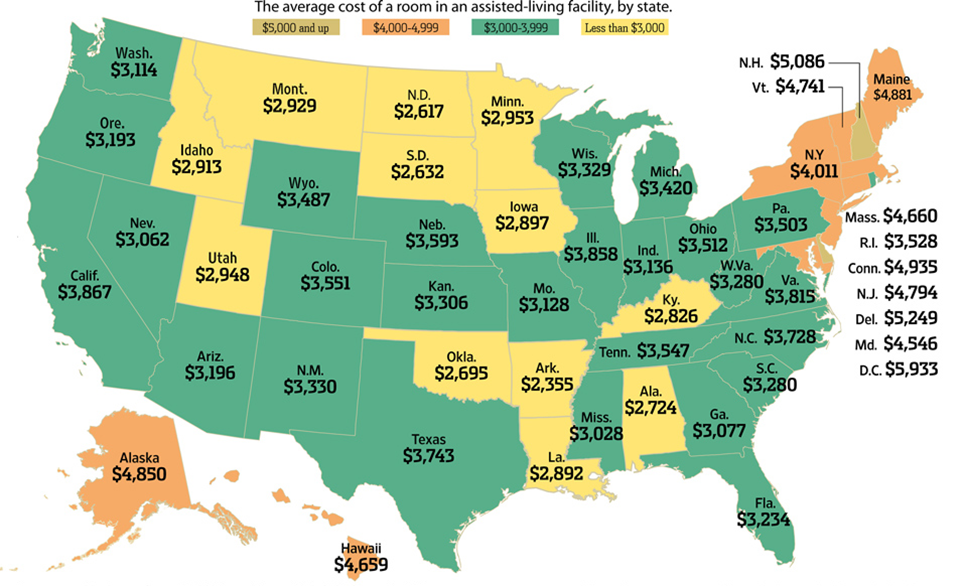
 

Connecticut Has 4th Highest Costs for Residents of Assisted-Living Facilities

The average monthly cost of a room in an assisted-living facility is higher in Connecticut than in 48 states.  Only Delaware, New Hampshire and the District of Columbia, on average, have higher rates than the Land of Steady Habits. The top twelve, as reported by the Wall Street Journal:

  1. District of Columbia         $5,933
  2. Delaware                             $5,249
  3. New Hampshire                $5,086
  4. Connecticut                        $4,935
  5. Maine                                   $4,881
  6. Alaska                                   $4,850
  7. New Jersey                        $4,794
  8. Vermont                              $4,741
  9. Massachusetts                  $4,660
  10. Hawaii                                   $4,659
  11. Maryland                             $4,546
  12. New York                            $4,011

The data reported in the WSJ was compiled by the MetLife Mature Market Institute, based on a survey of nearly 6,700 long-term care providers nationwide. At the other end of the spectrum, 12 states had average monthly costs that were below $3,000.  Lowest rate?  Arkansas at $2,355 – less than half that of the eight most costly states, including Connecticut.


map assisted living


Six CT Communities to Receive "Preservation of Place" Grants to Boost Local Downtowns

Connecticut Main Street Center (CMSC), the downtown revitalization and economic development non-profit, has awarded six organizations and municipalities a total of $60,000 in 2013 Preservation of Place grants. These grants will be used to provide the communities and organizations with targeted resources to increase their capacity to plan for preservation and revitalization initiatives in their downtowns and neighborhood commercial districts. The winning organizations and initiatives - which will each receive a $10,000 Preservation of Place grant - are:

  • the Town of Kent for a Planning & Engineering Study for its Village Center Streetscape;
  • the City of Bridgeport for the Little Asia Historic Streetscape and Archway Project;1272906927_CTMainStreetLogo
  • the Town of Putnam for the Putnam Downtown Center Signage and Wayfinding Design Project;
  •  the Town of Seymour for the Seymour Greenway Trail and Linear Park Master Plan;
  • the Westville Village Renaissance Alliance for the Westville Village Public Parking Comprehensive Design & Marketing Plan; and the
  • Northwestern Connecticut Regional Planning Collaborative for the NW CT Village Center Vitality Tourism Marketing Campaign.

The Preservation of Place grant program provides a source of funding for new initiatives that can be integrated into, and leverage, comprehensive Main Street preservation and revitalization programs. The funds are meant to be flexible to meet individual community need.

"Historic preservation and the revitalization of our Main Streets create jobs, bring vacant buildings back on the tax rolls and add value and vitality to adjacent buildings and neighborhoods," said John Simone, CMSC President & CEO. "The diversity of locations and the diversity of projects will allow each community to respond to their greatest current need, actively creating their direction of growth."

Since 2008, CMSC has awarded $288,030 through the Preservation of Place grant program to sixteen Connecticut communities, leveraging over $768,427 in local Main Street initiatives. The program receives support from the State Historic Preservation Office with funds from the Community Investment Act.

The mission of CT Main Street Center is to be the champion and leading resource for vibrant and sustainable Main Streets as foundations for healthy communities. CMSC is dedicated to community and economic development within the context of historic preservation, and is committed to bringing Connecticut's commercial districts back to life socially and economically. The Main Street initiative is one of the most successful economic development programs in the country. For every $1 spent on a local Main Street program, $73.13 is reinvested in Connecticut Main Street downtowns.

Manufacturing Summit Planned to Accelerate Industry Growth

“Manufacturing is vital to Connecticut’s economic health and future. Now, after decades of uncertainty, the state’s manufacturers could be entering a new era of opportunity. Employment is rising, companies that moved overseas are returning and continuous improvement initiatives are helping many manufacturers hone their operations and enhance competitiveness.”  That assessment, from the Connecticut Business & Industry Association, is driving a Connecticut Manufacturing Summit on Friday, January 25 at the Trumbull Marriott. The program will include an overview of U.S. manufacturing from Steve Menaker, Partner,  McGladrey LLP, and a presentation of CBIA’s report, Connecticut Manufacturing: Building on the Past, Creating Our Future, issued in mid-2012, from Pete Gioia, Vice President and Economist at CBIA. Among the key stats manufacturingthat will inform the discussion:

  • Connecticut is home to nearly 5,000 manufacturing companies that employ approximately 165,000 people and produce a vast array of products.
  • A CBIA/ DataCore Partners index contained in the report, placed Connecticut as 30th in the nation for manufacturing competitiveness.
  • Connecticut ranked 9th in the nation in the Milken Science and Technology Index that measures states’ ability to support growing manufacturing industries. (The ranking is based on public investments in R&D, a well-educated and skilled workforce, and the availability of risk capital to help convert R&D into viable technology products and services.)
  • Citing manufacturing as a jobs driver, the report also said that for each manufacturing job created in the state, between 1.5 and 4 additional jobs are created in other parts of the economy.
  • Each dollar’s worth of manufactured goods creates another $1.35 of activity in other economic sectors – twice the multiplier effect of most of the services sector.
  • Each year, manufacturers purchase more than $21 billion in goods and services from other state businesses, according to the Connecticut Economic Resource Center.
  • According to a Connecticut Industrial Energy Consumers report, manufacturing contributed $25.9 billion to the gross state product and accounts for about 11.4 percent of the state’s total employment.

The Summit will also include manufacturing executives discussing approaches for achieving success, resources needed for sustaining success, and strategies for cost-control and streamlining operations.  Among the participants are Brian DiBella, Vice President and General Manager - Wiremold Electrical Wiring Systems Division, Legrand and Don Janezic, CFO, Bigelow Tea. Panel participants also include Jason Howey, President, Okay Industries, Dr. Karen Wosczyna-Birch, Executive Director College of Technology, Connecticut Community Colleges, Dave J. Tuttle, Department Head/ Manufacturing, Connecticut Technical High School System and Douglas Johnson, Vice President of Operations, Marion Manufacturing Company.

There will be a policy discussion on improving Connecticut’s manufacturing climate led by Joe Brennan, Senior Vice President of Public Policy, CBIA.

The Summit, coming at the start of the 2013 state legislative session and prior to the Governor’s presentation of the state budget, aims to build on efforts at the Capitol to focus on high-tech manufacturing as part of the state’s economic mix.  At a news conference last Many to announce the formation of a “manufacturing caucus,” Sen. Gary LeBeau, D-East Hartford, said that over the last 10 years Connecticut has lost 50,000 jobs in manufacturing, which equates to 419 jobs lost each month. The caucus includes Sen. Tony Guglielmo (R-Stafford Springs), Rep. Zeke Zalaski (D-Southington), Rep. Vincent Candelora (R-North Branford), and Rep. Jeffrey Berger (D-Waterbury).


Modest Economic Growth Seen in 2013 Amidst Competing Indicators

The Connecticut Economic Digest, assessing the prospects for the state’s economy in the new year, has unveiled a series of observations and analyses that suggest it may be a challenging twelve months, but not without the possibility of progress, and an overall prediction of “modest growth”.  The first issue of 2013 of the journal produced by the state Departments of Labor and Department of Community and Econoecondigestmic Development, notes a range of factors that could impact economic prospects, among them:
  • Tourism: "Last year the state launched a multi-million-dollar, two-year marketing initiative to develop, foster and stimulate the state’s brand identity and bolster business and tourism. Tourism has a significant impact on the state’s economy, estimated by the University of Connecticut’s Center for Economic Analysis at $11.5 billion every year through total traveler and tourism revenue and $1.15 billion in state and local tax revenue. Travel and tourism creates more than 110,000 jobs throughout the state, or 6.5% of Connecticut’s total employment."
  • Large businesses: "The state’s “First Five” and “Next Five” job initiatives have promised substantial growth in employment and capital investment in Connecticut. At year’s end, nine business deals had been announced as part of the ongoing expansion program, which leveraged $1.3 billion in private investment. Between the nine companies — Cigna, ESPN, NBC, Alexion Pharmaceuticals, CareCentrix, Sustainable Building Systems LLC, Deloitte, Bridgewater Associates, and Charter Communications — up to 4,748 jobs are expected to be created and 11,087 retained."
  • Small Businesses: "The Small Business Express Program (EXP) provides loans and grants to Connecticut’s small businesses to spur job creation and growth and has seen vigorous activity since its inception. The state has assisted 435 companies with more than $60 million in loans and grants. With this much-needed capital, up to 1,523 jobs are expected to be created and 4,080 retained."
  • Housing: "The state’s housing market languished in 2011. Residential permit data through September 2012, however,  had grown by 32.2% compared to the same period the previous year. New homes sales grew 5.7% in September, and housing starts 3.6% in October, the highest level in four years."

The Digest noted that “the Connecticut recession from March 2008 through February 2010 saw the loss of 117,500 jobs. Jobs regained numbered 30,700 (26.1%) since February 2010 when the recovery began through November 2012, including 1,900 in the year 2012 through November (0.12%) seasonally adjusted since the beginning of the year. The private sector has regained 42,000 (38.1%) of the 110,200 private jobs lost in that same recessionary period.”  It is forecast that Connecticut will gain about 5,600 jobs or 0.3% in 2013.

In addition, the Digest pointed out that “The state’s unemployment rate, after peaking at 9.4% for five consecutive months in 2010 and falling rather steadily to 7.7% in March and April 2012, jumped unexpectedly through last summer to 9.0% and declined to 8.8% in November.” The New England Economic Partnership forecasts Connecticut’s unemployment rate will be 7.7 % in 2013.

State's Small Business Program Targets Jobs, Economic Growth

When a survey of family owned businesses last year found almost two-thirds of respondents projecting sales and revenue growth in 2013, it appeared that optimism was on the upswing. This weeks’ news from Connecticut’s Department of Economic and Community Development (DECD) on the progress of the state’s Small Business Express Program, launched a year ago, may be a contributing factor. The Small Business Express Program (SBEP) supports the retention and growth of small business in Connecticut through a combination of loans and grants. SBEP incorporates a stream-lined process that provides financial assistance in the form of revolving loan funds, job creation incentives; and matching grants. The program is designed to provide small business with access to capital, support job creation, increase skill development and encourage private investment. SBEP loans and grants are intended to have a positive impact on the growth of the companies receiving the funds, and decd-logo-spelled-out-centeredcorrespondingly on Connecticut’s overall economy.

Slightly more than 1,607 businesses with 100 or fewer employees applied for loans or matching grants in the program's first year, according to state officials. DECD approved just over half of the applications, and the program is currently helping about 500 small businesses retain 4,616 jobs and to create another 1,738.

The DECD authorized $67.2 million in financing to 494 companies through Dec. 31 -- $27.5 million in loans and $39.7 million in grants. It has already received $412,130 in principal and interest payments. State officials are reviewing applications from another 271 businesses, for an additional $38.3 million.

Components of the program include:

  • Small Business Express Revolving Loan Fund - Loans are available at a minimum of $10,000 to a maximum of $100,000 to assist small businesses with capital and operational needs.
  • Small Business Job Creation Incentive Program - Deferred Loans are available at a minimum of $10,000 and a maximum of $250,000 to assist small businesses to spur growth. DECD may forgive all or part of loan based on the attainment of job creation goals.
  • Small Business Creation Matching Grant Program - Grants are available at a minimum of $10,000 and a maximum of $100,000 to provide a dollar-for-dollar matching grant for specific job creation, capital investment and working capital goals.

The SBEP program assistance has leveraged approximately $40 million in private investment, according to DECD figures. Some participating business owners have noted that banks became more willing to lend once the business is accepted into the program.

Newtown Was Rated #4 Town Among Peers, with Lowest Crime Rate

When Connecticut magazine last ranked Connecticut’s towns and cities on their quality of life, Newtown placed fourth overall among 26 communities with between 25,000 and 50,000 residents. Breaking down the individual categories in the rating, Newtown placed first with the lowest crime rate, third in the vibrancy of its economy, and sixth in the quality of education, in data compiled for the 2011 rating.

The top eight communities were Westport, Farmington, Glastonbury, Newtown, Cheshire, Wallingford, Mansfield and New Milford. The categories included were education, crime, economy, cost, and leisure.

The crime category is based on major crimes (murder, rape, robbery, aggravated assault, burglary, motor-vehicle theft) committed in 2007, 2008 and 2009 per 1,000 population, using figures available from the state Department of Public Safety.  The education category combines five elements: the 2009, 2010 and 2011 Mastery Test results for 4th, 6th and 7th grades; results of the 2009, 2010 and 2011 Connecticut Academic Performance Test (CAPT); local SAT scores for 2008, 2009 and 2010, and the percentage of 2010 public high school graduates who went on to two- or four-year colleges. Test scores were weighted more heavily.

The strength of the local economy was determined by the 2011 Public Investment Community score, compiled by the Office of Policy and Management, which rates all Connecticut towns under a formula based on population, per capita income, the adjusted equalized grand list per capita, the unemployment rate, the equalized mill rate and per capita aid to children.

Newtown was in the middle of the pack in leisure/culture, placing 13th, and among the lowest in cost of living, placing 25th out of 26 communities evaluated. The cost of living category weighs most heavily the median price of a single-family house purchased in the first six months of 2011.   Leisure includes local library expenditures per capita in 2010, the number of theaters, museums, festivals, concert venues, historic sites, colleges and universities, golf courses, local newspapers, radio stations, state parks and forests, voter turnout in the 2008 election and good local restaurants.

Manufacturing Goes High Tech; Key Segment of CT Economy

Factory jobs in Connecticut slumped from 477,000 in 1969 – accounting for about one-third of total employment in the state – to just 174,000, about 10 percent of jobs statewide, in 2011, according to U.S. Bureau of Economic Analysis data. In the new issue of The Connecticut Economy however, UConn economist Steven Lanza issues a “report card” on manufacturing that presents the sector as among the most dynamic in the state’s economy, transformed by advanced technologies linked to research and development that are providing a catalyst for economic growth.  The analysis notes that during the past two years, Connecticut manufacturing employment has remained steady at about 165,000 workers.

The manufacturing sector contributed 20 percent of the growth in the state’s economic output in the decade ending in 2010, Lanza estimates, while boosting productivity – the value of manufactured goods per worker – by more than 50 percent from 1990 to 2007, with 35 percent fewer workers.

“Expanding output and falling employment [over that timeframe] combined to raise productivity per worker from $57,900 to $135,800, an impressive 134 percent increase,” Lanza says. Enhanced productivity, in turn, also led to higher wages: in 2011, Connecticut factory workers – who are now more likely to have a graduate degree and wear a suit or lab coat to work – earned an average salary of $76,900, or 26 percent above the state’s all-industry average of $61,100.

Connecticut’s manufacturing profile has also changed drastically; high-tech firms now produce more than 70 percent of the state’s output with computer/electronic products and chemicals accounting for more than 13 percent and 30 percent, respectively, of the total output in 2010.

Lanza also details how the state is now a leader in the aerospace and defense-related transportation equipment field – largely in the production of aircraft engines, helicopters, and nuclear submarines – totaling 23 percent of the state’s manufacturing output in 2010, compared with 20 percent in 1997.

Lanza is executive editor of The Connecticut Economy, a quarterly journal published by the University of Connecticut’s Department of Economics that offers data, forecasts, and substantive, data-driven analyses of current events, longer-term trends, and public policies affecting Connecticut’s economy.

International Air Travel Connections Drop in Hartford, Jump in New Haven

The Brookings Institute has released data on the flow of international passengers in and out of the largest U.S. metropolitan areas.  The web-based data, drawn from a new report primarily comparing 2003 with 2011, highlights the scale of passenger traffic flows and points to the international markets where these ties are particularly strong. The report, “Global Gateways:  International Aviation in Metropolitan America,” released in October 2012, found that:

  • International air travel in and out of the United States more than doubled between 1990 and 2011. The growth in international passengers during the 21-year period was more than double the growth in domestic passengers and real GDP
  •  Since 2003, international air travel grew between the United States and every global region, with the strongest growth coming from emerging markets.
  • Just 17 metropolitan gateways captured 73 percent of all international passengers starting or ending their trip in the United States as well as 97 percent of all international transfer passengers.
  • As metropolitan economies expand their global reach through trade and investment, international avia­tion plays a pivotal role in the movement of people across national borders.

The national growth was not uniformly reflected in Connecticut.  Of all passengers flying to or from an international destination in Hartford, 17.9% flew direct.  The remainder required connecting flights.  The number of passengers flying internationally thru Hartford dropped from 347,311 in 2003 to 278,997 in 2011, a downward change of nearly 20 percent.  In 2003, Hartford was 40th of 90 airport locations; by 2011 that had dropped to  47th of 90.  The change was a 19.7 percent drop.

By way of comparison, Providence ranked 49th in 2003 in international travelers and 69th in 2011, reflecting a drop in passengers from 187,819 to 126,423, a drop of 32.7 percent.

The numbers for New Haven were considerably smaller, but tell an interesting story nonetheless.  The number of international travelers touching New Haven jumped by 133.5 percent between 2003 and 2011, from 1,645 passengers to 3,841 passengers.  That’s the largest percentage increase of any of the 90 locations in the nation.  In terms of the number of passengers, however, New Haven nudged upward from dead last (90th out of 90) to 89th.

The Brookings data “goes beyond describing where passengers are going and tells us how they get there.”  Using data on transfer points and a map that visualizes each leg of each international route, it paints a portrait of how the global aviation infrastructure rises to meet the demand of international passengers.


Industry Growth and Enforcement: CT’s Twin Insurance Strategies

The Connecticut insurance sector plays a vital role in the global insurance landscape and the state's economy, according to a report from the Connecticut Insurance and Financial Services (IFS) Cluster and PwC US.  The report, released at the recent  2012 Insurance Market Forecast event in Hartford, highlighted the industry’s importance to the state, which was echoed in comments by the state Insurance Commissioner and Gov. Malloy. Commissioner Thomas Leonardi pointed out that “we regulate the 2nd largest insurance industry in America,” noting that “if Connecticut were a stand-alone country, we would be one of the 10 largest insurance producing jurisdictions in the world.” You can’t ignore this industry without putting the state in great peril.”  Malloy said, stressing the need to both regulate the industry and view them as “partners” in job creation and economic development.

The 2012 Connecticut Insurance Market Report highlights the sector's rich history, current challenges and opportunities with analysis and findings from Connecticut IFS Cluster, PwC, and the Connecticut Economic Resource Center (CERC).

KEY STATS

According to the report, Connecticut ranks first nationally in insurance employment as a percentage of total state employment and the industry represents approximately 3 percent of the state's workforce, 6 percent of the state's payroll and 9 percent of the gross state product.  Full-time employment in the sector is said to be 50,242.

Insurance also impacts other sectors of the state's economy.  The report says that one new job in the insurance industry adds an additional 1.46 jobs to the Connecticut economy; an increase of $1 in insurance labor income puts an additional $0.78 into state commerce; and every year the insurance industry purchases an average of $2 billion in goods and services from other industries in Connecticut.

"The inaugural Insurance Market Forecast is the showcase effort of that collaboration and will serve as a valuable guidepost as we expand our efforts to attract businesses and talent to our state," said James Bedard, IFS Chairman and Chief Financial Officer/Chief Operating Officer for UnitedHealthcare's Northeast Region.  [CT-N video of event.]

Looking forward, the report emphasizes that competing globally, investing in education, retaining and developing human capital, and government-led economic development initiatives are essential to maintaining the state's leadership position in the industry and growing its economy.  To drive that future growth, the report identifies the five key megatrends – social, technological, environmental, economic and political – that will influence the world's insurance industry, explaining their implications, and offering ideas and actions for embracing them.

A year ago, Gov. Malloy’s office noted that there are more than 65,000 people who work in the insurance industry in Connecticut, described as being down by almost 25% over the past 20 years.  The report compares employment by state, highlighting the top nine:  California (179,936); Texas (163,690); New York (144,077); Florida (134,393); Illinois (112,408); Pennsylvania (110,484); Ohio (108,492); New Jersey (81,119); Connecticut (61,583).

CONSUMER INTEREST

The State Department of Insurance, even as it promotes development of the insurance industry, also goes to bat for consumers.  In the third quarter of 2012, the Department’s Consumer Affairs Unit (CAU) fielded more than 1,500 complaints and inquiries and helped policyholders recoup nearly $1.2 million. During that same period, the Market Conduct division levied more than $1.1 million in fines against carriers and returned that money to the state General Fund. The fines resulted from a variety of violations and settlements ranging from untimely claim payments to improper licensing.  Since January 1, the Department has recovered more than $6.3 million for policyholders and state taxpayers.

The majority of the funds recovered for policyholders stemmed from complaints over health, accident, homeowners and life and annuities policies. The Department calculates its consumer recoveries based on what the policyholder received as a result of the Department’s intervention. The inquiries and complaints also help the Department identify industry trends that may adversely affect consumers. This data also helps determine topics for consumer education and as tools to help the Department monitor the industry. The Market Conduct enforcement actions are posted on the Insurance Department’s web site at www.ct.gov/cid