Nonprofit Density Impacts Unemployment Rate; CT Misses Top 10

Communities with better civic health have weathered the recent recession far better – and experienced considerably smaller increases in unemployment – than other communities that faced similar economic circumstances, according to a report by the National Conference on Citizenship (NCoC).  Counties across the nation that were rich in nonprofit organizations lost considerably fewer jobs than the low-nonprofit counties, the study revealed. A state-by-state analysis by the organization placed Connecticut in the second tier of states in both the density of nonprofit organizations, and social cohesion (interacting with friends and neighbors), the two measures used in the study, released in 2012.  Connecticut ranked between #11 and #20 in each category, just outside the first tier, top-10 states.

For individuals who held jobs in 2008, the odds of becoming unemployed were cut in half if they lived in a community with many nonprofit organizations rather than one with a few nonprofits, even if the two communities were otherwise similar, theNCoC study found.  Among the New England states, Maine, Rhode Island and Vermont placed in the top ten.
Overall, counties with more nonprofits per capita prior to the recession had lower unemployment in 2006. And while almost all of the counties lost jobs during the recession years, the counties with more nonprofits per capita lost fewer jobs between 2006 and 2009. Both patterns remain even when holding education, median income, housing prices, and other economic factors constant, according to the report.  Counties ranking in the top 10% in nonprofit density experienced an increase of only 2 percentage points in their unemployment rate between 2006 and 2009, compared with 5.1 percentage points for the counties in the bottom 10% in nonprofit density.

These results suggest – according to the report – that nonprofits may bring economic benefits by directly employing people and also by changing the economic climate of the whole community. Nonprofits support civic engagement and social cohesion; in turn, when citizens feel committed to their communities and connected to their fellow residents, they are more likely to make decisions that boost local employment.

The study used statistical models to investigate the relationship between civic health and unemployment in the 50 states, 942 metro areas, and more than 3,100 counties since 2006.  NCoC was chartered by Congress intop 10 1953 to harness the patriotic energy and national civic involvement surrounding World War II. In 2009, Congress  expanded the organization’s Civic Health Assessment to become the nation’s largest and most definitive measure of civic engagement.


CT Girlcott Set to Make History, Opens Make-Up Free Photo Exhibit

March is Women’s History Month, and a number of local organizations in Greater Hartford have come together looking to make some history of their own.   They’ve organized CT Girlcott, a movement of women willing to go makeup free for the month (or part thereof) and to donate the money usually spent on cosmetics to organizations that benefit women and girls in Connecticut and around the world.  The effort also aims to raise awareness around body image and the relationship between women and the makeup they wear. Among the organizers are Charter Oak Cultural Center, YWCA Hartford Region, Harriet Beecher Stowe Center, University of Hartford Women for Change, Women’s Education and Leadership Fund, CT Humanities, and the Permanent Commission on the Status of Women.  A website, www.ctgirlcott.org has been launched highlighting the initiative.

The Charter Oak Cultural Center is hosting a photography exhibition as part of CT Girlcott which features the images of the women leaders who have “dared to bare it all for the camera.” Revealed: Images of Women Leaders Who Bared to Make ChangeGirlcottLogoFINAL opens with a reception on February 28, 6-8 PM, and runs through April 13.  Photographs of over thirty women leaders from the Greater Hartford community will be revealed without their make-up, including many familiar names (and faces).

Girlcott is "a movement of Connecticut women raising consciousness" on behalf of women around the world and the issues currently confronting women in 2013.  Girlcott asks women to “girlcott” (as opposed to boycott) make-up for the month of March and to donate the monies spent on cosmetics to organizations and programs that help and support women and girls in Hartford and internationally. Connecticut Humanities provided funding for the exhibition, which includes the work of photographers Nilofer Haider, Lena Stein, and Nicolette Theriault.

CT Girlcott hopes to encourage conversations among women about body image, definitions of beauty, and what cosmetics are really covering up, and support the flourishing of women and girls in Connecticut, as well as in developing and war-torn countries.  The initiative also seeks to raise awareness about the representation of women in the media, the pressures women live with to look a certain way, the objectification of women, and the impact all of this has on women’s lives and the life of the nation and world.


Sustainability, Green Infrastructure Advance in CT

green-energyWhen considering Connecticut’s progress in sustainability, green infrastructure, and green investments, a variety of statistics help to tell the story.  Among them:

  • The U.S. Department of Energy considers 13 percent of Connecticut’s electricity as coming from renewable resources, ranking the state 31st in the nation.  The majority of the renewable power comes from biomass and hydropower, as reported in the Connecticut Green Guide (www.CTGReenGuide.com).
  • Connecticut’s transportation sector employees more green workers than any other industry in the state, with 8,238 green jobs.
  • In the Northeast, 76 percent of companies use at least one type of green technology or practice.  According to the U.S. Bureau of Labor Statistics, the most popular green methods are:
  1. Energy efficiency
  2. Waste reduction
  3. Conserving natural resources
  4. Reducing greenhouse gas emissions
  5. Removing pollutants from workspace
  6. Generating onsite renewable energy
  • Connecticut Innovations, the state’s quasi-public investment firm, currently puts 6 percent of its portfolio into clean technology start-ups.  Here’s the portfolio breakdown:
  1. Information technology               49.5%
  2. Bioscience                                           42%
  3. Clean tech                                           6%
  4. Photonics                                            2%
  5. Advanced materials & other       .5%


  • The U.S. Energy Information Agency reports that Connecticut ranks fifth in the nation among the states consuming the least amount of energy per capita.  The top ten:
  1. Rhode Island
  2. New York
  3. Hawaii
  4. California
  5. Connecticut
  6. Massachusetts
  7. Arizona
  8. New Hampshire
  9. Florida
  10. Vermont


  • Connecticut leads the New England states in demand response resources – businesses and facilities that power down when electric prices and demand spikes, according to data from ISO New England.

State                                     Megawatts of Demand Response

Connecticut                        996.6Picture1

Massachusetts                  800.5

Maine                                   447

New Hampshire              183.2

Vermont                              144

Rhode Island                      140


Among the most common practices used by employers are asking employees to conserve, turn off or dimming lights, adjusting indoor temperature, and turning off equipment such as printers, copiers, and PCs).  Other steps, used less often, include shutting down production, starting emergency generation, limiting the use of elevators and escalators, and shutting down an entire plant.


Foreclosure Rate Drops Nationally, CT Better Than National Average

Foreclosure filings — default notices, scheduled auctions and bank repossessions — were reported on 150,864 properties across the U.S. during January, a decrease of 7 percent from the previous month and down 28 percent from January 2012. The report - by RealtyTrac®, a leading online marketplace for foreclosure properties and real estate data - shows one in every 869 U.S. housing units with a foreclosure filing during the month, down 28 percent from a year ago to the lowest level since June 2006 — a 79-month low. Each of Connecticut’s eight counties is below the national average, and the state continues to be outside the top 10 states for the number of foreclosures, according to the U.S. Foreclosure Market Report™ for January 2013.  The prevalence of foreclosures, based on the number of housing units, was greatest in Windham, Tolland, and New Haven Counties.

The Florida foreclosure rate ranked highest among the states for the fifth month in a row. One in every 300 Florida housing units had a foreclosure filing in January — more than twice the national average. A total of 29,800 Florida properties had a foreclosure filing during the month, up 12 percent from the previous month and up 20 percent from January 2012.MapPic_000918

With one in every 344 housing units with a foreclosure filing in January, Nevada posted the nation’s second highest foreclosure rate for the fourth consecutive month. A 32 percent month-over-month jump in scheduled foreclosure auctions helped the Illinois foreclosure rate rise to third highest among the states in January. One in every 375 Illinois housing units had a foreclosure filing during the month.

Other states with foreclosure rates among the nation’s 10 highest were Arizona (one in 501 housing units with a foreclosure filing), Georgia (one in 513 housing units), Ohio (one in 612 housing units), Washington (one in 674 housing units), California (one in 753 housing units), Indiana (one in 784 housing units), and Michigan (one in every 837 housing units).

In Connecticut, New Haven County had the largest number of foreclosures in January, with 317, followed by Hartford County with 265 and Fairfield County with 193.  Overall, Connecticut had 5,187 home foreclosures during the month, with the average foreclosure sales price of $186,405.  The county-by-county breakdown:

  • Windham            51 foreclosure properties             1 in every 958 housing units
  • Tolland                 52 foreclosure properties             1 in every 1,109 housing units
  • New Haven        317 foreclosure properties          1 in every 1,138 housing units
  • Hartford               265 foreclosure properties          1 in every 1,409 housing units
  • Litchfield              57 foreclosure properties             1 in every 1,530 housing units
  • New London      78 foreclosure properties             1 in every 1,546 housing units
  • Fairfield                193 foreclosure properties          1 in every 1,865 housing units
  • Middlesex           37 foreclosure properties             1 in every 2,013 housing units

In New Haven County, the numbers were driven by Waterbury with 84 foreclosures and New Haven with 59.  West Haven had 38 during the month.  In Hartford County, there were 44 foreclosures in New Britain, 35 in East Hartford and 26 in Manchester, according to the data provided by RealtyTrac.

Connecticut Ranks #25 in Homelessness, Federal Data Shows

Connecticut ranked #25 in the nation in state-by-state comparisons of the homeless population in emergency and transitional shelters in each state, according to data compiled by the U.S. Census Bureau and reported in the AARP Bulletin. Earlier this week, The Hartford Courant reported that “volunteers and social service workers roved the streets for the U.S. Department of Housing and Urban Development's national ‘point in time’ homeless census, which provides more up-to-date data to consider along with the 2010 census data that was the basis of the state comparisons.

Mandated at least every other year, the ‘point in time’ count helps advocates and housing officials analyze trends in homelessness, determine who stays in the shelters and gain insight into why, despite a stronger government push to combat homelessness, people remain out in the cold, the Courant reported.

About 4,210 homeless people lived in the state in 2012, including men, women and children in emergency shelters and transitional housing, federal data show. Among the nearly 770 reported homeless in Hartford — the biggest homeless population of the state's urban centers — 141 were children, according to a report released Wednesday by the Connecticut Coalition to End Homelessness.

Latinos are overrepresented among clients using the state’s many homeless shelters, and they tend to be much younger, according to coverage of the report by ctlatinonews.com. “While Hispanic/Latino persons represent only 12.3% of the Connecticut population, they comprised 28 percent of all emergency shelter and 23 percent of all transitional housing clients.

“They also tended to be younger. The most common age of Hispanic/Latino emergency shelter clients was between 18-29 years old (29 percent), while that of non-Hispanic/Latino clients was 40-49 years old (31 percent).”

“Connecticut’s emergency shelters alone served 11,700 people, including more than 1,500 children. The number of people in shelters and transitional programs at any given point in time increased 3% from 2009 to 2010, while shelter bed usage has exceeded 100% during all of 2010 and much of 2009. While collectively we may have slowed the rate of growth in homelessness over time, the numbers continue to increase,” the report said.


CT Businesses Less Optimistic About Immediate Prospects

Business confidence in both the U.S. and Connecticut economies slumped in the fourth quarter of 2012, according to a survey released by the Connecticut Business & Industry Association (CBIA).   The organization’s Quarterly Economic Survey: Fourth Quarter 2012 found that more than half (52%) of surveyed business leaders expect the state’s economy to worsen in 2013. That represents an increase of eight percentage points over the previous quarter. Just 14% thought the state economy would improve, while 34% believed conditions would remain stable.  Expectations for the national economy also dipped, with 40% of those surveyed responding pessimistically, compared with 36% last quarter. About one-quarter (24%) felt conditions would improve.

The survey, as reported by CBIA,  showed similar results to the two prior quarters, with most differences within the margin of error of the survey. Some noteworthy responses include:

  • 34% of respondents expect increases in production and sales, with 21% seeing decreases, the best numbers in the survey.CBIA
  • 18% see their work force expanding, while 19% expect to shed positions over the next quarter.
  • 27% see an improved outlook for their firm against 22% who see conditions declining.
  • For their industry, 23% see improving conditions while 28% see declines.

The third quarter rebound in business confidence--recovering from record low optimism in the April-June 2012 survey--was short-lived. And the outlook has taken a turn for the worse since the fourth quarter of 2011, when two-thirds saw improving or stable conditions in the state and 81% forecast the same for the U.S. economy.

Based on the state Department of Labor’s latest figures, Connecticut lost 1,800 jobs in December, finishing the year with a net loss of 100 jobs.  The unemployment rate fell three-tenths of a point to 8.6%. Writing in the Connecticut Economy recently, UConn economist Steven P. Lanza noted that “Connecticut’s economy will struggle to post more than nominal job gains’ in the coming months.

The Connecticut Economic Digest, in the current issue, noted that in December 2012, private sector workweek hours show Connecticut “is still firmly in slow employment recovery mode, highlighted by the hours worked month-to-month volatility.”  The publication is developed by the state Department of Labor and Department of Economic and Community Development.

CBIA’s Quarterly Economic Survey: Fourth Quarter 2012 was emailed to approximately 1,900 Connecticut businesses in January of 2013. A total of 187 responded, for a 10.2% response rate and a margin of error of +/- 7.3%.

Credit Card Debt Increases Among Older Residents

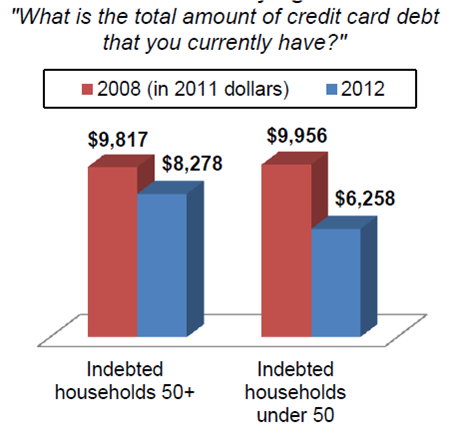
As Connecticut struggles to lift itself from a nagging recession and rebuild a shaky economy and grow jobs, new national data suggest that economic realities plus an aging population are combining to increase the credit card debt among a significant segment of the population. It has been estimated that the state's 65+ population would increase by 69 percent between 2000 and 2030. Middle-income Americans age 50 and older are carrying more credit card debt on average than younger people, according to a National Survey on Credit Card Debt of Low- and Middle-Income Households, released last month by Demos, a national policy think tank and AARP’s Public Policy Institute.

The results of the 2012 survey are a reversal of findings from a survey conducted by Demos in 2008.  It reveals a troubling picture of middle-income 50+ households carrying card debt near or in their retirement years.

The report shows that nationwide, older households carried an average credit card balance of $8,278 in 2012. For those underlogo 50, credit card debt averaged $6,258. Other key findings for middle-income households that carried credit card debt for three months or more:

  • A third of older households used credit cards to pay for basic living expenses such as rent, mortgage payments, groceries, or utilities.
  • Half of Americans age 50+ carried medical expenses on their credit cards. Prescription drugs and dental expenses were the main contributors.
  • A quarter of older households said loss of a job contributed to their credit card debt in the last three years.
  • Nearly one in five (18 percent) older Americans nearing retirement said they dipped into retirement funds to pay down credit card debt.chart
  • Older Americans were twice as likely as those under age 50 to take on credit card debt to assist other family members (23 percent vs. 11 percent).

This report suggests that credit card debt among older Americans is primarily a reflection of difficult economic times, not a lack of personal financial responsibility.  State-by-state data was not available.

The findings may help to explain the economic challenges facing Connecticut’s citizenry, which is on track to becoming one of the oldest among the states, expected to grow from 470,183 (13.8% of the total state population) in 2000 to 794,405 in 2030, constituting 21.5% of the projected total state population.


Economic Impact of CT Hospitals Highlighted in Report

Connecticut hospitals contribute $20 billion to the state and local economies, according to a report, Connecticut Hospitals: Improving Health, Strengthening Connecticut’s Economy, compiled by the Connecticut Hospital Association (CHA). According to the CHA report, Connecticut hospitals provide more than 54,000 jobs, with a total annual payroll of $5.2 billion.  Earnings by Connecticut hospital and health system employees reverberate through the community, creating an additional 55,000 jobs in the local economy.

The four-page report, which focused on the economic impact of Connecticut’s hospitals and was released in the opening weeks of the state legislative session, noted that “hospitals and health systems serve as a magnet for other healthcare businesses and a stimulus for new businesses such as retail stores, banks, grocery stores and restaurants.”CHA cover

Connecticut hospitals are major employers and purchasers of goods and services, spending $9.6 billion in 2011 – funds that help to stimulate further economic growth across the state.  Goods and services purchased by hospitals, and funding spent on buildings and equipment, create additional economic value.  With these “ripple effects” included, an additional $10.4 billion is added to the Connecticut economy, resulting in a total contribution of $20 billion by Connecticut’s hospitals to the state’s economy, CHA official pointed out.

The report indicates that Connecticut hospitals treat more than 1.6 million patients in their emergency departments, bring nearly 38,000 babies into the world, and care for more than 420,000 admitted patients, providing more than 2 million days of inpatient care.

“Connecticut hospitals are a critical economic engine,” said Jennifer Jackson, President and CEO, CHA.  “They are often a community’s largest employer, stimulating jobs and attracting other businesses.  At a time when the state has never relied more on its hospitals for the safety net they provide, it is critical – both to our quality of life and economic health – that these institutions remain strong and stable.”

CHA membership includes 29 acute care hospitals and health care organizations and facilities throughout the state.  The report was issued at a time of considerable change in both the healthcare delivery and business sides of the industry, with mergers and affiliation agreements having been reached or under active consideration among industry leaders in Hartford, New Haven, Waterbury, New London and elsewhere across Connecticut, as well as nationally.

Three Cities Selected for Program to Bring Housing Downtown

Connecticut Main Street Center (CMSC) has selected Middletown, Torrington and Waterbury for its new pilot program, Come Home to Downtown. CMSC developed the mixed-use real estate planning pilot program to provide selected communities with new tools to strengthen economic health and restore vitality to their downtowns, facilitating the development of viable, interesting housing opportunities while improving downtown neighborhoods. The goal of the Come Home to Downtown program is to set the stage to attract developers and “mom and pop” building owners to redevelop vacant or underutilized buildings with a mix of uses and housing choices. CMSC will also provide local public and private champions and partners with strategic tools to aldowntownlow them to create or enhance a strong downtown management program.  The Come Home to Downtown pilot was created in partnership with the Connecticut Housing Finance Authority (CHFA), through a $250,000 investment using Community Investment Act (CIA) Program funding.

“Our Come Home to Downtown pilot communities were selected based on criteria we feel is vital for success, including local public and private sector leadership, a strong record of community engagement, success of previous downtown revitalization initiatives and multi-story buildings and property owners who are motivated to redevelop them,” said CMSC’s John Simone.

CMSC will work in concert with Middletown, Torrington and Waterbury, beginning with the collection of data, building analysis and the coordination of community engagement activities, exploring their downtown redevelopment issues in-depth and creating new strategies that respond to changing demographics and market dynamics.  Work will continue throughout the summer on consensus buiphoto_center_01lding, a downtown development audit for each of the towns, model building analysis, assistance to small-property owners who demonstrate a desire to redevelop their properties to include housing, and downtown management organizational development.

Connecticut Main Street Center is a statewide nonprofit that inspires great Connecticut downtowns, Main Street by Main Street. Its mission is to be the champion and leading resource for vibrant and sustainable Main Streets as foundations for healthy communities.

Norwich Will Host New York-Penn. League All-Star Game in August

A cold winter’s week is the perfect time to think ahead to baseball season.  And if thinking ahead is attractive, there’s nothing better than seeing future major league stars in action on the diamond.  The Norwich Tigers will make that possibility more accessible this year when they host the 2013 New York-Penn League All-Star Celebration. 4aiVsHZ3The 2013 New York-Penn League All-Star Game will take place on Tues. August 13 at 7:35 p.m. at Dodd Stadium in Norwich.

The All-Star Celebration logo honors the community's rich maritime history and it's affiliation with the American League Champion Detroit Tigers. Maritime flags, an anchor and a dock rope make up the nautical logo, combined with classic Tigers old English lettering.

"We're thrilled to be hosting this game," said Vice President/General Manager C.J. Knudsen. "It's a great tribute to our fan base and exciting for all baseball fans throughout the state of Connecticut."

Tickets - now on sale - for the All-Star Celebration Game are the same as the 2013 single game ticket prices: $10.00 for premium seat tickets, $9.00 for reserved seat tickets and $8.00 for grandstand seat tickets.  They can be purchased  online at www.cttigers.com and at the ticket office at Dodd Stadium.

The 2013 Connecticut Tigers schedule is now available online at cttigers.com and features six Friday fireworks games in addition to five Saturday promotional giveaways. The 2013 season begins on Monday, June 17 against the Lowell Spinners, the NYPL affiliate of the Boston Red Sox, at 7:05 p.m. at Dodd Stadium with fireworks after the game.

In 2012, the Connecticut Tigers ranked #182 in average attendance among all minor league and independent teams, with 1,660 fans per game.  The independent Bridgeport Bluefish were #162, with an average of 2,033 fans attending games, and the Triple-A New Britain Rock Cats were #47 with average home attendance of 5,061.  The top minor league team in the nation was in Lehigh, PA where the Lehigh Valley IronPigs drew 9,153 per game.

The All-Star logo was brought to life at Brandiose in San Diego, where the company generated top selling logos for teams ranging from the Lehigh Valley Iron Pigs to America's oldest baseball club, the Cincinnati Reds. T-shirts featuring the All-Star Celebration logo will also be available through the Tigers' official website.

The Connecticut Tigers are the NYPL affiliate of the Detroit Tigers and play a 76 game (38 home, 38 away) schedule from late June through early September.  The Dodd Stadium Box Office is open daily from 9 a.m. to 5 p.m. Monday through Friday. Fans that want to purchase tickets may call the Tigers at (860) 887-7962, visit the box office or log on to www.cttigers.com.   Play ball!  (Well, not quite yet.)