Boehringer Ingelheim Backs AFib Education Initiative

Recognizing the need for increased education and awareness of atrial fibrillation, or AFib,  and AFib-related stroke, global pharmaceutical leader Boehringer Ingelheim – with United States headquarters in Ridgefield -  became founding sponsor of Team AFib, a national coalition offering an array of initiatives that include educational materials, an informational website, and appearances at major events across the country.AFib booth

The Team AFib alliance, launched in 2011, continues to grow.  Inaugural members include StopAFib.org, National Blood Clot Alliance, National Stroke Association, Mended Hearts, VFW and Womenheart.

The Men’s Health Network joined the coalition this year, and included the TeamAFib Insight tour in coordinated health screening events at targeted NFL venues, including the Seattle Seahawks, Cleveland Browns, Washington Redskins, and Philadelphia Eagles.

Atrial fibrillation is an irregular heartbeat and a common, serious form of heart arrhythmia.

Nearly 350,000 hospitalizations every year are attributed to AFib, which can contribute to congestive heart failure and other serious heart conditions. 

The most serious complication of AFib is stroke, and  people with AFib are nearly five times more likely to suffer a stroke than those without the condition. AFib-related strokes are nearly twice as fatal and twice as disabling as non-AFib related strokes.

Why did the company get involved?  Officials point to the firm’s dedication to patient education and improving the quality of life for patients and their families. The Team AFib effort aims to  educate patients about AFib, stroke risk and to provide tips and tools to help patients talk to their doctors.AFib website

Among the key initiatives:

Team AFib Insight tours: These live events provide an opportunity for patients to participate in a virtual 3D journey through the body to understand how AFib can lead to stroke. This experience puts AFib “in sight” to help people understand how AFib can lead to the formation of a clot that can break loose and travel to the brain where it has the potential to cause a stroke.

Podcasts and Webinars: A webinar and podcast series centered on areas of importance to the coalition, including how to recognize and respond quickly to stroke signs and symptoms, gaps in knowledge among patients and their healthcare providers about AFib and stroke risk and supporting loved ones with AFib. AFib booklet

In addition to information about AFib, diagnosing AFib and understanding stroke risk, the website provides insights from experts in Q&A form and via webcasts/podcasts, a stroke assessment tool, and the Insight Tour schedule. 

The podcasts and webinars are available at https://www.teamafib.com/hear-from-experts/webinars-and-podcasts/  The Insight tour made stops during 2013 in Washington DC at a local health fair, at the VFW National Convention in Reno, and at AARP conventions in Las Vegas and Atlanta.  The 2014 schedule is being finalized, and updates to the website are in the works.

Boehringer Ingelheim is a research-driven company dedicated to researching and developing, manufacturing and marketing pharmaceuticals that improve health and quality of life. The company has more than 44,094 employees in 145 affiliated companies worldwide, research and development (R&D) facilities at 12 sites in seven countries and production plants in 15 countries.

Task Force Report on State Response to Alzheimer’s Nears Completion

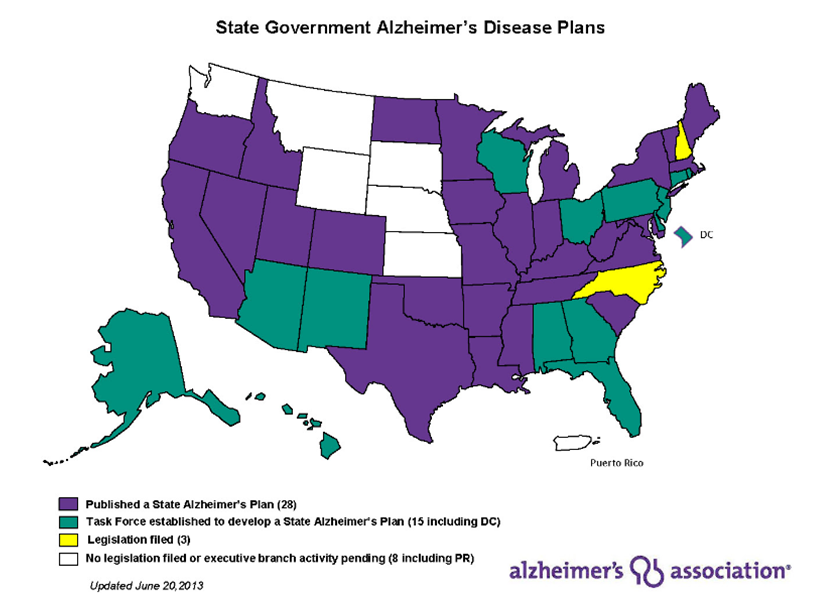
Thirty-one states have published a plan to respond to what advocates describe as the “escalating crisis” of Alzheimer’s Disease. Connecticut may be next, and is one of 13 states currently in the midst of developing plans.

The Connecticut Chapter of the Alzheimer’s Association was among the leaders in crafting and shepherding legislation in the 2013 General Assembly session to create a task force to study the care provided to persons diagnosed with Alzheimer's disease and dementia in the state.  That Task Falzheimers-wordsorce has been up and running throughout the fall, and is poised to announce its recommendations next month, just ahead of the start of the 2014 legislative session in February.

The 23-member task force of key agencies and community stakeholders convened in September, under the auspices of the Legislative Commission on Aging, to prepare findings and recommendations on ways to improve early detection, better coordinate health care services, set training requirements for health care providers and other professionals, services for early-stage and younger onset, and support to family caregialz mapvers.

The Task Force was co-chaired by State Commissioner on Aging Edith Prague and Rep. Joseph Serra of Middletown.  Members included Laurie Julian of the Alzheimer’s Association in Connecticut and other diverse community stakeholders appointed by legislative leadership and representatives from state agencies including the Department of Public Health, Department of Emergency Services, Department of Banking, Department of Labor and Department of Social Services, as well as six current legislators.

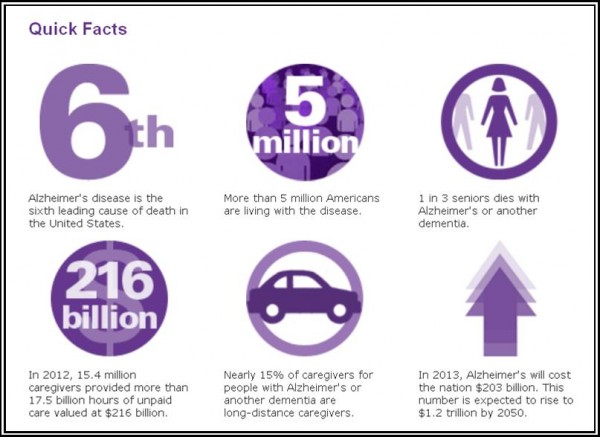
Over 5 million Americans are living with Alzheimer’s, and as many as 16 million will have the disease in 2050. Nearly one in every three seniors who dies each year has Alzheimer’s or another dementia. The cost of caring for those with Alzheimer’s and other dementias is estimated to total $203 billion in 2013, increasing to $1.2 trillion (in today’s dollars) by mid-century. Between 2000 and 2010, nationally, the number of people who died as a result of breast cancer, prostate cancer, heart disease, stroke and HIV all declined, while the number of people who died with Alzheimer’s increased by 68 percent.

In Connecticut, there were 820 deaths due to Alzheimer’s Disease in 2010, there are more than 63,000 individuals with Alzheimer’s in nursing homes in the state and it is estimated that 68% of nursing home residents have a cognitive impairment. As of 2010, there were an estimated 2,800 people between age 65-74 with Alzheimer’s in Connecticut, 30,000 between 75 and 84, and 37,000 age 85 or older.

The task force, in accordance with the legislation, will make recommendations in areas including:alz stats

  • services provided to persons diagnosed with Alzheimer's disease and dementia; including persons with early-state and early-onset of Alzheimer's disease, and such persons' family members and caregivers
  • legislative policy changes to better serve such persons, family members and caregivers;
  • coordination between state agencies and private community-based health care providers to serve such persons, family members and caregivers;
  • case management services for such persons, family members and caregivers;
  • the transition of such persons from one health care facility to another; and
  • the placement of such persons in community-based settings or health care facilities other than nursing home facilities, when feasible.

The state legislature acknowledged the growing numbers of residents impacted by the disease, passing the bill unanimously earlier this year, with 67 co-sponsors. It was signed into law in June by Gov. Malloy.  The Alzheimer’s Association has been actively involved in the effort. The organization’s   Connecticut chapter is based in Rocky Hill, with regional offices in Hamden, Norwalk, Norwich and New Milford.

In accordance with the legislation, the task force report is due to be published early next month, according to officials at the State Legislative Commission on Aging.


18 Connecticut School Districts Named to Advanced Placement Honor Roll

Eighteen Connecticut school districts have been named to The College Board’s 4th Annual AP District Honor Roll — a list of 477 districts across the U.S. and Canada being honored for increasing access to AP (Advanced Placement) course work while simultaneously maintaining or increasing the percentage of students earning scores of 3 or higher on AP Exams.

Reaching these goals indicates that these districtsAP district are successfully identifying motivated, academically prepared students who are likely to benefit from rigorous AP course work, according to The College Board.

The Connecticut school districts include public schools in Berlin, Brookfield, Cheshire, Clinton, East Hampton, Ellington, Enfield, Fairfield, Greenwich, Killingly, Monroe, Newtown, Southington and Wallingford, as well as Regional School Districts 8 (Hebron, Andover, Marlborough), 14 and 18 and the Diocese of Bridgeport.

Most of the districts had received similar recognition in previous years; new to the list are Wallingford, Regional Districts 14 (Woodbury and Bethlehem) and 18 (Lyme and East Lyme), Killingly, Greenwich, Clinton, Fairfield and Enfield and the Diocese of Bridgeport. A year ago, there were 26 Connecticut school districts recognized on the AP District Honor Roll.

 AP is a rigorous academic program that offers more than 30 courses in a wide range of subjects and college-level assessments developed and scored by college and university faculty members and experienced AP teachers. According to the College Board, a score of 3 or higher on an AP exam represents the score point that is predictive of college success and college graduation. The AP courses offered various by school dstudents hsistrict, but often include biology, chemistry, physics, Spanish, U.S. history, English literature, and calculus.

Helping more students learn at a higher level and earn higher AP scores is an objective of all members of the AP community, from AP teachers to district and school administrators to college professors, officials at The College Board point out. They noted that many districts are experimenting with a variety of initiatives and strategies to determine how to simultaneously expand access and improve student performance.

Inclusion on the 4th Annual AP District Honor Roll is based on the examination of three years of AP data, from 2011 to 2013, for the following criteria.

  • Increased participation/access to AP by at least 4 percent in large districts, at least 6 percent in medium districts, and at least 11 percent in small districts;
  • Increased or maintained the percentage of exams taken by African American, Hispanic/Latino, and American Indian/Alaska Native students, and;
  • Improved performance levels when comparing the percentage of students in 2013 scoring a 3 or higher to those in 2011, unless the district has already attained a performance level at which more than 70 percent of its AP students are scoring a 3 or higher.

In 2013, more than 3,300 colleges and universities around the world received AP scores for college credit, advanced placement and/or consideration in the admission process, with many colleges and universities in the United States offering credit in one or more subjects for qualifying AP scores.

Regional School District 14’s Superintendent, Jody Ian Goeler said, “It is wonderful to see so many of our High School students challenging themselves to take and succeed in our most rigorous courses. It is a strong indication our Board of Education’s advocacy for these programs is well placed and providing excellent opportunities and results for our students.”

Greenwich High School Principal Chris Winters recently commented that “Our participation in AP  classes is at a 10-year high, and the average score has remained unchanged and at very high levels. For the first time, over 50 percent of Greenwich High School have passed at least one AP exam during their four years.”

Nationwide data from 2013 show that among African American, Hispanic, and Native American students with a high degree of readiness for AP, only about half of students are participating. These 477 districts, The College Board indicated, are committed to expanding the availability of AP courses among prepared and motivated students of all backgrounds.

Hartford Hospital Will Devote Annual Fundraiser to Mental Health

The call to action regarding mental health awareness and treatment, which intensified in the aftermath of the Sandy Hook Elementary School murders a year ago, now has a strong local voice for the New Year.  Hartford Hospital is kicking off a campaign to end the stigma of mental illness at the annual Black & Red Gala on January 25, 2014 at The Bushnell Center for the Performing Arts in Hartford. The goal is to obtain 5,000 pledges, spreading the message that changing attitudes can begin to change minds.

Proceeds raised at this year’s Black &Red will benefit the Institute of Living (IOL) at Hartford Hospital. The IOL will be better able to respond to this national call to action with improved access to mental health care for adolescents and young adults –a critical need not only in Connecticut, but throughout the nation. Support will help carry out critically needed research, offer increased shhMainLogoSubervices and treatments, and provide much needed education to those impacted by mental illness.

An estimated 26.2 percent of Americans ages 18 and older — about one in four adults — suffer from a diagnosable mental disorder in a given year. In addition, mental disorders are the leading cause of disability in the U.S. and Canada. Many people suffer from more than one mental disorder at a given time.

Mental health stigma can be divided into two distinct types, according to the Hartford Hospital website:

  • social stigma is characterized by prejudicial attitudes and discriminating behavior directed towards individuals with mental health problems as a result of the psychiatric label they have been given.
  • perceived stigma or self-stigma, is the internalizing by the mental health sufferer of their perceptions of discrimination and perceived stigma can significantly affect feelings of shame and lead to poorer treatment outcomes.StopTheStigma_WordsMatter

The annual gala – Hartford Hospital's lead fundraising event - will feature entertainment by Barenaked Ladies, winner of two American Billboard Music Awards and two Grammy nominations.

Individuals attending the event will be asked to sign a “pledge” to...

  • Show compassion by reaching out to those in need of help. I will not let anyone suffer in silence.
  • Have the courage to speak up and challenge stereotypes and attitudes. I will not tolerate or perpetuate stigma.
  • Teach by sharing my own experiences with mental illness and encouraging others to share their stories with me. I will learn in order to change.
  • Demand a change in how we view and address mental illness. I will help lead the way.

The pledge, and additional information about mental illness and the Hartford Hospital initiative, is now available on a new webpage on the Hospital’s website, at www.stopthestigma.org   Individuals do not need to attend the event in order to sign the pledge – that can be accomplished directly on the website.

 “We will be looking to our employees of Hartford Hospital and across the Hartford HealthCare system to take the pledge. As a healthcare leader in the community and the state, it is our duty to set the example and stop the stigma associated with mental illness. Together, we can do it,” said Stuart Markowitz, M.D., President Hartford Hospital and Hartford Region, Senior Vice President Hartford HealthCare.

Harold (Hank) Schwartz, M.D., Hartford HealthCare Regional Vice President, Psychiatrist in Chief, Institute of Living at Hartford Hospital, says for some people, a mental illness iol_logo_300x175may be a lifelong condition, like diabetes. “However, as with diabetes, proper treatment enables many people with a mental illness to lead fulfilling and productive lives. By helping combat the stigma associated with mental illness, we can help increase the number of people that seek treatment.”

Examples of common mental illnesses include bipolar disorder, depression, PTSD, schizophrenia, OCD, anxiety disorders, eating disorders, ADD/ADHD, autism and Asperger’s.  CT by the Numbers has previously reported on research underway at the Institute of Living.

A year ago, over $1,000,000 in net proceeds was raised at the Black & Red gala for Hartford Hospital’s transplant services.

Connecticut is Nation’s Fourth Most Innovative State, Data Reveals

Connecticut is ranked as the nation’s fourth most innovative state, in a new analysis from Bloomberg Technology.  The state’s ranking was based on factors including education, professionals in science, technology, engineering and math (STEM) fields, state research and development spending, and technology companies.

The state’s overall score in the analysis, 76.45, is just behind top-ranked Washington’s 83.25, California’s 81.97 and Massachusetts’ 80.93. States were ranked on a scale of zero to 100 in six factors, and received an overall score that was an average of the six. Because productivity consisted of two sub-factors, each was weighted 50%.

 Connecticut’s ranking was based on the following factors:states of innovation

  • STEM professionals as a percentage of state population: 2.72% (CT ranked #7)
  • Science and tech degree holders as a percentage of state population: 10.2% (CT ranked #6)
  • Utility patents granted as a percentage of U.S. total: 1.74% (CT ranked #17)
  • State government R&D spending as a percentage of U.S. total: 2.79% (CT ranked #8)
  • Gross state product per employed person: $114,891 (CT ranked #5)
  • Three-year change in productivity: 0.88% (CT ranked #32)
  • Public tech companies as a percentage of all public companies based in the state: 17.65% (CT ranked #17)

Sources of the data include Bloomberg, Bureau of Economic Analysis, Bureau of Labor Statistics, National Science Foundation, U.S. Census, and the U.S. Patent and Trademark Office.  The analysis was updated in November 2013, and the rankings were published this month.

The remainder of the top 20 innovative states were:

5. Oregon 6. New York 7. New Jersey 8. Colorado 9. Maryland 10. Minnesotabloomberg technology 11. Virginia 12. Texas 13. Utah 14. Arizona 15. North Carolina 16.  Illinois 17. Pennsylvania 18. Kansas 19. New Hampshire 20. D.C.

At the bottom of the list of innovative states were Louisiana, Tennessee, Wyoming, Mississippi and Arkansas.

Newtown High School Students Win International Public Health Education Contest

Each year, about 3.5 million children die before their 5th birthday due to preventable diseases, mainly diarrhea and acute respiratory diseases.   According to survey data from the Global School-based Student Health Survey, over 15 percent of schoolchildren in some countries say they rarely or never wash their hands before eating.

Those facts spurred a group of Newtown High School student to action.  They participated in the World Health Organization’s Touching Lives School Talent International Contest.  The onewtown highne-minute educational video they produced was selected by a jury of international experts as the winning entry in the middle/high school age category (age 10-16) and was the only United States-based entry to win its category.

The Newtown Public Health class submitted the video at the start of the school year, and it was selected this fall among the winners in various age categories.  Their video now appears on the website of the Pan American Health Organization, and has begun to appear on other public health websites, including the Connecticut Public Health Association.  It was designed, written and pan americanproduced in the opening weeks of school, just prior to  the mid-September entry deadline.

Experts point out that “just rinsing your hands is not washing.” In order for hands to be clean, soap and water must be used, for at least 20 seconds. Handwashing with soap is the most effective and inexpensivsinke way to prevent diarrheal and acute respiratory infections. Together, they are responsible for the majority of all child deaths, officials report.

Turning handwashing with soap before eating and after using the toilet into an ingrained habit could save more lives than any single vaccine or medical intervention, cutting deaths from diarrhea by almost half and deaths from acute respiratory infections by one-quarter, experts predict.  They also point out that a vast change in handwashing behavior is critical to meeting the Millennium Development Goal of reducing deaths among children under the age of five by two-thirds by 2015.

The educational video is preceded with the words “A Message from Newtown High School’s Public Health Class” filling the screen. It then begins with a male student gently singing over a strumming guitar, reminding viewers of the importance of hand-washing in rhyming lyrics, including urgintv monitorg viewers to “always think, 20 seconds at the sink.”  The video then features a variety of voices repeating “20 seconds” in nearly a dozen world languages.  It concludes by suggesting “don’t be part of the problem, be part of the solution.”

The video was edited by Amylee Anyoha.  Students in the Newtown High Public Health Class included Jess Amante, Maddie Erhardt, Enea Musaka, Sarah Craig, Kelly O’Connell, Chris Beaurline, Sydney Allen, Gabby Durkin, Tim Krapf, Amanda Paige, Taylor Strolli and Heather McKeown.

In the 2013 #TouchingLives School Talent International Contest, students could work individually or in a group, and all the countries in the Americas, were eligible and encouraged to develop songs, videos, illustrations, written compositions or any other expression of art promoting hand washing. The contest was, according to organizers, “about giving your personal touch to change the world.”

Two-Thirds of Drivers Use Cell Phones While Driving Despite Dangers, Survey Says

It turns out that the problems is much greater than just teens.  Texting while driving – like texting – is cutting across the population, presenting dangers that are well-documented and increasingly ignored.  And it’s not only texting – it is the use of phones while driving as well that is causing concerns among safety experts.

New research from the AAA FoundOLYMPUS DIGITAL CAMERAation for Traffic Safety indicates that high school-aged teens report using their phones or texting while driving substantially less often than adults do.  The AAA survey found that adult drivers ages 25-39 were the most likely to admit engaging in these risky behaviors behind the wheel.

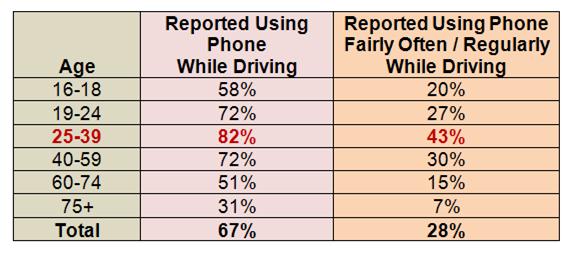
Though the practice is hazardous at any age, two out of three drivers reported using a cell phone while driving within the past month. Forty-three percent of adults ages 25-39 reported doing so fairly often or regularly while driving, compared to only 20 percent of teens.  Motorists age 60 and up were the least likely to report using a phone.

“Using your phone while driving may seem safe, but it roughly quadruples your risk of being in a crash according to previous research,” said Stephen Rourke, manager of driving school administration for AAA. “None of us is immune from the dangers of distracted driving. The best advice is to hang up and drive.”AAA age

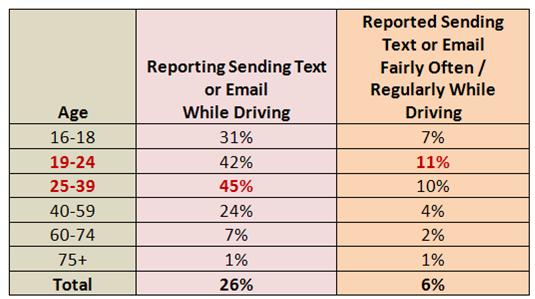
More than one-in-four motorists reported sending a text or email while driving within the past month. Adults ages 25-39 reported texting and driving most frequently, while those age 60 and up reported doing it the least.

According to the National Highway Traffic Safety Administration, one out of every ten fatal crashes involves distraction, resulting in more than 3,000 deaths per year, although experts agree the numbers are likely underestimated.

Previous research shows that hands-free cell phones offer no significant safety benefits over handheld phones – hands-free is not risk-free.  Earlier this year, Connecticut by the Numbers reported on a proposal in Connecticut to ban the useAAA text chart of electronic devices in vehicles.

The AAA Foundation for Traffic Safety collected the data as part of the 2013 Traffic Safety Culture Index. The data are from a sample of 2,325 licensed drivers, ages 16 and older, who reported driving in the past 30 days.

Connecticut Receives "F" in Report Card on High School Financial Literacy Requirements

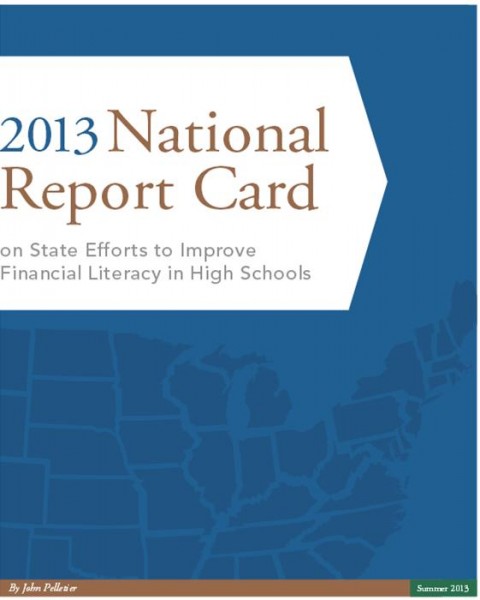
Connecticut received a resounding F in a state-by-state Report Card of financial literacy education requirements at the high school level, according to a study by the Center for Financial Literacy at Champlain College in Burlington, Vermont.cover

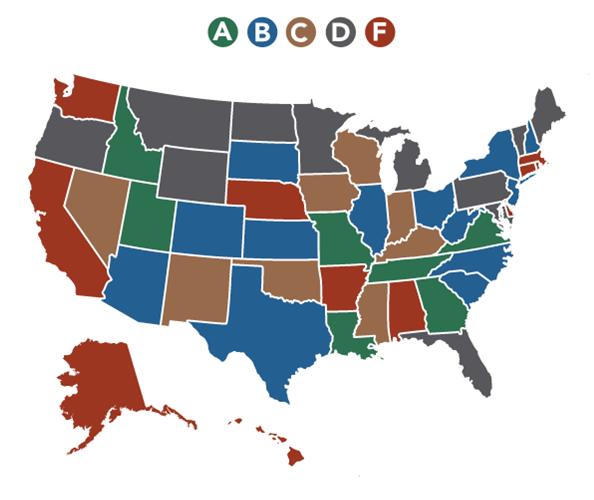
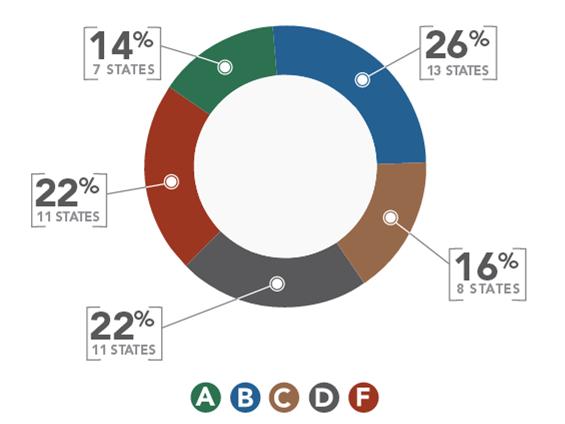
Connecticut is one of 11 states to receive a failing grade.  The others were Alabama, Alaska, Arkansas, California, Delaware, Hawaii, Massachusetts, Nebraska, Rhode Island and Washington.  Those states, according to the report, “have few requirements, or none at all, for personal finance education in high school.”

USA grade mapOverall, 60 percent of states received a C, D or F while 40 percent of states received an A or B grade.  Among those at the head of the class, receiving an A, were Georgia, Idaho, Louisiana, Missouri, Tennessee, Utah and Virginia.  Four of those states – Virginia, Utah, Tennessee and Missouri – require a one-semester standalone course in personal finance as a graduation requirement.

The report, 2013 National Report Card on State Efforts to Improve Financial Literacy in High Schools, indicated that in Connecticut:

  • Personal finance topics are included in the state’s educational guidelines but the state does not require that local school districts teach these topics. (Source: CEE Survey)
  • No personal finance requirement, although personal finance may be taught at certain schools as an elective. (Source: Jump$tart Survey)
  • Since 2007 Connecticut legislators have introduced seven bills in an attempt to bring financial literacy into their schools. All attempts have failed. In 2009 the state passed a law allowing banks to open branches in schools to help students learn about saving money. (Source: NCSL Summaries)

The report suggests four key elements to a successful financial literacy program at the high school level:

  1. Requirement: Financial literacy topics must be taught in a course that students are required to take as a graduation requirement.states circle
  2. Training: Teacher training is critical.  To effectively educate our students about personal finance, we need confident, well-trained educators.
  3. Funding: Funding is needed to ensure that these classes are offered to all high school students.
  4. Assessed:  In order to make sure that the high school classroom personal finance training is working, we need to give students standards assessments on knowledge and behaviors.

Noting the lack of financial literacy education across the country, the report indicates that “for our nation’s youth, learning is often being down through personal experience.  Making mistakes with your credit is a painful way to learn a life lesson.”  The report’s introduction also notes that “to improve personal finance outcome for American citizens, our nation must be educated in personal finance… In too many of our states, our youth receive little if any personal finance training in middle school, high school and college.”

Bullying Presents Ongoing Danger; Efforts to Educate Intensify As Incidents Continue

"From a young age, we teach children to say, 'Sticks and stones will break my bones, but names will never hurt me.' But this isn't true. Bullying hurts so much not because one individual is rejecting us but because we tend to believe that the bully speaks for others that if we are being singled out by the bully, then we are probably unliked and unwanted by most. Otherwise, why would all those others watch the bully tease us rather than stepping in to help support us? Absence of support is taken as a sign of mass rejection.”

That observation, in Social: Why Our Brains Are Wired to Connect, a new book by Matthew D. Lieberman, Director of the UCLA Social Cognitive Neuroscience laboratory, Socialpublished by Random House, provides insight into why bullying has such dramatic impacts, including incidents in Connecticut.

A Hartford Courant review of state education records, published this fall, found more than 1,250 incidents of school bullying were reported to the state from 2005 to 2012. The state's largest cities — Hartford, Bridgeport and New Haven — reported the most incidents, with Hartford reporting 91 verified incidents.

A quarter of the state's high school students — and 35 percent of the state's ninth-graders — report having been bullied or harassed on school property, according to the state Commission on Children. The Connecticut School Health Survey shows that state high school students who report being bullied are more likely to get less sleep, miss school because they feel unsafe, feel depressed, or attempt suicide, the Courant reported.

New Recommendations Anticipated

The state Department of Education plans to make a series of recommendations to the 2014 General Assembly “to address current conditions in Connecticut.”  Those recommendations may include an examination of the terminology regarding bullying and climate in an attempt to signal increased and focused attention on improving school climate in addition to, or rather than, exclusively reacting to bullying incidents, as well as addressing the relationship between the definitions of bullying and harassment and the implications for actions that the district or state should take regarding reported incidents.

The Department prepared “Bullying and Harassment in Connecticut:  A Guide for Parents and Guardians” a year ago, in December2012.

Programs Respond and Teach

The Anti-Defamation League (ADL) is one of the leading organizations providing information and training for individuals who work with students on a daily basis, and anti-bias and anti-bullying programs for students ranging in age from fourth grade through seniors in high school. Such programs include “Names Can Really Hurt Us,” “Step Up!” and “Becoming an Ally.” The Connecticut ADL hosted two parent workshops in Greenwich this fall, just weeks after a 15-year-old Greenwich student took his own life on the first day of school this fall, and friends said bullying may have been a factor in the death.

The programs, which had been planned since the spring, sought to give parents strategies for bullying prevention and intervention. As part of the program, Greenwich High School students who had been trained by ADL talked to those in attendance about their experiences with bullying and cyber-bullying, Greenwadllogoich Time reported. “We offered strategies and resources that the parents found very valuable. It was a unique opportunity for parents and high school students to have an open and honest dialogue about bullying and cyber-bullying issues that face today’s youth,” said Marji Lipshez-Shapiro, ADL Connecticut’s Director of Education.

The ADL programs explore stereotyping, prejudice, discrimination and scapegoating through the lens of students' experiences, and include student testimony, skits, videos and discussion groups. The ADL’s Names Can Really Hurt Us is described as a powerful, student-centered assembly program designed to give a voice to the targets of bullying and prejudice, build empathy in the perpetrators and inspire bystanders to become allies. ADL works with a team of students and school staff who participate in six hours of training and assist ADL in putting on a full-day program consisting of a morning assembly, break-out groups and a closing assembly.  During the morning assembly, student participants share their personal experiences with bullying, name-calling and prejudice in a safe forum. Students then participate in small group discussions led by student-teacher teams. The program culminates with a report of “next step” ideas, generated by students, to help create a welcoming and supportive school community.

Incidents Continue Despite Law

Stamford police arrested a 12-year-old girl and charged her with disorderly conduct for bullying another girl this fall. Police said an investigation began in September when the target's parents contacted police and said another student had repeatedly bullied the 13-year-old at school. When the bullying worsened and the targeted girl made comments about committing suicide, police saidstop bullying they immediately got involved. School administrators in Manchester last month suspended four Manchester High School students suspected of creating and posting degrading descriptions of female students, The Hartford Courant reported.

In Connecticut, the state legislature unanimously passed an anti-bullying law in 2011 that speeds school response, expands staff training, makes all school employees mandated reporters of bullying, addresses cyber bullying and launches statewide school climate assessments.  Under the state legislation, schools must report acts of bullying to the state. The state's definition of bullying includes "the repeated use by one or more students of communication, a gesture or a physical act directed at or referring to another student in the same district that causes physical or emotional harm or fear of such harm."

A 2011 U.S. Department of Justice survey shows that 54 percent of Asian-American teenagers, 38.4 percent of black students and 34.3 percent of Hispanics reported being bullied in the classroom. The survey found that 31.3 percent of white students reported being bullied.

In September, Michelle Pincince, Project Director of the Connecticut ADL’s A World of Difference Institute met with about 25 school resource officers from throughout Connecticut. The program, which took place at Redding Elementary School, was organized by Redding Police Chief Doug Fuchs, according to published reports.  A school resource officer is a law enforcement officer who is assigned to a school in his town, and who protects the students in the school and works to promote positive relationships between students and law enforcement. ADL runs 200 education programs and reaches over 20,000 individuals in Connecticut annually.  Since the school year began this fall, 31 Connecticut schools have participated in ADL programs. 

LEGO KidsFest in Connecticut This Weekend, State Experiences Company’s Growth, Strength

There’s no mistaking the popularity of LEGO.  The colorful bricks are ever-present in playrooms, bedrooms, and under couch cushions everywhere.  The passion for the colorful bricks will be on display this weekend (Dec. 6-8, 2013)  in Connecticut when the LEGO Kidsfest returns to the Connecticut Convention Center in Hartford for a weekend of creativity and construction, concluding the year’s six-city tour, and the first time it’s been back in Connecticut in two years.  (Tickets for Saturday are already sold out, with limited availabilities for Friday and Sunday sessions. )KidsFest

Beyond this weekend’s event, the Connecticut connections to LEGO may be surprising.

The LEGO KidsFest is a nationally-traveling giant LEGO expo held over three days and filled with interactive, creative and educational activities for the whole family. Connecticut is central to the LEGO universe.  LEGO Systems, Inc. is the North American division of The LEGO Group, a privately-held, family-owned company based in Billund, Denmark, one of the world’s leading manufacturers of creatively educational play materials for children.  The LEGO Kidsfest, however, is produced by LIFE Marketing and Events, located in West Hartford.

LEGO floorAt each tour stop, the LEGO KidsFest partners with national and local organizations and businesses whose products, services and promotional efforts are kid-friendly and beneficial to attendees. Next year, the tour will again run in seven cities: North Carolina: February 28–March 2;  Michigan: April 25–27;  Alberta, Canada: May 16–18;  Georgia: June 27–29;  Texas: August 29–31;  Virginia: October 3–5; and Indiana: November 7–9.  In 2011, the KidsFest was held in five cities, and has steadily grown in popularity.  Sellouts have been regular occurrences throughout 2013.
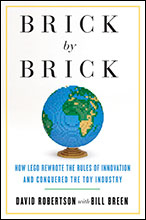
In the new book “Brick by Brick:  How Lego Rewrote the Rules of Innovation and Conquered the Global Toy Industry,” published by Crown Business division of Random House, author David C. Robertson points out that Lego “is driven by two desires.  The first is to inspire imaginative play and creative expression in as many kids and kids-at-heart as possible, in as many ways as possible.”  The second is to out-innovate every company it comes up against.”

The book, which explores Lego’s resurgence from near oblivion over the past two decBrickbyBrickades, outlines the company’s trials, tribulations (including near-bankruptcy in 2003), innovations and success, observing that “The LEGO Group’s leaders believe that to discover the next big growth opportunity, the company must adhere to a fundamental truth about innovation:  the more experiments you launch, the more likely it is that one will strike gold.”   KIdsFest is but one example.
The company is also expanding is footprint in Connecticut, having announced earlier this year that it was leasing an additional 80,198 square feet in the Enfield Business Park.  The company eventually plans to add more than 200 employees.

“We have about 600 employees in Enfield currently, and the space will provide desks for an additional 250 — not all of whom will be hired immediately,” Michael McNally, Lego’s brand manager said in April. The company in 2011 started to reconfigure its former manufacturing space into administrative offices. The building houses workers in finance, human resources, information technology, consumer services, direct-to-consumer retail, as well as Lego Master Builders.

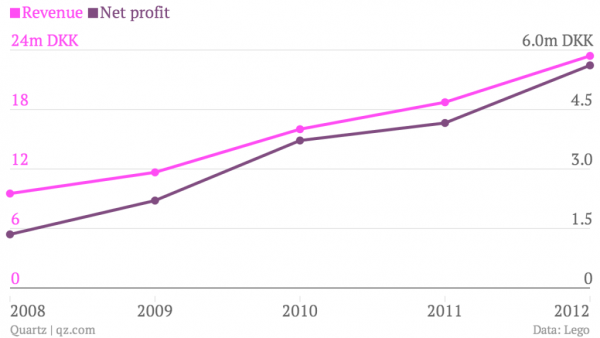
revenue-net-profit_chartbuilderLast month, it was reported that LEGO, already the second-biggest toy maker in the world, after Mattel, is continuing its expansion. In 2014, it will go from having one global headquarters, in Denmark, to five. The company is expanding its offices in London, Singapore, Shanghai and Enfield, Connecticut to form a network of global hubs.

The globe depicted on the cover of Robertson’s book, made of LEGO bricks, of course, is a fitting representation of the company’s growth – with Connecticut playing a noteworthy role.