Foreclosure Rate Drops Nationally, CT Better Than National Average

Foreclosure filings — default notices, scheduled auctions and bank repossessions — were reported on 150,864 properties across the U.S. during January, a decrease of 7 percent from the previous month and down 28 percent from January 2012. The report - by RealtyTrac®, a leading online marketplace for foreclosure properties and real estate data - shows one in every 869 U.S. housing units with a foreclosure filing during the month, down 28 percent from a year ago to the lowest level since June 2006 — a 79-month low. Each of Connecticut’s eight counties is below the national average, and the state continues to be outside the top 10 states for the number of foreclosures, according to the U.S. Foreclosure Market Report™ for January 2013.  The prevalence of foreclosures, based on the number of housing units, was greatest in Windham, Tolland, and New Haven Counties.

The Florida foreclosure rate ranked highest among the states for the fifth month in a row. One in every 300 Florida housing units had a foreclosure filing in January — more than twice the national average. A total of 29,800 Florida properties had a foreclosure filing during the month, up 12 percent from the previous month and up 20 percent from January 2012.MapPic_000918

With one in every 344 housing units with a foreclosure filing in January, Nevada posted the nation’s second highest foreclosure rate for the fourth consecutive month. A 32 percent month-over-month jump in scheduled foreclosure auctions helped the Illinois foreclosure rate rise to third highest among the states in January. One in every 375 Illinois housing units had a foreclosure filing during the month.

Other states with foreclosure rates among the nation’s 10 highest were Arizona (one in 501 housing units with a foreclosure filing), Georgia (one in 513 housing units), Ohio (one in 612 housing units), Washington (one in 674 housing units), California (one in 753 housing units), Indiana (one in 784 housing units), and Michigan (one in every 837 housing units).

In Connecticut, New Haven County had the largest number of foreclosures in January, with 317, followed by Hartford County with 265 and Fairfield County with 193.  Overall, Connecticut had 5,187 home foreclosures during the month, with the average foreclosure sales price of $186,405.  The county-by-county breakdown:

  • Windham            51 foreclosure properties             1 in every 958 housing units
  • Tolland                 52 foreclosure properties             1 in every 1,109 housing units
  • New Haven        317 foreclosure properties          1 in every 1,138 housing units
  • Hartford               265 foreclosure properties          1 in every 1,409 housing units
  • Litchfield              57 foreclosure properties             1 in every 1,530 housing units
  • New London      78 foreclosure properties             1 in every 1,546 housing units
  • Fairfield                193 foreclosure properties          1 in every 1,865 housing units
  • Middlesex           37 foreclosure properties             1 in every 2,013 housing units

In New Haven County, the numbers were driven by Waterbury with 84 foreclosures and New Haven with 59.  West Haven had 38 during the month.  In Hartford County, there were 44 foreclosures in New Britain, 35 in East Hartford and 26 in Manchester, according to the data provided by RealtyTrac.

Credit Card Debt Increases Among Older Residents

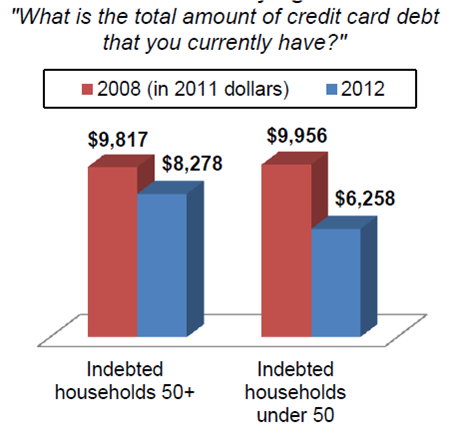
As Connecticut struggles to lift itself from a nagging recession and rebuild a shaky economy and grow jobs, new national data suggest that economic realities plus an aging population are combining to increase the credit card debt among a significant segment of the population. It has been estimated that the state's 65+ population would increase by 69 percent between 2000 and 2030. Middle-income Americans age 50 and older are carrying more credit card debt on average than younger people, according to a National Survey on Credit Card Debt of Low- and Middle-Income Households, released last month by Demos, a national policy think tank and AARP’s Public Policy Institute.

The results of the 2012 survey are a reversal of findings from a survey conducted by Demos in 2008.  It reveals a troubling picture of middle-income 50+ households carrying card debt near or in their retirement years.

The report shows that nationwide, older households carried an average credit card balance of $8,278 in 2012. For those underlogo 50, credit card debt averaged $6,258. Other key findings for middle-income households that carried credit card debt for three months or more:

  • A third of older households used credit cards to pay for basic living expenses such as rent, mortgage payments, groceries, or utilities.
  • Half of Americans age 50+ carried medical expenses on their credit cards. Prescription drugs and dental expenses were the main contributors.
  • A quarter of older households said loss of a job contributed to their credit card debt in the last three years.
  • Nearly one in five (18 percent) older Americans nearing retirement said they dipped into retirement funds to pay down credit card debt.chart
  • Older Americans were twice as likely as those under age 50 to take on credit card debt to assist other family members (23 percent vs. 11 percent).

This report suggests that credit card debt among older Americans is primarily a reflection of difficult economic times, not a lack of personal financial responsibility.  State-by-state data was not available.

The findings may help to explain the economic challenges facing Connecticut’s citizenry, which is on track to becoming one of the oldest among the states, expected to grow from 470,183 (13.8% of the total state population) in 2000 to 794,405 in 2030, constituting 21.5% of the projected total state population.


Three Cities Selected for Program to Bring Housing Downtown

Connecticut Main Street Center (CMSC) has selected Middletown, Torrington and Waterbury for its new pilot program, Come Home to Downtown. CMSC developed the mixed-use real estate planning pilot program to provide selected communities with new tools to strengthen economic health and restore vitality to their downtowns, facilitating the development of viable, interesting housing opportunities while improving downtown neighborhoods. The goal of the Come Home to Downtown program is to set the stage to attract developers and “mom and pop” building owners to redevelop vacant or underutilized buildings with a mix of uses and housing choices. CMSC will also provide local public and private champions and partners with strategic tools to aldowntownlow them to create or enhance a strong downtown management program.  The Come Home to Downtown pilot was created in partnership with the Connecticut Housing Finance Authority (CHFA), through a $250,000 investment using Community Investment Act (CIA) Program funding.

“Our Come Home to Downtown pilot communities were selected based on criteria we feel is vital for success, including local public and private sector leadership, a strong record of community engagement, success of previous downtown revitalization initiatives and multi-story buildings and property owners who are motivated to redevelop them,” said CMSC’s John Simone.

CMSC will work in concert with Middletown, Torrington and Waterbury, beginning with the collection of data, building analysis and the coordination of community engagement activities, exploring their downtown redevelopment issues in-depth and creating new strategies that respond to changing demographics and market dynamics.  Work will continue throughout the summer on consensus buiphoto_center_01lding, a downtown development audit for each of the towns, model building analysis, assistance to small-property owners who demonstrate a desire to redevelop their properties to include housing, and downtown management organizational development.

Connecticut Main Street Center is a statewide nonprofit that inspires great Connecticut downtowns, Main Street by Main Street. Its mission is to be the champion and leading resource for vibrant and sustainable Main Streets as foundations for healthy communities.

Foundation Seeks Loaned Funds to Launch Early Childhood Music in Hartford

A full page advertisement in The Hartford Courant recently sought individuals interested in “parking idle funds for education.”  The open request, designed to attract funds that would enable the organization to create a free early childhood music program in Hartford, came from the POTE Foundation, Inc., a Connecticut based organization committed to providing educational support and resources to youth. POTE, which is an acronym for providing opportunity though education, promotes the vision that success is achieved when opportunity meets preparation.  The organization, founded in 2007:

  • provides financial and support services to all levels of the educational process—early childhood through higher education;POTE
  • strives to develop unique programs to encourage educational excellence for youth who encounter the lack of opportunity, either because of economic or intellectual barriers; and,
  • engages the intellectual and financial resources of baby boomers along with corporate and foundation outreach.

The ad points out that POTE “has successfully provided cost free violin instruction to K and pre-K students in Connecticut,” noting that “early involvement in music enhances reading achievement and fosters and appreciation of music in the development of the child.”

It asks that interested individuals “grant an interest free term loan to provide investment income to fully fund enrollment” in the program, to be used to develop a learning facility in Hartford and provide investment income to fully fund enrollment.  “Loan principal will not be expended for either construction or operating costs,” the organization points out. And POTE emphasizes that “all funds collected from fundraising activities go to program services – there are no administrative costs for POTE activities,” according to POTE President Christopher Wolf.

In accordance with its mission statement, during the past five years, the Glastonbury-based POTE has:

  •  Enrolled 90+ pre-k and kindergarten children in Suzuki cost free violin program over five years in Windsor Locks
  • Provided major funding for 565 youth (ages 4 to 18) for inner city youth in the Waterbury Police Athletic League’s Safe Water Information Movement (SWIM) program
  • Funded after school program for middle school youth for science, math and technology in Waterbury
  • Used fees collected from consulting services, to fund $3,000 for water appreciation and nature walk for Waterbury’s West Side Middle School
  • Provided $5,000 in grant funds to Hartford Conservatory for musical instrument acquisition, maintenance and repair

POTE provided $34,000 in funding for various youth educational programs during 2012.

POTE anticipates that if they are able to move forward with the new Hartford early childhood music education program, “local jobs would be created during the development phases” and the ongoing program would “employ local musicians.”  In the event that the program does not go forward, all proceeds would be refunded.


Six CT Communities to Receive "Preservation of Place" Grants to Boost Local Downtowns

Connecticut Main Street Center (CMSC), the downtown revitalization and economic development non-profit, has awarded six organizations and municipalities a total of $60,000 in 2013 Preservation of Place grants. These grants will be used to provide the communities and organizations with targeted resources to increase their capacity to plan for preservation and revitalization initiatives in their downtowns and neighborhood commercial districts. The winning organizations and initiatives - which will each receive a $10,000 Preservation of Place grant - are:

  • the Town of Kent for a Planning & Engineering Study for its Village Center Streetscape;
  • the City of Bridgeport for the Little Asia Historic Streetscape and Archway Project;1272906927_CTMainStreetLogo
  • the Town of Putnam for the Putnam Downtown Center Signage and Wayfinding Design Project;
  •  the Town of Seymour for the Seymour Greenway Trail and Linear Park Master Plan;
  • the Westville Village Renaissance Alliance for the Westville Village Public Parking Comprehensive Design & Marketing Plan; and the
  • Northwestern Connecticut Regional Planning Collaborative for the NW CT Village Center Vitality Tourism Marketing Campaign.

The Preservation of Place grant program provides a source of funding for new initiatives that can be integrated into, and leverage, comprehensive Main Street preservation and revitalization programs. The funds are meant to be flexible to meet individual community need.

"Historic preservation and the revitalization of our Main Streets create jobs, bring vacant buildings back on the tax rolls and add value and vitality to adjacent buildings and neighborhoods," said John Simone, CMSC President & CEO. "The diversity of locations and the diversity of projects will allow each community to respond to their greatest current need, actively creating their direction of growth."

Since 2008, CMSC has awarded $288,030 through the Preservation of Place grant program to sixteen Connecticut communities, leveraging over $768,427 in local Main Street initiatives. The program receives support from the State Historic Preservation Office with funds from the Community Investment Act.

The mission of CT Main Street Center is to be the champion and leading resource for vibrant and sustainable Main Streets as foundations for healthy communities. CMSC is dedicated to community and economic development within the context of historic preservation, and is committed to bringing Connecticut's commercial districts back to life socially and economically. The Main Street initiative is one of the most successful economic development programs in the country. For every $1 spent on a local Main Street program, $73.13 is reinvested in Connecticut Main Street downtowns.

Adding Women to Corporate Boards Makes Financial Errors Less Likely

Two years ago, Calvert Asset Management Company, Inc. and the Connecticut Retirement Plans and Trust Funds (CRPTF) announced the successful resolution of their joint shareholder proposal on board diversity filed with Netflix, the world's largest subscription entertainment service. The announcement came as the company named its first female director, Ann Mathers, an entertainment industry veteran who joined the Netflix Board on July 1 of that year.  On behalf of the CRPTF, Connecticut Treasurer Denise L. Nappier has spearheaded Connecticut's initiative to increase the participation of women and minorities as members of Boards of Directors of corporations in which the $24 billion pension fund invests.

New data developed by a team of researchers at the University of Wisconsin-Milwaukee suggests that Nappier got it right, at least in one critical aspect of business.  Companies whose directors include one or more women are 38% less likely to have to restate their financial-performance figures to correct errors than firms with all-male boards, says the team led by Lawrence J. Abbott of the University of Wisconsin-Milwaukee.

Gender diversity may make a board more open to viewpoints that oppose the CEO's and may encourage a more deliberative and collaborative decision-making process, according to the research, published in the American Accounting Association journal Accounting Horizons.

Treasurer Nappier has filed numerous shareholder resolutions on corporate board diversity, in accordance with the State of Connecticut's investment policy and the recognition that companies and firms that demonstrate a commitment to diversity are more likely to succeed in an increasingly global marketplace.

Restatements are necessitated by serious misrepresentations, whether through error or fraud, in corporate financial reports. A woman's presence on a board, the researchers found, does more on behalf of financial integrity than such tried-and-true measures as requiring the board's audit committee to consist entirely of independent directors, one of them with financial expertise, and mandating that it meet at least four times annually. The study finds those measures in combination to reduce the likelihood of restatements by about 20%, about half the effect achieved by having a woman director.

As the findings point out, “Gender diversity can potentially affect the outcome by generating more questioning of the status quo, greater acknowledgment and legitimization of opposition and third-party viewpoints (including those of the audit committee, auditor, or internal audit director) and a slower, more deliberative and collaborative decision-making process...heightening the monitoring effectiveness that may [otherwise] be diminished by groupthink."

The study's findings involved a comparison of companies that had to issue financial restatements with a control group of similar firms with no such reporting problem. The restatement sample consisted of 540 firms in total, with each of the restating firms matched with a control company on the basis of market capitalization, industry, and the ranking of the firm that performed its auditing.

Nappier, inducted into the Connecticut Women’s Hall of Fame in 2011, has served as State Treasurer since 1999, having previously served as Treasurer of the City of Hartford.  She is the first African-American woman to serve as a State Treasurer in the nation’s history.

Student Debt Continues to Climb; CT is 5th Highest in USA

Two-thirds of college seniors who graduated in 2011 had student loan debt, with an average of $26,600 per borrower, up from $25,250 in 2010, according to a recent report from the Project on Student Debt at The Institute for College Access & Success (TICAS).  The loan burden of Connecticut college students, on average, exceeded the national average. The top-five leading high-debt states were New Hampshire ($32,440), Pennsylvania ($29,959), Minnesota ($29, 793), Rhode Island ($29,097)and Connecticut ($28,783).  In addition, 64 percent of Connecticut college students have debt, which places the state 15th in the nation.

The five-percent increase from 2010 to 2011 is similar to the average annual increase in recent years. The report also found that about two-thirds of the Class of 2011 had loans, and that private (non-federal) student loans comprised about one-fifth of what they owed.

The report’s findings focus solely on public and private nonprofit four-year colleges, because so few for-profit colleges chose to report the necessary data. However, federal survey data show that nationwide, graduates of for-profit four-year colleges are much more likely to borrow federal and private student loans, and they borrow significantly more than their counterparts at other types of colleges.

Utah and Hawaii had the lowest and second lowest average debt at $17,250 and $17,450.

In looking at the institutions specifically, the only Connecticut higher education institution to reach the top 20 High-Student Debt Public Colleges was the University of New Haven.   Among the top 20 “low-debt” institutions was Yale University.


Targeting Financial Fraud Against Senior Citizens in CT

Attorney General George Jepsen is encouraging members of the public and social service agencies that work with seniors to attend the annual Connecticut Triad conference to learn more about financial exploitation and ways to protect against such abuse. The conference will be Thursday, Nov. 1 from 8:30 a.m. to 12:30 p.m. at the Riverfront Community Center, 300 Welles Street in Glastonbury. In addition to the Attorney General, featured speakers include Hubert H. Humphrey III, of the Consumer Financial Protection Bureau’s Office of Financial Protection for Older Americans; Special Agent Anna Ferreira-Pandolfi of the U.S. Department of Health & Human Services’ Office of the Inspector General and Dr. Linda Eagle of the Global Bankers Institute.

Assistant Attorney General Phillip Rosario, head of the OAG’s Consumer Protection unit, will moderate a panel discussion by representatives of the Glastonbury Police Department, the state Department of Banking, the state Department of Social Services, People’s Bank Fraud Unit and the Probate Court.

The event is free and open to the public, but seating is limited and those attending are asked to reserve a space by e-mailing gjames@swcaa.org, or by calling 203-814-3620, on or before Friday, Oct. 26.

Triad is a national initiative of law enforcement agencies and community groups working together to reduce crimes against seniors. There are more than 60 local Triad chapters in Connecticut. Current members of the CT Triad Advisory Board include: The Office of the Attorney General, The Department of Social Services Aging Services Division, People’s United Bank, The CHOICES Senior Medicare Patrol (SMP) Healthcare Fraud and Abuse Project, AARP Connecticut and the Connecticut Area Agencies on Aging.

David B. Fein, U.S. Attorney in Connecticut, hosted the first of the six summits nationwide focusing on financial fraud earlier this month. He says between 2008 and 2011, FBI statistics show at 136 percent increase in investor fraud schemes. At an event in Stamford on October 1, speakers discussed an increase in scams involving reverse mortgages, the failure of victims to have done any due diligence on those they trust their money to, and a lack of skepticism when an "investment counselor" asks for funds to be paid directly to them.  Since last year, the U.S. Department of Justice says, it has charged, brought to trial, taken pleas or received sentences for more than 800 defendants in investor fraud cases. The amount taken from victims exceeds $20 billion.

Earlier this week, a Wells Fargo survey found that a growing number of middle-class Americans plan to postpone their golden years until they are in their 80's.  CNN reported that nearly one-third, or 30%, now plan to work until they are 80 or older -- up from 25% a year ago, according to the survey of 1,000 adults with income less than $100,000.   Overall, 70% of respondents plan to work during retirement, many of whom plan to do so because they simply won't be able to afford to retire full time.


Student Debt Levels High in CT, Young Unemployment Rate Drops Slightly

As college students across the nation graduate with record-high levels of loans, a recent report found that Connecticut ranks among the five states  with the highest loads of student debt. Roughly 66 percent of college students from the class of 2011 nationwide graduated with student loan debt, and the average loan debt per person amounted to $26,600, according to a report by The Project on Student Debt, an initiative of The Institute for College Access and Success.

The survey  asked universities to self-report debt figures from their graduating classes. In Connecticut, the 2011 average was $28,783, making it the fifth-highest debt state behind four other Northeastern states.  New Hampshire topped the list, with average student debt of $32,450.

The report also found that unemployment rate for young college graduates was 8.8 percent in 2011, a slight drop from 2010’s record high of 9.1 percent. Many more young graduates were underemployed, working just part-time or in lower paying jobs that did not require a college education. Still, college graduates are much better off than those without a college degree. The unemployment rate for young high school graduates was 19.1 percent in 2011, more than double the rate for those with bachelor’s degrees.

Connecticut-specific data, by institution, offers stats including the percentage of students graduating with debt in 2011, which includes universities where the percentage exceeded three-quarters of students.


CT nonprofit launches online financial literacy program

The Connecticut Association for Human Services (CAHS) has launched Financial Avenue, a free, online financial education program to help adults and young adults better manage their money and assets.  The program is the latest in a full range of financial literacy services offered by the New Haven-based CAHS, including in-person classes at partner nonprofits throughout the state.  The new on-line courses provide an option for those who have had trouble making it to  scheduled on-ground classes. Students can earn up to 16 certificates in specific topics and work at their own pace.  According to the Pew Research Center's Internet & American Life Project, two-thirds of American adults earning less than $30,000 use the internet. In addition lower-income internet users (earning $25,000 or less) tend to spend more time on the internet than others, about 13 hours online per month.

CAHS also offers the Connecticut Money School as well as a series of downloadable fact sheets on various financial topics. Connecticut Money School (CMS) is a project of the CAHS  and five nonprofit partners.

To sign up or receive more information on the Financial Avenue program, visit www.ctmoney.org.  Class topics span a wide range of topics including: Budgeting, Borrowing Money, Tackling Debt, Understanding Insurance, Taxes & You, Understanding a Paycheck, Importance of Saving, Banking Basics, Investing in Your Future, Your First Job, Paying for College, Working in College, Credit History, Credit Cards, Contracts, and Identity Theft.

A $25,000 grant from the First Niagara Bank Foundation helped launch Financial Avenue.