More Bicycling, Walking to Work; New Haven Leads the Way in Connecticut

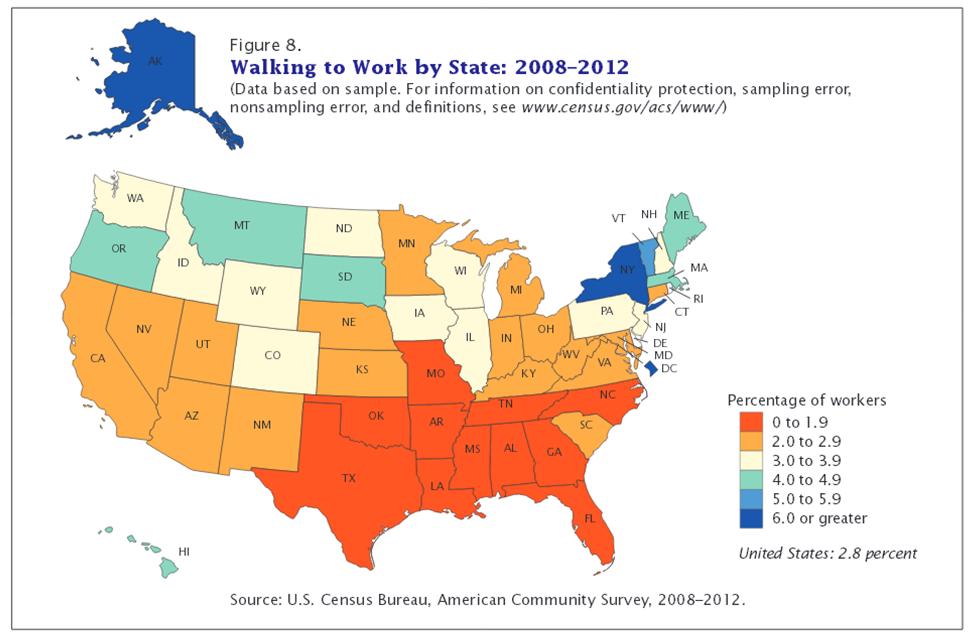
Connecticut has the smallest percentage of people walking to work among states in the Northeast, and is one of two states with the smallest percentage of people who bicycle to work, according to newly released U.S. Census data.  Nationwide, both walking and bicycling to work are on the rise. Between 2000 and 2008–2012, the number of workers in the U.S. who traveled to work by bicycle increased by 60.8 percent, from about 488,000 in 2000 to about 786,000. This increase in the number of bicycle commuters exceeded the percentage increase of all other travel modes during that period, but the overall share of workers who commute bnew haveny bicycle remains low, according to the U.S. Census American Community Survey. In 1980, 0.5 percent of workers commuted by bicycle. This rate dropped to 0.4 percent in 1990, where it remained in 2000, before nudging upward in the latest survey.
The 2008–2012 5-year data show that, among the approximately 140 million workers in the United States during that period, 2.8 percent walked to work and 0.6 percent commuted by bicycle, compared with 86.2 percent of workers who drove alone or carpooled to work.

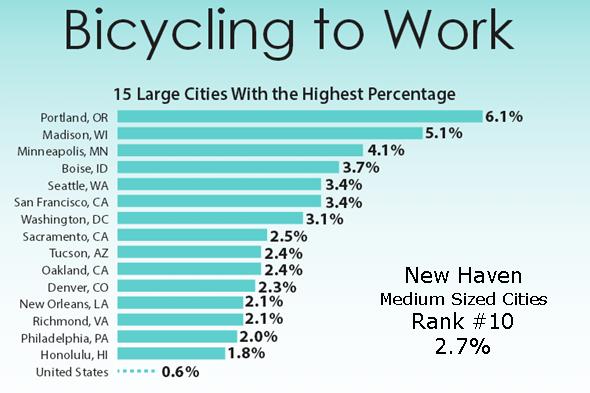
walk toAmong the nation’s medium sized-cities, (with pbike to workopulations between 100,000 and 199,999) New Haven ranks at #5 with 12.4 percent walking to work and at #10 with 2.7 percent of the population using bicycles to get to work. Hartford ranks at #10 among the top walk-to-work medium sized cities with 8.2 percent, and did not reach the top 15 in bicyclists.
The top medium-sized cities for percent of the population walking to work were Cambridge, Berkley, Ann Arbor, and Provo, just ahead of New Haven. The top bicycle-to-work medium sized cities were Boulder, Eugene, Berkeley, Cambridge, and Fort Collins.

The nation’s #1 walk-to-work city is Boston (15.1 percent) followed by Washington, Pittsburgh, New York, San Francisco and Madison. For bicycling to work, the top cities are Portland (6.1 percent), Madison, Minneapolis, Boise and Seattle.

The nationwide data indicates that:

  • The combined rate of bicycle commuting for the 50 largest U.S. cities increased from 0.6 percent in 2000 to 1.0 percent in 2008–2012.
  • The Northeast showed the highest rate of walking to work at 4.7 percent of workers, while the West had the highest rate of biking to work at 1.1 percent. The South had the lowest rate of biking and walking to work.
  • Younger workers, those aged 16 to 24, had the highest rate of walking to work at 6.8 percent.
  • At 0.8 percent, the rate of bicycle commuting for men was more than double that of women at 0.3 percent.

The percentage of workers age 16 and over who carpool to work is below 10 percent in each of Connecticut’s eight counties, with the exception of Windham County, at 10.5 percent.

Fairfield County has longest commute, most use of mass transit

The walk to workaverage commute to work in Connecticut is about 25 minutes, ranging from 28 minutes in Fairfield County, 27 minutes in Litchfield County, 26 minutes in Windham County, 25 minutes in Middlesex County and Tolland County, to 24 minutes in New Haven County, 23 minutes in New London County, and 22 minutes in Hartford County.
The highest percentage of workers using public transportation to reach their place of employment each day is in Fairfield County, at 8.9 percent, more than double the percentage of the next highest county, New Haven County, at 4.1 percent.

The Census Bureau released a new commuting edition of the interactive map Census Explorer, which gives Web visitors easy click-and-zoom access to commuting statistics for every neighborhood in the U.S. It also shows how commuting has changed since 1990 at the neighborhood, county and state level — including how long it takes to get to work, commutes longer than an hour, and number of bikers. It uses statistics from the American Community Survey, the national source of commuting statistics down to the neighborhood level.
Mystic Aquarium Honored at White House Ceremony with National Medal

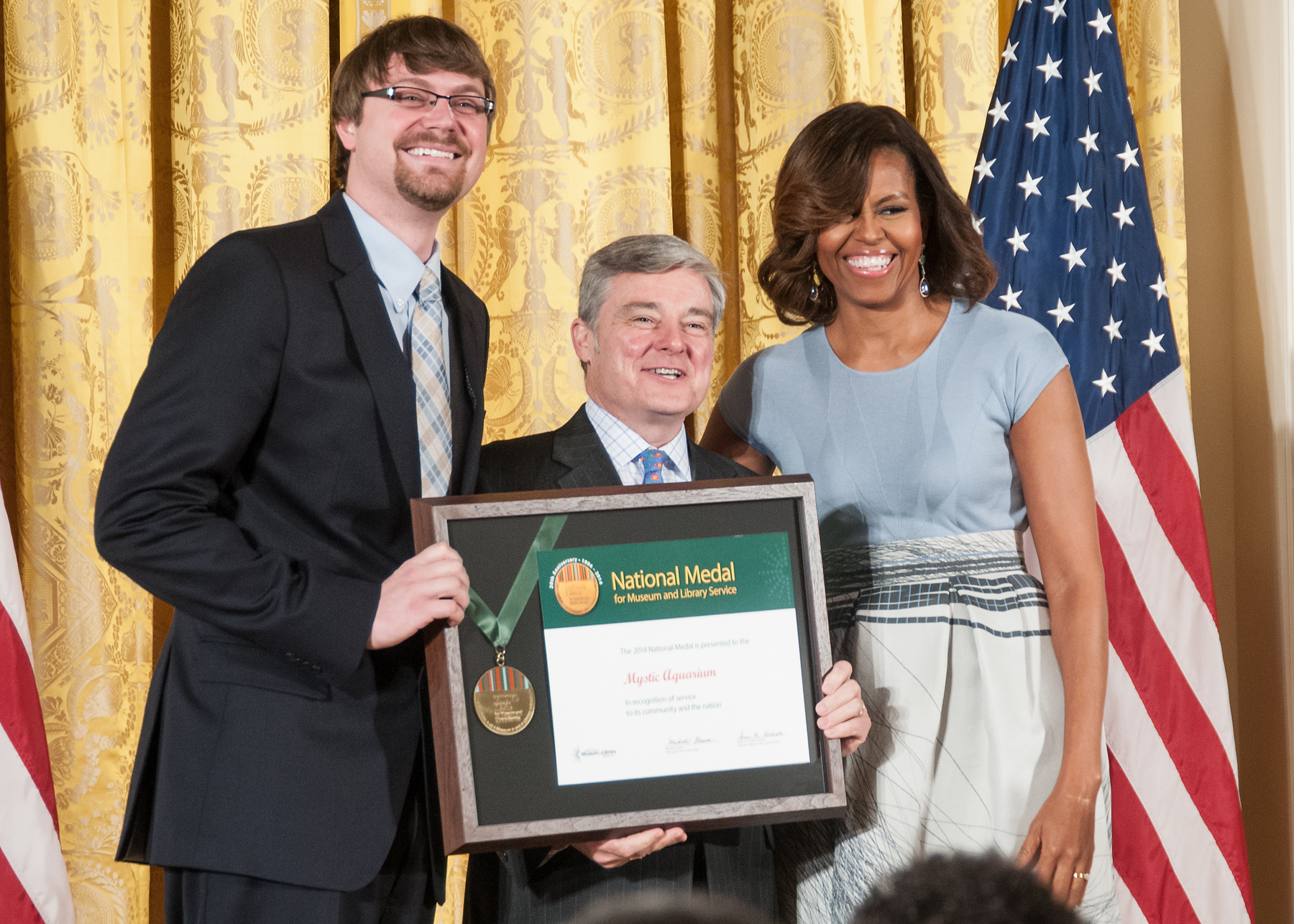
Mystic Aquarium has earned some high profile attention this month, recognized at a White House ceremony hosted by First Lady Michelle Obama. The Institute of Museum and Library Services (IMLS) honored Mystic Aquarium as the only aquarium or zoo nationwide to receive its National Medal for Museum and Library Service for 2014. Impressively, Mystic Aquarium was one of four Connecticut finalists considered for the National Medal, along with the Hartford Public Library, Mattatuck Museum in Waterbury and Otis Library in Norwich. A total of only 30 institutions across the country were finalists, from which ten winners were ultimately chosen.

The National Medal is the nation’s highest honor conferred on museums and libraries for service to their communities. The Institute of Museum and Library Services, an independent agency of the U.S. govemedal_lg-400x405rnment with the mission to create strong libraries and museums that connect people with information and ideas, is celebrating its 20th year of saluting institutions that make a difference for individuals, families and communities.

Mystic Aquarium gives back to the community with a direct financial impact of $72.2 million annually. In addition, the aquarium buys $5 million in services and supplies from Connecticut businesses annually. The institution’s conservation efforts protect the vitality of Long Island Sound, an important revenue-generating natural resource for Connecticut. It is the largest informal science education provider in Connecticut and Southeastern New England, reaching 100,000 students annually. whale

The work of Mystic Aquarium was brought to the attention of Susan H. Hildreth, Director of the Institute of Museum and Library Services, by some of Connecticut’s most prominent cultural, education and government leaders. Rodney A. Butler, Mystic Aquarium Trustee and Chairman of the Mashantucket Pequot Tribal Nation, nominated the Aquarium for the National Medal, noting the pivotal role the Aquarium plays with its education and cultural exchange program for Native American high school students from the village of Point Lay, Alaska, and the Mashantucket Pequot Tribal Nation in southeastern Connecticut.

A major criterion for the award is the institution’s impact on members of its local community. Dr. Stephen M. Coan, President and CEO of Sea Research Foundation, the parent of Mystic Aquarium, who accepted the National Medal from Mrs. Obama, said: “We are honored to receive this prestigious award. We are committed to our educational and public engagement programs that make Mystic Aquarium not only an enjoyable family destination, but also a research facility dedicated to protecting our oceans and its aquatic creatures.”

U.S. Senators Richard Blumenthal and Christopher Murphy supported the nomination along with Stonington Public Schools, which cited the Aquarium’s exemplary work with young people with intellectual disabilities. Michael Cotela, Executive Director of the Boys & Girls Club of Stamford extolled the Aquarium’s critical educational programming for underserved communities.

Founded in 1973, Mystic Aquarium has a collection of 4,00Medals2014_Mystic0 animals, including such species as beluga whales and the endangered African Penguin.

 

PHOTO (Left to right): Justin Richard, Stephen M. Coan, Mrs. Obama.

Who Knew? Northeast is Hotbed of Entrepreneurial Activity, For Some More than Others

Takes one to know one. Or, more accurately, know one and you may become one. That’s the bottom line of an exploration into entrepreneurship by a Kauffman Foundation researcher, who found that the Northeast is the best place to catch the entrepreneurial bug. As Connecticut sinks increasing dollars into initiatives to encourage entrepreneurship, develop jobs, and turn ideas into businessentrepreneurses (often with state financial incentives) the report offers guidance of factors influencing the frequency of entrepreneurial launches.  Connecticut Innovations,  established and supported by state government,  helps Connecticut businesses grow through creative financing and strategic assistance,  and is the nation's sixth most-active early stage investor.
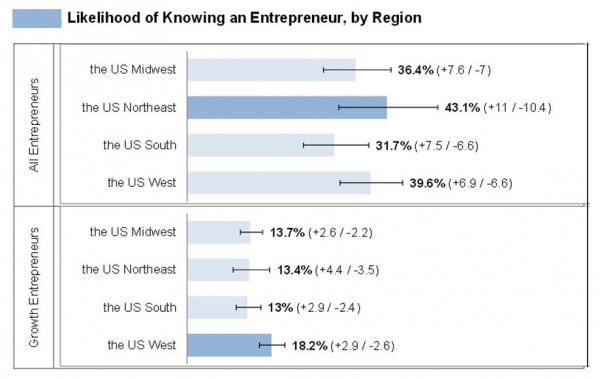
The survey indicated that the likelihood of a person knowing entrepreneurs varied widely by location, income, gender, and age. Respondents were much more likely to know entrepreneurs if they were male, had modest income, or were middle-aged. And they were much less likely to know entrepreneurs (or be entrepreneurs) if they were female, had a higher income, or were located in the Midwest or South.

The study suggests that there could be “material increases in entrepreneurship simply through doing a better job of exposing people to existing entrepreneurs, especially peers or contemporaries.” Entrepreneurship grows, the study found, where it is planted.

Key factors to consider when attempting to encourage entrepreneurship, according to the study:

  • Women have less exposure to growth entrepreneurs than men
  • The young have much more exposure to growth entrepreneurs
  • People in lower income strata are much less likely to be exposed to growth entrepreneurs

The study concluded that “In all cases, an individual’s exposure to entrepreneurs—and to growth entrepreneurs in particular—may increase his or her likelihood of being one. Entrepreneurship can be viral, but must be introduced early and often in environments where it is least often seen.”

The study distinguished between entrepreneurial companies and “growth entrepreneurial companies,” those companies growing more than 20 percent a year and with more than $1 million in sales, generate more employment and contribute more to wealth and GDP than do slower-growing ventures.

The likelihood of a respondent reporting knowing an entrepreneur by Region in the United States was 36.7 percent. The likelihood of knowing a growth entrepreneur was considerably lower, at 15.4 percent.

When broken down by gender, the likelihood of males knowing an entrepreneur was 39.9 percent, females 35.8 percent. For growth entrepreneurs, the gender gap was considerably wide, 24.8 percent to 12.1 percent.

A year ago, CTNext, Connecticut’s innovation ecosystem managed by Connecticut Innovations (CI), announced the launch of the Entrepreneur Innovation Awards (EIA), a competitive pitch process that provides awards up to $10,000 to entrepreneurs in Connecticut for growth-related activities. CI helps innovative companies in four key ways: by offering equity, debt, grants and strategic guidance.

A month ago CTNext announced the winners of the latest round of EIA awards; Connecticut-based companies and entrepreneurs, received $10,000 for their project ideas. CI also selected David Wurzer, formerly a senior managing director at CI, to be chief investment officer and executive vice president. As part of his new role, Wurzer will be responsible for the management of the investment function, staffing needs, portfolio and risk management, outreach to stakeholders, budget planning and performance measurement.

The study “Getting the Bug: Is (Growth) Entrepreneurship Contagious?” was conducted by Paul Kedrosky of the Kansas City-based Kauffman Foundation, and is aimed at providing data to guide efforts across the country to grow entrepreneurship. The survey, which categorizes responses of 2,000 individuals by age, income, gender, and location, was done via Consumer Google Survey.

When One CT Beer Week Is Just Not Enough

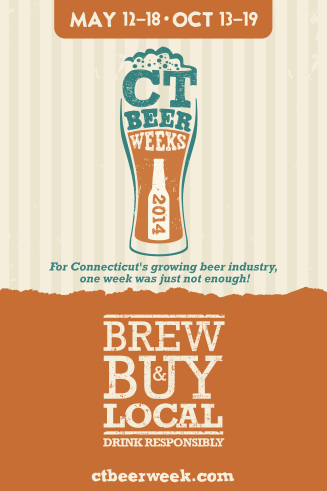
For Connecticut’s growing beer industry, a single beer week was just not enough.

The Connecticut Beer Wholesalers Association, which is comprised of six beer wholesalers in Connecticut and conducted the CT Beer Week marketing campaign for the first time last May, has decided to double down on the effort in 2014.  The second annual Beer Week later this month will be the first to two “weeks” planned for this year.

The first Beer Week ict-beer-week-2014s coming up during the week of May 12 – 18, the same week as American Craft Beer Week. The second one is slated for October 14-20, and coincides with CT Restaurant week. Consumers are asked to “join us as we celebrate the growth of an industry in partnership with craft brewers, restaurants and retailers.”

Organizers say the "Brew & Buy Local" campaign brings focus to the Connecticut organizations that work together to strengthen “a vibrant industry filled with cooperative spirit and a desire to brew something good for Connecticut!”

Among the events in Connecticut later this month will be the 4th Annual Rising Pint Brewfest, designed to kick off American Craft Beer Week. The event will be May 10, 2014 at Rentschler Field, featuring over 90 craft breweries, live bands and local restaurants.  Proceeds of the Rising Pint go to Folds of Honor, a foundation working to help the families of our fallen and severely injured soldiers.CTBeerWeekTshirts

A full calendar of beer week events has been developed, and features more than 40 events around the state.  Connecticut has 22 local breweries, with a dozen new breweries being developed including three slated to open later this year in Oxford and Glastonbury.

Top Main Street Revitalization Initiatives in Connecticut Named

Manchester, New Britain, Waterbury, Seymour and the Northwestern CT Regional Planning Collaborative are being highlighted by the Connecticut Main Street Center (CMSC) for their strategic downtown revitalization initiatives.

As recipients of the organization’s 2014 Awards of Excellence, the efforts include a community college partnering with the downtown and others to create a co-working space; connecting the Naugatuck River with the downtown through extended trails and a linear park; and regionalizing marketing for a collection of small village centers.

The annual  Connecticut Main Street AwardCT Main Street LOGOs of Excellence were created in 2003 to recognize outstanding projects, individuals and partnerships in community efforts to bring traditional downtowns and neighborhood commercial districts back to life, socially and economically. All of the award recipients continue the tradition of stimulating economic development and reinvigorating Connecticut's social centers, officials said.

"Our members continually inspire us with how creatively they respond to the needs of their community," said CMSC President & CEO John Simone. "They're deeply committed to every aspect of their downtown - the businesses, public spaces, local institutions, and above all, creating a place that people really enjoy living in and visiting. We couldn't be happier with how this year's winners represent all we stand for in downtown revitalization."

Submissions were judged on criteria which included innovation, replication, representation, partnerships utilized, and outcomes.  The awards will be presented at the 2014 Connecticut Main Street Awards Gala on June 9th at Roia Restaurant in downtown New Haven.  Award recipients, by category, are:

Events & Programming

Award of Excellence for Wine on Main St. to Main Street Waterbury, Terry Boyd, Braza Churrascaria, Courtyard by Marriott, Diorio's Restaurant, Shamrock Pub & Grill, Tryst Lounge, Signature's Restaurant, City Hall Café, Howland Hughes Center, and Nutmeg Fine Wine & Spirits.

Marketing & Communications

Award of Excellence for Discover NW CT to Northwestern CT Regional Planning Collaborative (representing the Towns of Sharon, Falls Village, Goshen, Cornwall, Canaan, Salisbury, Kent, and Norfolk), Studio Two, local business owners in the eight towns in the "Secret Corner", and local historical societies.

Public Space

Award of Excellence for Complete Streets Master Plan for Downtown New Britain to Downtown Streetscape Working Group, the City of New Britain (including the Mayor's Office, Public Works, Planning and Parks Departments), New Britain Downtown District, Polonia Business District, Central Connecticut State University/ITBE, Capitol Region Council of Governments, and Project Consultant Team.

Renewed Commitment to Main Street

Award of Excellence for Seymour Downtown Action Strategy to the Town of Seymour, Seymour Economic Development Commission, Seymour Downtown Committee, Greater Valley Chamber of Commerce, Naugatuck River Greenway Steering Committee, Naugatuck Valley Council of Governments, Downtown Merchants Association, Planimetrics, Milone and MacBroom; CT Department of Energy and Environmental Protection,and the National Oceanic and Atmospheric Administration.

Main Street Partnership

Award of Excellence for Axis901 and MCC on Main (Manchester) to First Niagara Bank, Manchester Community College (MCC) Foundation, and the Town of Manchester (Board of Directors and Staff).

Economic & Business Development

Award of Excellence to The Business Women of Grand Street (Waterbury) to The Dutch Flower Lady, Technology Forensics, John Bale Book Company, Fine Craft Jewelers, Dottie's 2, Princess Lingerie, Brass City Market on Field, and Fashion Addict.

Yankees - Red Sox: Battle Extends Off the Field, Atop Baseball's Finances

The Yankees and Red Sox, always the focus of attention, argument and controversy across Connecticut, can each claim some victories - on the field and off.  The Red Sox are defending World Champions, having won the 2013 World Series.  They Yankees are the most valuable team in baseball, having won the 2013 monetary championship, just ahead of the Los Angeles Dodgers and Boston Red Sox, according to data compiled by Bloomberg News.MLB

The New York Yankees are worth $3.3 billion, making them the sport’s most-valuable enterprise. The Los Angeles Dodgers rank second with a value of $2.1 billion. Ten teams are worth more than $1 billion. The Boston Red Sox and New York Mets each are valued at more than $2 billion, the data shows.

The Yankees ranked first in overall team value, and 1st in the following categories:  Team Revenue ($570 Million), Gate Receipts ($265 million), Concessions $53 million), Sponsorship ($84 million), and Media Rights ($158 million).  The Yankees ranked 4th in attendance during 2013, at 3.3 million.

The Red Sox ranked third overall, just behind the Los Angeles Dodgers.  The Red Sox ranked 2nd in Team Revenue ($405 million), Gate Receipts ($174 million), Concessions ($36 million).  The team was third in Sponsorship ($40 million), seventh in Media Rights ($89 million), and 9th in Attendance (2.8 million).

In calculating team value, Bloomberg News examineMLB webd revenue from ticket sales, concessions, sponsorships and broadcast rights, as well as interests in TV channels, radio stations and real estate.

The Yankees ranked 1st in Team Value, 2nd in the value of their Regional Sports Network, 2nd in Related Business; the Red Sox ranked 3rd in Team Value, 3rd in Regional Sports Network and 3rd in Related Business.

Revenue from national TV contracts and merchandise is split evenly among the teams, as is the value of MLB Advanced Media, a subsidiary that supplies content to Internet and mobile subscribers.

Fourteen teams have stakes in regional sports networks, according to the report. Of the 10 teams valued at $1 billion or more, only the Philadelphia Phillies don’t have one. The team and Comcast are in negotiations for a new TV contract. Their current deal ends in 2015.

The average value of a team’s interest in a regional network is about $360 million, with the Mets’ 65 percent stake in SportsNet New York having the biggest valuation of almost $1.2 billion, according to data compiled by Bloomberg.

Encore Entrepreneurs – Over 50 and Building New Businesses

Mix a relatively slow economy and a shortage of jobs with a large number of aging boomers looking for meaning and purpose in their work. The result is a growing number of “encore entrepreneurs” seeking to launch income-generating ventures that make a positive difference in their communities.

That has led the U.S. Small Business Administration (SBA) and AARP to launching a strategic alliance to provide counseling and training to entrepreneurs over the age of 50 who want to start or grow a small business.   AARP

April is Encore Entrepreneur Mentor Month, and would-be “encore entrepreneurs” will have the opportunity to connect with a number of organizations and community leaders for advice and assistance in their endeavors as part of seminars held as part of the AARP-SBA initiative.

Next up in Connecticut:  a free seminar, Want to Start or Grow a Small Business?, at the Hartford Public Library on Wednesday, April 23, 2-4 PM, at 500 Main Street.  Space is limited. Interested individuals can register online or call toll-free 877-926-8300.   There will also be a session in New Haven on May 15.

For many Americans born between 1946 and 1964, retirement has a very different meaning than it did a generation ago.   According to a USA Today/Gallup poll, 63% of American adults plan to work in retirement; two-thirds say enjoyment of work is the key reason. With years of valuable work experience, maturity, and plenty of energy at their disposal, today's older workers are increasingly finding financial and personal fulfillment in running their own small businesses.entrepreneur

New research released by Encore.org (formerly Civic Ventures) and funded by the MetLife Foundation shows:sba-logo-300x121

  • Approximately 25 million people – one in four Americans ages 44 to 70 – are interested in starting businesses or nonprofit ventures in the next five to 10 years.
  • More than 12 million of these aspiring entrepreneurs are potential encore entrepreneurs who want to make a positive social impact as well as a living.  Potential encore entrepreneurs have realistic financial expectations and plan local, small ventures to meet needs in their communities.
  • These aspiring entrepreneurs bring a lot of experience to the table, including an average of 31 years of work experience and 12 years of community involvement. Additionally, five out of six report having management experience – 15 years on average.

A 2010 survey by the Kauffman Foundation found that Americans 55 to 64 start new business ventures at a higher rate than any other age group, including 20-somethings. Fully 23 percent of new entrepreneurs were age 55 to 64, up from 14 percent in 1996.

The first event in Connecticut was held in Bridgeport in late January, followed by Danbury in early April.  An additional program is slated for New Haven on May 15 (2 to 4 PM) at Gateway Community College.

Getting to the Final Four: $140 for Some UConn Students, Multiples Higher for Fans

For 51 UConn undergraduate students, $100 will provide a round trip to Texas for the NCAA men’s basketball Final Four as UConn pursues a National Championship.  For everyone else, the price tag is considerably steeper – and climbing.

UConn’s Undergraduate Student Government is sponsoring a bus to take students from Storrs to Texas this weekend. The bus will depart from Storrs at 6:00 AM on Friday and is expected to arrive in Arlingto2014finalfourn, Texas no later than 1:00PM Saturday – in time for the early evening game at AT&T Stadium.

The student government is not responsible for meals, lodging or other accommodations at any point during the trip, but will get the fortunate 51 (first come, first served, of course) within shouting distance of the Final Four.  For a shot at a bus ticket, however, students must have proof that they are already a NCAA student ticket holder for the Final Four, showing an email confirmation from the official NCAA purchase process. Student General Admission ticket price:  $40.

Why take the bus? Norwalk-based priceline.com is reporting that the national average airfare to Dallas/Ft. Worth is around $340, but the average round trip airfare from Bradley International Airport is $604.  By comparison, the average round trip fare from the home cities of the other Final Four arPRICELINEe less - Jacksonville is $541, $584 from Wisconsin, and $385 from Lexington, priceline.com reported.  The average rate for an economy or compact rental car at the Dallas/Ft. Worth Airport is $60 a day for the weekend dates.

Online ticket aggregator TiqiQ reports that the average ticket price for the two semi-final match-ups on Saturday, as of April 2, is $1,091.81.  (A ticket for just one of the semi-finals runs averages about $595.) The Championship Game ticket for next Monday night is going for an average of $580.70.  That’s a slight drop from earlier in the week, but an increase of about 20 TIXpercent over the ticket price a week ago, before the four contenders for the National Championship were determined.

PrimeSport, the Official Ticket Exchange of the NCAA Final Four, lists available tickets ranging from $335.75 in the upper deck of the AT&T Arena to $4,037.50 in Row U facing mid-court.  There remain tickets available.

Compared to the last four years, this is shaping up as the second-most expensive price for NCAA tournament tickets to the final four, behind only last years’ Final Four in Atlanta, Forbes magazine reported this week. Last year, the average price for the semi-final game was $887, which was driven up by three big programs in Louisville, Michigan, and Syracuse, in addition to Wichita State. The lowest price for final four tickets over the last four years was 2011, the last time UConn won the national championship, the magazine reported.Cowboys-Stadium-NCAA-Tournament

Students holding the prized $40 tickets will not be able to resell them on the secondary market, TIME magazine reported this week. Students from the Final Four competitors - UConn, Wisconsin, Florida and Kentucky - must provide valid student ID’s, verification of purchase, and the originating credit card to gain entry to the Final Four stadium.

The Final Four at AT&T Stadium is expected to bring the largest crowd ever to attend a NCAA tournament game college basketball game. The previous record was the 75,421 people that saw the 2011 Final Four semifinal games at Houston's Reliant Stadium. This year’s Final Four may also break the all-time college basketball attendance record of 78,129, Huffington Post reported.

As for the return trip for the 51 UConn students taking the bus from Storrs, there are two scenerios: should UConn lose on Saturday, the bus will depart from Arlington at 9:00AM on Sunday, April 5. If the Huskies advance to the championship, the bus will depart from Arlington at 8:00AM Tuesday, April 8.  Sleep deprived, at the very least.

Investor Opportunities in Mobile Technology, Consumer Products Focus of Back-to-Back Conferences

It is described as “the Biggest and Most Disruptive Platform in Human History,” by William Davidson, Senior Vice President of Qualcomm.  Davidson will be the keynote speaker Wednesday in New Haven at “Connecticut Mobile Summit – Exploring Mobile Venture Opportunities and Challenges.”  Connecticut’s top mobile industry executives will be meeting to discuss how to accelerate mobile adoption, engagement and monetization, according to conference organizers.

Conference officials note that “penetration of smart phones into the workplace has been persistent since the iPhone launch in June of 2007. More recently, tablets have supplanted PCs as productivity boosters.”  The Connecticut Mobile Summit is designed to help educate Connecticut’s investment and technology communities in mobile venture opportunities and challenges.

mobile summittIn addition to Davidson, expert panelists participating include Carissa Ganelli, Founder & CEO, LightningBuy; Drue Hontz, Founder & President, KAZARK, Inc.; John Nobile, Founder & President, Tangen Biosciences; and Nadav Ullman, Founder & CEO, Dashride.

“In three to five years any enterprise that has not implemented mobility solutions for its customers, employees, and suppliers will be leapfrogged, disintermediated, or go bankrupt. Connecticut cannot afford to be behind this curve,” observed event moderator, Brenda Lewis, Principal of Transactions Marketing, Inc.

Davidson is senior vice presidemobile-technologynt of strategy and operations for Global Market Development in Qualcomm Technologies, Inc. In this role, he handles reporting and operations as well as executing on strategic global business initiatives. In addition, Davidson is senior vice president of investor relations where he serves as the primary liaison with the investment community and Qualcomm shareholders. Davidson has more than 25 years of experience in technical sales, marketing and general management roles in the telecommunications industry.
The half-day conference is being presented by the Connecticut Technology Council, Crossroads Venture Group and AT&T. The event is supported by Mea Mobile.

Opening remarks will come from Bruce Carlson, Acting CEO & President of the Connecticut Technology Council, Liddy Karter, Executive Director of Crossroads Venture Group, and Claire Leonardi, CEO of the recently re-branded Connecticut Innovations.  The event is $40 for members of the Connecticut Technology Council and Crossroads Venture Group, $50 for non-members.

The following day, the Northeast Consumer Product Conference will be held in Stamford, with the Connecticut Technology Council and Crossroads Venture Group joined by the Connecticut chapter of the Association for Corporate Growth (ACG) as sponsors.  The conference is described as the Northeast’s largest ‘mergers and acquisitions’ conference focused on early state and middle market consumer-facing companies.  It brings together operators, buyers, investors, and transaction professionals to discuss the challenges and opportunities within consumer industries.

The Stamford conference will include expert-led panels reviewing the state of the capital markets and share strategies for consumer marketing in a digital world, for both early and late stage firms.

Keynote presentation will be from Mike McMahon, President, Spire, a Datalogix company.  Panelists for a session on “Raising Capital in Today's Environment,”  to be moderated by Ramsey Goodrich, Managing Director, Carter Morse & Mathias, include Richard Baum, Managing Partner, Consumer Growth, Partners; Christopher Bradley, Principal, Mistral Equity Partners; and Tom Hayes, MaACGnaging Partner & Principal, New England Consulting Group.

ACG CT President Karin (McKittrick) Kovacic said, “This conference brings together owners and managers with investors and transaction professionals to discuss the challenges and opportunities within the consumer products sectors.”

The Connecticut Chapter of ACG is one of the fastest growing ACG chapters in the country, with close to 300 local professionals focused on middle-market corporate growth (i.e.: mergers and acquisitions, financing opportunities, business development, joint ventures, licensing arrangements, etc.), including a diverse group of private equity funds, intermediaries, lenders, and service providers.

The Connecticut Technology Council (CTC) is a statewide association of technology oriented companies and institutions, providing leadership in areas of policy advocacy, community building and assistance for growing companies.  With over 2,000 member companies that employ some 200,000 residents, the CTC works to position Connecticut as a leader in idea creation, workforce preparation, entrepreneurial aptitude, early stage risk capital availability and providing on-going support and mentoring to high potential firms.