Nation's Mayors Award Hartford, Waterbury for Work Promoting Youth Jobs, Exercise

The mayors of two of Connecticut’s major cities – and their communities – had moments in the spotlight at the just-concluded annual meeting of the U.S. Conference of Mayors (USCM)  in Washington, D.C.

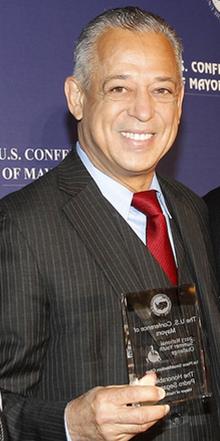
Hartford Mayor Pedro E. Segarra won first place for medium/small cities in the organization’s 1st Annual National SummerYouth Jobs Challenge. The award honors the outstanding achievements in innovative partnerships between cities and local business and non-profit communities to help provide youth with meaningful summer job experiences.

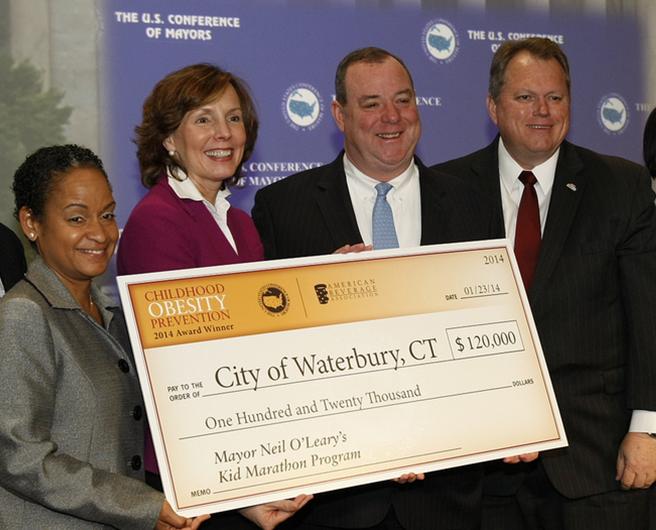
Mayor Neil M. O’Leary accepted a first place award for Waterbury’s Kid’s Marathon Program.  The organization gave six awards to mayors of cities with outstanding programs that encourage healthy weight through balanced diet choices and regular physical activity.  As the top selection, Waterbury receives a $120,000 grant that will support the 2014 Kid’s Marathon Program, a partnership between the YMCA, City of Waterbury, Department of Education, Boys and Girls Club, Police Activity League (PAL) and Connecticut Association of Schools, aimed at introducing the sport of running to youth ages 7-12, over a 12-week period and at no charge to the participants.mayors conf

Approximately 250 mayors, USCM business council members, USCM Workforce Development Council members and other workforce development professionals from major cities across the country attended the annual meeting.  The award was presented to Hartford at Thursday morning’s plenary session, which included remarks by Segarra, Louisville Mayor Gwaterburyreg Fischer, U.S. Labor Secretary Thomas Perez and Wendy Spencer, CEO of the Corporation for National and Community Service.
Since taking office in 2010, Segarra has invested regularly in youth employment programming, leverageing state and foundation funds to further expand work opportunities for young people. In 2013, the Mayor secured $1.25 million that put nearly half of the 2,056 youth in the region to work, officials said.  Additionally, in conjunction with four other regional mayors, he spearheaded an “unsubsidized” youth employment campaign, aligned with the Obama administration’s Youth Jobs + effort, which resulted in an additional 208 employer-paid positions.

Segarra was joined at the mayor’s conference by  Capital Workforce Partners President and CEO, Tom Phillips who was the 2012 President of the U. S. Conference of Mayor’s Workforce Development Council, and whose organization is instrumental in finding worksites and providing career competencies for over 2,000 youth in the North Central Connecticut region each summer.

Among the ten Connecticut Mayors registered to attend the conference in addition to Segarra and O’Leary were Bridgeport Mayor Bill Finch, Stratford Mayor John Harkins, West Haven Mayor Edward O’Brien, Trumbull Mayor Tim Herbst, Shelton Mayor Mark Lauretti, East Hartford Mayor Marcia Leclerc, Fairfield Mayor Michael Tetreau, and Stamford Mayor David Martin.  The U.S. Conference of Mayors is the official nonpartisan organization of cities with populations of 30,000 or more.  There are 1,399 such cities in the country today, and each city is represented in the Conference by its chief elected official.
segarraThe Kid’s Marathon Program is designed to target city youth lacking in physical activity and good nutrition habits.  Students run 1-2 miles, two or three times per week, completing a cumulative 26.2 mile marathon over the course of the program.  They also receive positive and practical guidance on nutrition that helps foster long-term healthy eating behaviors.  In 2013, the program’s first year, 438 students participated, with the culminating 1-mile run occurring at Crosby High School before a crowd of family, friends and supporters.

USCM also recognized Eugene Morton, a Hartford resident who participated in employment opportunities created through Segarra’s youth initiatives. A 2007 graduate of Hartford’s Sports and Medical Sciences Academy, Morton is a Marketing major at Central Connecticut State University with a 4.0 average. In 2013, he took advantage of a summer employment opportunity at St. Francis Hospital and Medical Center and was one of 13 college students who participated in the summer youth employment program offered at St. Francis Hospital and Medical Center in partnership with the Blue Hills Civic Association.

Mayor O’Leary and Waterbury were recognized with the first place award for their collaborative efforts on launching the Kid’s Marathon Program with the Rod Dixon Kid’s Marathon Foundation. The grant awards were divided into small, medium and large city categories, with first place and second place awards given in each category.  Waterbury placed first in the “medium city” category; the second place finisher was Little Rock, AR. The grant program is the result of a partnership between USCM and the American Beverag06-09-12-kids_05-300x229e Association (ABA), to support and/or enhance mayors’ ongoing childhood obesity prevention programs in their cities.    A total of $445,000 in grants was awarded to support both new and existing programs.  Denver, CO and Dallas, TX (large cities) and York, PA and Monrovia, CA (small cities) were the other recipients.

Last fall, the U.S. Conference of Mayors and Partner America awarded Hartford Mayor Pedro E. Segarra their small business advocate of the year award.  The USCM presented Segarra with the award during the Greater New England Minority Supplier Development Council Expo, at the Connecticut Convention Center.  The organization credited Segarra for launching the iConnect storefront revitalization project, quickening the pace of city permit approvals, investing $500,000 in façade improvements and awarding over $100,000 to 16 local artists and small businesses.  At the time, the mayor's office said the city has gained 134 small business and 200 jobs since 2010.


 

A Merger, A Name Change, and A Partnership: Chambers of Commerce Realign

There’s some movement among business associations in the Land of Steady Habits, with economic realities driving a new merger, a name change, and a partnership.

The Guilford and Branford Chambers of Commerce have merged, effective on New Year’s Day.  The new merged entity is called the Shoreline Chamber of Commerce - Guilford/Branford Alliance.  The merger was approved by the Boards of Directors and membership of both organizations in recent weeks.  branford

At a Special Meeting earlier this month, the membership of the Greater Meriden Chamber of Commerce voted to change the organization’s name to Midstate Chamber of Commerce.  Meriden Chamber President Sean W. Moore, said that “Midstate Chamber of Commerce reflects the inclusivity of this chamber’s membership throughout the central Connecticut region and reaffirms our commitment to ALL of the businesses and communities we serve.”

While not “official” until March 1, members and the communities can start to see changes as soon as next week.  A new website, www.midstatechamber.com, will transition from the existing website in the coming weeks.  The Chamber has more than 550 members.

The Middletown-baschamber_sign_250x175pxed Middlesex County Chamber of Commerce remains by far the state’s largest, with over 2,350 members that employ over 50,000 people.  The organization, led by longtime President Larry McHugh, “strives to be the voice of business in Middlesex County and the surrounding area,” according to its website.

In the Guilford-Branford merger, the plan calls for the board of directors of the two corporations to merge into one board containing up to 37 members. As terms of directors expire, the number of directors will be reduced to no more than 21, with up to 7 selected from Branford, up to 7 selected from Guilford, and up to 7 selected from the entire membership.  The merged organization will have an office in each town.

Guilford has 320 members and Branford has about 350.  The first event of the joint organization will be a Business After Hours networking event on January 28 at Page Hardware & Appliance in Guilford.  It is co-hosted by Bailey, Murphy and Scarano, a CPA firm in Branford.  A logo for the newly merged association has yet to be unveiled.

A statement by the organization pointed out that “this proactive move will allow members to double their audience, double their market and provide enhanced networking opportunities.” The websites of the former Branford and Guilford websites are still active, and announcing the merger.  Among the advantages cited are:

  •  Increased marketing and promotional opportunities through distribution of publications, website visits and email communications
  • Better educational programs for professional development
  • More signature events to attend and potentially sponsor as each town and chamber will continue and maintain this type of event
  • Two Shoreline Locations along with a larger staff to assist business
  • Larger social media presence and website traffic to membership pages
  • Opportunity to re-brand as a member of  a larger more influential 650-member chamber
  • Eventual gain of resources through economies of scale, allowing more money to go directly to member services
  • Enhanced technology for website referrals and member servicesmeridenChamber-Logo

Janet Testa, executive director for the Guilford Chamber, told the New Haven Register that 99 percent of members wanted the merger. She said her organization is always looking for ways to serve its members by “joining forces” with others. Ed Lazarus, president of the Branford Chamber, believes combining the chambers will benefit both communities. “Businesses will be represented the way they’re used to but with a combined staff,” the Register reported.

It is not the first Chamber merger in Connecticut.  In 1989, the North Haven Chamber joined the Wallingford Chamber to form the Quinnipiac Chamber of Commerce.  That business association has grown to more than 700 members.

Last fall the Greater New Haven Chamber of Commerce (GNHCC) and The Quinnipiac Chamber of Commerce announced the formation of a strategic affiliation between the two organizations, “creating a stronger, more streamlined collaboration that will work together to move the region forward.” As of October 15, 2013, the Greater New Havenew haven chambern Chamber and the Quinnipiac Chamber began to “officially collaborate on all aspects of their respective organizations, while continuing to operate as separate business units in separate office locations.”


In 2003, the Central Connecticut Chambers of Commerce was formed around the Bristol Chamber of Commerce, “in an effort to expand the area it benefited and to enable the Chamber to assist more members. This allowed the Chamber to expand from covering just Bristol to the entire Central Connecticut region,” the website points out.  The Central Connecticut Chambers – with a combined membership of approximately 1800 - is composed of several affiliate chambers including those of Bristol, Bloomfield , Burlington, Farmington, Plymouth/Terryville and Wolcott.

In terms of membership numbers, after the Middlesex Chamber and Central Connecticut Chambers, the next largest are the Chamber of Commerce of Eastern Connecticut, with 1,600 members; the Northwest Connecticut Chamber of Commerce, with 730 members; and the Quinnipiac Chamber of Commerce.  The MetroHartford Alliance is #6, with 600 members (although it may now be eclipsed by the newly combined Shoreline Chamber), followed by chambers from Greater Southington  (590 members), Greater Manchester, Greater Meriden and Glastonbury (each with approximately 550 members) and West Hartford, approaching 500 member businesses.


Nonprofit Seeks Support for STEM Mentoring Initiative Focused on Women, Underserved

It is, after all, National Mentoring Month.  It makes perfect sense, therefore, for a fledgling Connecticut-based nonprofit devoted to mentoring young women and students of color to increase their presence in the STEM fields (science, technology, engineering and math) to launch a fundraising initiative.

ManyMentors, a nonprofit that promotes peer mentoring to increase the interest, pursuit and attainment of STEM degrees among underrepresented students, has kicked-off an Indiegogo crowdraising campaign aimed at supporting the development of “the world’s first mobile mentoring app and complementary online platform,” according to the campaign’s website.  mentors logo

Online contributions will also support the ongoing outreach and advocacy activities of ManyMentors in Connecticut, and support outreach activities planned for establishment of student chapters at universities nationwide.  The fundraising initiative runs through February 10, 2014.

The organization’s website notes that “of the 20 fastest growing occupations projected for 2014, 15 of them require significant mathematics or science preparation.”  The nonprofit hopes to “make STEM mentoring more mainstream among middle and high school students, college and graduate students, as well as working professional.”  As their slogan emphasizes, “If they never know, they will never go!”

Keshia Ashe, co-founder and CEO of ManyMentors, gave a well-received TEDx talk in Springfield, MA last fall about the important role of mentors and role models to encourage our young people to pursue degrees and careers in STEM. Keshia Ashe is a University of Virginia alumna, and current Ph.D. candidate in Chemical Engineering at the University of Connecticut. Since the age of 11 she has been actively involved in several youth-serving groups and advisory boards, and has had many opportunities to travel nationally and internationally as a speaker and trainer. mentors app

The ManyMentors program primarily serves middle and high school students located in the state of Connecticut. The organization currently implements onsite mentoring opportunities with local community partners, and is piloting the mobile mentoring with a select number of mentor/mentee pairs.  Supporting organizations of ManyMentors include the CBIA Education Foundation, Granville Academy of Waterbury, and CPEP (Catalysts Powering Educational Performance).

Tiffany St. Bernard, the co-founder and Chief Operating Officer of ManyMentors, is a University of Connecticut alumna, and current Ph.D. student in Genetics at Cornell University. She is passionate about ManyMentors because she has experienced first-hand the positive benefits of having many mentors guide her through academic life, beginning during her years at Tunxis Community College.

Using social networking, ManyMentors aims to connect students from a wide variety of academic and ethic backgrounds with the hopes that these relationships will stimulate, sustain, and support students’ interest in, pursuit, and attainment of STEM degrees.

Among the upcoming activities ManyMentors is sponsoring this year are a series of “STEMinars” at UConn, beginning in February, aimed at “Preparing Tomorrow's Female STEM workforce, Today.”  The sessions are designed to “increase awareness of female STEM workplace issues by being exposed to female STEM professionals mentors photowho will discuss topics such as career placement basics, salary and promotions, communication, creating support groups, being culturally aware, finding a work/life balance, and appreciating the value of staying true to oneself in male-dominated fields.”

ManyMentors is moving forward with three central efforts:

  • Creating partnerships between K-12 students, institutions of higher education and STEM professionals to stimulate and sustain student interest in the STEM fields.
  • Selecting college mentors with a vested interest in sharing their best advice, wisdom, and insight to support the academic, professional, and cultural development of their mentees.
  • Providing ongoing trainings for mentors to share best practices and cultivate a community of STEMentors.

 Photo:  Keshia Ashe (left) and Tiffany St. Bernard

Pay Inequality Gap Widens in Greater Hartford; 8th Largest in U.S. Since 2008

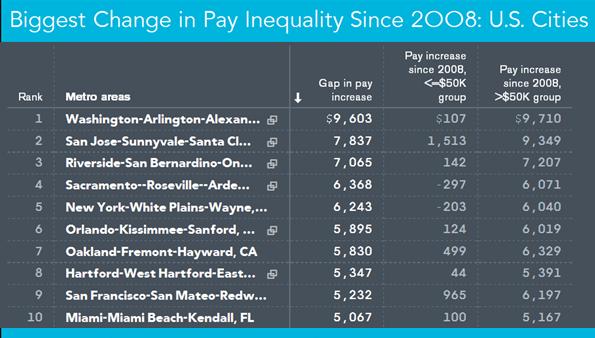
If you thought the earnings gap between the “have’s” and “have-nots” in the Greater Hartford region has been widening in recent years, new data indicates your impression is correct.  The Hartford-East Hartford-West Hartford region ranks #8 among the nation’s metropolitan areas with the largest widening gap in employee earnings, when comparing those making less than, or more than, $50,000. The data was compiled from the U.S. Bureau of Labor Statistics.

Between 2008 and 2013, the gap in the increase in pay between those earning less than $50,000 and those making more than $50,000 was $5,347 – the eighth largest gap in the nation.  The pay increase for the lower paid employees since 2008 was an averpay inequalityage of $44, compared with a $5,391 average increase among those earning more than $50,000.

In analyzing the data, Bloomberg ranked the 49 metro areas with the most employed people on the difference in pay since 2008 between those earning more than $50,000 and those earning $50,000 or less.  Occupations with both annual median pay and total employment numbers were included. On average, more than 500 occupations in each Metropolitan Statistical Area were studied.

The widest gap was in the Washington-Arlington-Alexandria metropolitan area, at $9,603, followed by San Jose-Sunnyvale-Santa Clara at $7,837, and Riverside-San Bernadino-Ontario at $7,065.  Also with a wider gap than the Hartford region were metropolitan Sacramento ($6,368), theearnings gap New York metropolitan area ($6,243), greater Orlando ($5,895) and metropolitan Oakland ($5,830).

The only big city in the U.S. where the gap between highest and lowest earners has narrowed since 2008 is Memphis, TN.

In the survey methodology, annual pay was employee-weighted and included base salary, cost-of-living allowance, guaranteed pay, hazardous-duty pay and incentive pay - commissions, production bonuses and tips. The analysis was released in December 2013, using the most recent data available.

Local Farmland Preservation Leaders Earn Recognition

The Working Lands Alliance, a project of American Farmland Trust, has recognized two individuals and a dairy cooperative of six family farms in Connecticut with Farmland Preservation Pathfinder Awards, and noted the work of two Connecticut legislators in advocating for farmland preservation in the state.

The Alliance is a statewide coalition dedicated to preserving Connecticut’s productive farmland and presents the Pathfinder Awards to recognize individuals and groups who have significantly advanced farmland preservation through leadership, advocacy, planning and education.pathfinder-logo

“Each of these award winners is an outstanding example of what can happen when a group of dedicated people work together to achieve what many may think is an impossible goal,” said Terry Jones, chair of the Working Lands Alliance. “Their success shows what imagination and hard work can do and provide a wonderful example for others to follow.”

“About 1,800 acres of agricultural land has been lost in Connecticut every year for the last 25 years, nearly 62 square miles in all,” said Andrew McElwaine, President and CEO of AFT. “The leaders we recognize with Pathfinder Awards are part of an enthusiastic and diverse group of individuals and organizations working to reverse that trend.”

The winners of the annual awards for 2013, were:

Tom Crider, President, Southbury Land Trust - Outstanding Individual: Under Crider’s leadership over nearly two decades, the Southbury-based Trust has preserved seven family farms and thousands of acres of habitat, including 825 acres of prime farmland at the Southbury Training School.  Working closely with the Southbury delegation, Town officials and his Board, Crider was a critical part of the team advocating for the successful passage of legislation that permanently protects 825 acres of prime state-owned farmland at the Southbury Training School.

The Farmer’s Cow, Mansfield Ceeggs_cartonnter - Outstanding Group: The Farmer’s Cow is a group of six family-owned dairy farms that market their products under a single brand. The Farmer’s Cow has done extraordinary work educating their consumers about the importance of farmland preservation. During the past year, they launched an ice cream flavor appropriately named Farmland Crunch to draw attention to the development pressures on Connecticut’s rich farmland. Proceeds from the sale of each pint are donated to Connecticut Farmland Trust, to support their important work of preserving working farmlands. They also sponsored this year’s Corn Maze adventure at Fort Hill Farm in Thompson with the theme of Saving Farmland, again to educate the public on the importance of farmland preservation. Their member farms have collectively preserved nearly 4,000 acres of active farmland through the state’s Farmland Preservation Program.

George Hall, George Hall Farm, Simsbury - Education Leader: Throughout his long farming career, Hall has been an outstanding mentor and teacher to countless interns and apprentices who come to learn about the importance of farming, the meaning of hard work, and the love of the land.  Using a unique approach to preservation, Hall will also sell the development rights on 12 highly developable acres of farmland in exchange for the rights to 40 acres of farmland he has been leasing; a transaction that will, in the end, provide him little financial gain. Through this example, Hall is demonstrating that securing lands for the future outweigh monetary considerations.

The Working Lands Alliance also presented State Representatives Linda Gentile and Arthur O’Neill its Legislative Leadership Award for farmland preservation efforts.

“We are very pleased this year to recognize two legislators for the role they played in passing legislation to permanently preserve 825 acres of prime farmland at the Southbury Training School and their ongoing interest in farmland preservation,” said Jones.No-Farms-No-Food-R

Rep. O’Neill represents the 69th Assembly District, including the towns of Southbury, Bridgewater, Roxbury and Washington. Rep. Gentile represents the 104th Assembly District, including Ansonia and Derby.

“While the Alliance has successfully advocated for robust investments in the Farmland Preservation Program and the permanent protection of state-owned farmland, much more needs to be done,” said Lisa Bassani, Working Lands Alliance Project Director, American Farmland Trust. “The importance of our work in farmland preservation can be summarized in four words-- No Farms, No Food.”

The Working Lands Alliance was formed in 1999 with the sole purpose of preserving Connecticut’s most precious natural resource – its farmland.  WLA is a coalition whose supporters include more than 600 individuals and 200 businesses and organizations that include farmers, conservationists, anti-hunger groups, planners and local food enthusiasts. WLA is a project of American Farmland Trust. The American Farmland Trust is the nation’s leading conservation organization dedicated to protecting farmland, promoting sound farming practices and keeping farmers on the land.

Landlines Continue to Disappear in CT and Nationwide, New Federal Data Shows

One-fifth of all adults and one-quarter of all children under 18 living in Connecticut reside in households that have wireless telephones but no landlines, according to data compiled in the National Health Statistics Report.  For calendar year 2012, the most recent data available, 20.6 percent of adults age 18 and over and 25.4 percent of children under age 18 did not have a landline telephone in their home.

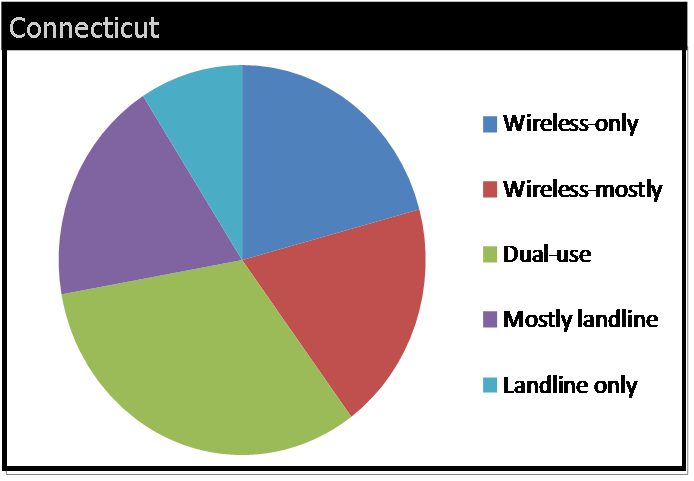
The report also indicates that in Connecticut, 20.6 percent of adults live in a wireless-only residence, 18.8 percent live in a mostly-wireless home, 32 percent live in a “dual-use” residence using both wireless and landline, 18.5 percent are mostly landline at home, and 9 percent have landline only.

Among children under age 18 in Connecticut, the growing dominance of mobile phones is evident, with nearly half in wireless-only (25.4 percent) or wireless-mostly (20.6 percent) households and 32.9 percent in dual-use residences.  Only 11.8 percent and 8.4 percent describe their household as being landline-mostlyphone pie or landline-only.

The National Health Interview Survey is the most widely cited source for data on the ownership and use of wireless telephones.  It is conducted by the Centers for Disease Control and Prevention’s National Center for Health Statistics, within the U.S. Department of Health and Human Services.

The report showed “great variation in the prevalence of adults living in wireless-only households across states.  Estimates for 2012 ranged from a high of 52.3 percent in Idaho to a low of 19.4 percent in New  Jersey.  Other states in which the prevalence of wireless-only adults was relatively high (exceeding 45 percent) were Mississippi (49.4%), Arkansas(49.0%), and Utah(46.6%).

Several other states in the northeascellphone survey health covert joined New Jersey with prevalence rates below 25 percent, including Connecticut (20.6%), Delaware (23.3%), New York (23.5%), Massachusetts (24.1%), and Rhode Island (24.9%).

Results showed a great variation in the prevalence of wireless-only children across states, ranging from  a high of 63.4 percent in Mississippi to a low of 20.6 percent in New Jersey.  Other states with a high prevalence of wireless-only children included Idaho (62.2%), Arkansas (59.8%), Missouri (55.2%), and South Carolina (54.5%). Other states with a low prevalence of wireless-only children included Vermont  (24.5%), Connecticut (25.4%), Alaska (25.7%), and Massachusetts (26.7%).

The 2012 state-by-state data was released by the NHIS in December 2013.  At the same time, the agency released composite national data for the first six months of 2013 that indicates 38.0 percent of U.S. adults lived in a household that has only mobile telephone service and no landline. As reported in the Huffington Post, their tracking shows that more than half of adults under age 35 and nearly two thirds (65.6 percent) of those ages 25 to 29 are cell-phone only.

The Pew Research Center, in a spring 2013 survey, found that ror the first time, cell phone ownership among adults has exceeded 90 percent. Cell phones are now being used by 91 percent of adults, according to the Internet & American Life Project survey conducted between April 17 and May 19 of 2,252 adults.2013-12-18-cdcnhiscellonly

Revitalizing CT Downtowns Earns Recognition, Success

For the Connecticut Main Street Center, a greater role in the advancement of downtowns across Connecticut is bringing both recognition and a facelift.  The organization, recently selected by the Connecticut Chapter of the American Planning Association (CCAPA) to receive the 2013 Education & Outreach Award for its "Come Home to Downtown" initiative, is launching a new branding initiative to match its more visible role supporting the state’s municipal main street initiatives.

Their new, updated  logo reflects the changing face of tCT Main Street Centerhe state’s downtowns, one that commands attention and respect for being forward-thinking while preserving the integrity and values of the past.  At CMSC, “we'll continue to promote the Four Point Approach to downtown management while also championing innovations in transit and sustainable design, promoting our local businesses and attractions, and advocating for mixed-use development that integrates housing with a diversity of uses, cultures and incomes.”

Through the Come Home to Downtown program, which just concluded its pilot year, CMSC and its team of expert consultants worked with community leaders, local stakeholders, and downtown management groups to educate them on the value and potential of mixed-use development. The organization also sought input and feedback from the public at community meetings held in each of the towns on the plans for redeveloping the model buildings and the demand for downtown housing.Come-Home-logo-150x150

CMSC chose three communities – Middletown, Torrington and Waterbury – as well as three property owners and their buildings as the focus of the program’s in augural year.  It is a pilot program aimed at facilitating viable, interesting housing opportunities while revitalizing downtown neighborhoods by providing customized technical assistance to communities and owners of small, under-utilized downtown properties.

CMSC worked with municipal officials and the building owners to develop viable redevelopment options including: determining what financing would likely be needed for redevelopment; performing an assessment of zoning and regulatory requirements; reviewing the downtown management function; and measuring the downtown's walkability. APA CT

Specific recommendations for improving the buildings, including a recommended floor plan designed to attract new residents and bring market rate housing downtown, was also provided to each property owner. Once rehabilitated, these buildings are expected to create 60 new units of rental housing in downtown Middletown, Torrington and Waterbury, as well as make approximately 25,000 square feet of commercial and retail space available. The total development cost to renovate all three buildings is estimated to be $11.4 million.

The 2013 Education & Outreach Award was presented to CMSC at CCAPA's Annual Award Luncheon last month. CCAPA is the Connecticut Chapter of the American Planning Association, the national organization of professional planners and citizens involved in planning communities. CCAPA is dedicated to advancing the practice of good planning in Connecticut. Every year, CCAPA solicits nominations for notable planning projects in a variety of categories from public service and citizen planners to physical development and plan implementation.

Health Risks of Flame-Retardant Chemicals Require Policy Changes in CT, Nation, Report Says

The 2014 session of the Connecticut General Assembly is expected to include consideration of legislation designed to protect the public from potential health risks of flame retardant chemicals that are present in many consumer products.  Such a proposal, currently being developed, comes following a report from North Haven-based Environment and Human Health Inc. (EHHI), an organization of physicians and public health professionals, that calls on state and federal governments to institute new policies to protect the public from flame-retardant exposures that the researchers say “pose health risks to fetuses, infants, children and the human population as a whole.”

The comprehensive 107-page report, “Flame Retardants: The Case for Policy Change,” closely examines the health risks that flame-retardants pose to the general population and recommends sweeping policy changes to protect the public.

"It has become clear that flame-retardants are proving to be a health risk to both the human population and the environment,” said Nancy Aldermaflame reportn, president of Environment and Human health, Inc. “It is time for flame-retardants to be removed from all low fire-risk situations and products. As well, a certification program should be established where manufacturers certify the absence of flame-retardants, just as organic food programs certify the absence of pesticides.”
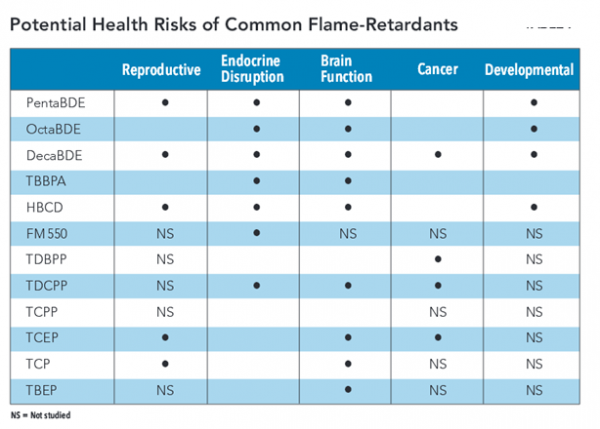

The report examines the history of flame-retardants and demonstrates the enormous scope of the problem, noting that flame-retardants “are now ubiquitous in our environment.”  The history of flame-retardant use in the United States is a story of substituting one dangerous flame-retardant for another, the report outlines. The country lived through decades when asbestos was used as a fire-retardant. Then when asbestos was proven too dangerous to be used, the country moved over to PCBs, and five decades later, when PCBs were deemed too dangerous for use, the country moved on to chlorinated and brominated flame-retardants.

The report points out that “the labeling of flame-retardant chemicals in consumer products is NOT required by Congress, EPA, FDA or the Consumer Product Safety Commission.  It is therefore impossible for consumers to avoid flame-retardants in their purchases.”  Sources of exposure cited in the report include carpets, mattresses, children’s and baby products, furniture, and electronics.  falame retardant

In the 1970s, a flame-retardant called "Tris" was added to children's sleepwear. Tris was later found not only to be carcinogenic but also capable of being absorbed through the skin. Tris was finally banned in children's sleepwear in 1977, according to the report.  Tris is still used in many other infant products, such as crib mattresses, changing tables, nap mats, and infant car seats, the report indicated.

"Tris was, and remains, carcinogenic," said Dr. D. Barry Boyd, oncologist at Greenwich Hospital and Affiliate Member of the Yale Cancer Center.  There is ample evidence concerning the health risks from Tris to conclude that it should be removed from all infant products."

John Wargo, Ph.D., first author of the report and the Tweedy-Ordway Professor of Environmental Health and Political Science at Yale University, said, "Flame-retardants are not required to undergo health and environmental testing, and they are not required to be labeled on the products that contain them. Because exposures to flame-retardants carry health risks, they should only be used when the risk of fire outweighs the risk from flame-retardant exposures. When risk from fire is high, such as in airplanes, then the use of flame-retardants is warranted; when the risk from fire is low, flame-retardants should not be used."

Recent toxicological studies demonstrate that flame-retardants pose the greatest risk to the normal growth and development of fetuses, infants and children. "Manufacturers should start labeling their products so that consumers can understand when flame-retardants have been added," said Dr. Andrea Asnes, associate professor of pediatrics at the Yale School of Medicine.

Environment and Human Health, Inc. (EHHI) is a non-profit organization composed of physicians, public health professionals and policy experts, dedicated to protectinEHHIg human health from environmental harms. EHHI does not receive any funds from businesses or corporations.   The organization’s mission is “to conduct research to identify environmental harms affecting human populations, promote public education concerning the relationships between the environment and human health, and promote policies in all sectors that ensure the protection of human and environmental health with fairness and timeliness.

By promoting effective communication of environmental health risks to those exposed and to responsible public and private officials, EHHI hopes to empower individuals and groups to take control over the quality of their environment and be more protective of themselves and their families.  The report was issued in November 2013.  Among the recommendations :

  • States should pass laws that protect their citizens from flame-retardant exposures.  Industry will always work to pre-empt states’ legal authority to set safety standards that are more stringent than those adopted by the federal government. States should have the right to protect their citizens when the federal government fails to do so.
  • States should restrict flame-retardants in infant and toddler products.  Recent toxicological studies show that flame-retardants pose the greatest risk to the normal growth and development of fetuses, infants and children. Infants and small children’s body weight is so low that their exposures to flame retardants, in relation to their body weight, is simply too great. The health risks that all infants and children are experiencing, due to the federal law mandating that flame retardants be in many of their products, far outweigh the risk of fire.
  • States should require that products containing flame-retardants be labeled.  Any product containing a flame-retardant should be labeled as such. Labels should include which flame-retardant has been used.
  • States should promote fire-prevention programs.  States should invigorate their fire prevention programs. Promotion of fire prevention is the most effective, least expensive, least environmentally damaging priority our nation could pursue to reduce loss of health, life and property from fires. States should promote low-cost and highly effective early warning technologies. Smoke alarms save lives. They should be available to all, regardless of income status.
  • States should offer opportunities to recycle electronic products.  Foam that contains flame-retardants remains a problem for landfills. State and local governments have primary responsibility for managing the disposal of solid and hazardous wastes. Most solid wastes in Connecticut are disposed of via incineration, but some are still placed in landfills. The broad failure to effectively recycle electronics, building materials, auto plastics and foam means that most products containing flame-retardants are released to the environment at the end of their life-cycle.

State Mental Health Budgets, Cut During Recession, Increase After Newtown Tragedy, Report Finds

State mental health budgets were gutted during the recession, according to a report issued by the National Alliance on Mental Health (NAMI), and are only now beginning to return to previous levels in most states, even as mental health needs are becoming better known and growing.

“With reductions totaling $4.35 billion from FY2009 to FY2012, public mental health systems struggled to meet rising demand with diminishing resourcesnami,” the report indicated. Then, the shooting at Sandy Hook Elementary School in Newtown on December 14, 2012 provided “a major impetus for lawmakers to propose legislation which would impact children and adults living with mental illness,” the 63-page report indicated.

Nearly 60 million Americans experience a mental health condition every year, according to the organization. Regardless of race, age, religion or economic status, mental illness impacts the lives of at least one in four adults and one in 10 children across the United States.

NAMI is the nation’s largest grassroots mental health organization.  NAMI advocates for access to services, treatment, supports and research and is steadfast in its commitment to raise awareness and build a community for hope for all of those in need.

“Realizing the risks of failure to provide adequate public mental health services, governors and legislatures in many states began the process of restoring state mental health budgets,” according to the report, “Trends, Themes & Best Practices in State Mental Health Legislation.”

The report concludes that “Dramatic changes in American healthcare finance and delivery systems combine with an improving economy and a growing array of best practices to provide a window of opportunity in the next few years to transform the mental health system and integrate care across systems.”

In addition, NAMI recommends that “advocates and policy makers should continue the work of building the mental health system of the future, one in which mental illness is identified as it emerges and an array of proven, cost-effective services are available as needed to provide children, youth and adults with the mental health care they need to stabilize, recover and live healthy lives.”

Looking ahead to the 2014 state legislative sessions, NAMI issued a series of recommendations including: mental health budgets

  • Actively engage in outreach and enrollment
  • Increase integrated care
  • Increase the mental health workforce capacity
  • Identify mental illness and intervene early
  • Build the bridge from Medicaid to private health coverage
  • Increase access to supported employment services
  • Increase housing with supportive services
  • Increase justice system diversion strategies
  • Comply with mental health parity
  • Expand Medicaid

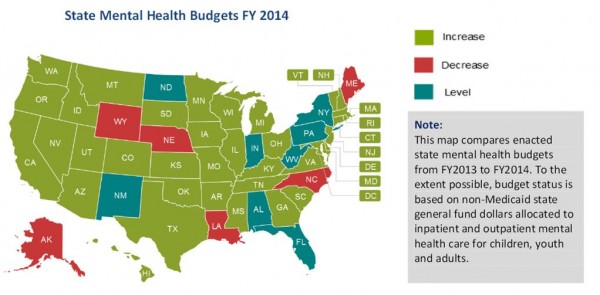
Most states either increased or maintained state mental health authority budgets at current levels during 2013 legislative sessions. Of special note, the report indicated, is Texas which allocated a $259 million increase over the previous biennial budget, the largest mental health budget improvement in the state’s history. South Carolina reversed previous cuts to its mental health budget while Illinois restored $32 million that had been cut in 2011 due to an administrative error. In California, an additional $143 million was allocated to create crisis and triage positions throughout the state.

The report stated that “A tipping point on the heels of several recent mass shootings, the Newtown tragedy shaped the debate about the lack of access to mental health services and the barriers that many families and individuals face in light of the nation’s fragmented and grossly inadequate mental health system.”

After the Newtown tragedy NAMI advocated for policies supporting early identification and intervention, training for school personnel, families and the public, mental health services in schools and increased access to care.

The report highlights actions by states in 2013 in areas including mental health system monitoring, early identification and mental health screening, services for transitional youth, school mental health training and services, mental health facilities and suicide prevention.  Also included are elements of state legislation in law enforcement areas such as juvenile justice, incarceration and the courts.  A final section looks at stigma reduction efforts in the states.

Mental illnesses are medical conditions that disrupt a person's thinking, feeling, mood, ability to relate to others and daily functioning. Mental illnesses are medical conditions that often result in a diminished capacity for coping with the ordinary demands of life.  Serious mental illnesses include major depression, schizophrenia, bipolar disorder, obsessive compulsive disorder (OCD), panic disorder, post traumatic stress disorder (PTSD) and borderline personality disorder.

Connecticut resident Marilyn Ricci, a past president of NAMI Connecticut, serves on the national NAMI Board of Directors, and is on the board of NAMI Farmington Valley in Connecticut, which she helped found in 2004.  Kevin Sullivan, a former Connecticut Lieutenant Governor currently serving as Commissioner of Revenue Services, is a past Board member of the organization. The state legislative report was issued on October 28, 2013.

Connecticut Skater Seeks Olympic Chance At U.S. Championships in Boston

Timing, as they say, is everything.  For Olympic hopeful Zachary Donohue of Madison, Connecticut, and his skating partner Madison Hubbell of Michigan, a lifetime of training, determination, resiliency and competition will be in full view at the U.S. Figure Skating Championships in Boston this week.

As U.S. national bronze medalists in 2012, and fourth place finishers at the 2013 U.S. Championships, the ice dance couple is at the cusp.  Three couples will earn U.S. Olympic team slots, to be announced on Sunday. The contest for those positions is expected to be extremely close.2014 USChampionships

For Donohue, it has been a long and winding road from New Haven and Madison, where he grew up, through New Jersey, Colorado, and Michigan where he trained and lived beginning at age 15, to the U.S. Championships in an Olympic year, just days after his 23rd birthday.

The journey began while visiting cousins in North Carolina, who took him along to go skating at a local spot.  “I was just messing around, imitating what they were doing.  One of my cousins said, “hey, you’re pretty good.”  Unbeknownst to 10-year-old Zach, his athletic ability on blades was mentioned to his mom, who promptly signed him up for a “Learn to Skate” program when they returned home to New Haven. He excelled, and skating soon evolved from a “cool outlet for all my energy” to a more serious interest.

Then at age 13, he grew a foot and a half in a year, and had to reduce his ice time to let his body catch up to itself.  The bones were outpacing the muHubbell_Donohue_FS_145scles, which made jumps and spins painful.  It was during that time that his love of music and interest in skating merged toward ice dance.

Now 6’2”, 195, Donohue is “tall, long and strong” – all attributes for a powerful yet graceful ice dancer.  Madison “Madi” Hubbell, at 5’8” is taller than many ice dance partners, and together they bring and impressive line to their skating.   The word most associated with their performances is “connection. “ They convey an emotional bond on the ice that is mesmerizing –earning the effusive admiration of commentators describing the fluidity, artistry and technical precision reflected in their routines.

In addition to training seven-days-a-week at the Detroit Skating Club, Donohue coaches skaters in nearby Troy, from 7 year-olds to young adults.  His coaching focuses on everything but dance, an understandable change of pace.  Through the years, he has discovered that he not only enjoys coaching, but choreography as well.  That is not only helpful with his students, but in developing the championship-caliber routines of Hubbell & Donohue.

Perseverance Through Injuries

It has been a stunningly successful and incredibly challenging, injury-riddled year.  Hubbell, out for two months recuperating from a concussion during which doctors precluded her from any exercise whatsoever, fought back and they not only competed effectively but won the coveted 2013 Nebelhorn Trophy in Oberstdorf, Germany, exceeding their personal best scores.  No small task in the best of circumstances; remarkable given the realities.  They had won the same competition two years ago, in their debut season together.

Barely back on the ice, and with pressure-packed competition as skating’s Grand Prix season intensifying, Hubbell has bravely forged through the current season despite a diagnosis of a labral tear, a hip-injury not uncommon in the sport, but incredibly painful, and at times, debilitating.  She has been forthright about the injury, describing the challenges and limitations on their blog, while remaining upbeat and positive.  And despite it all, they won their first-ever Grand Prix medal, and finished fourth at Skate America.

“They just focus, and they’re so supportive of each other.  It is the persistence of an athlete – I’ve worked so hard for this, I’m just not gonna stop.  They both have that,” observes Diane “Dee” Eggert, Donohue’s mother and biggest fan.  Their recent success, in the midst of trying times, comes built on a foundation of trust and confidence that is “essential to any partnership,” Donohue points out.  “Although still a relatively new team, just three years together, it was evident relatively quickly that “all the pieces fell into place” when they got together.  “It takes time to get the kinks out,” Donohue says, but “we have become that well-oiled machine, through a tremendous amount of hard work.”  Hubbell’s determination working through injuries has impressed not only Donohue, but the skating community.

It is an on-ice partnership that was unplanned, but clicked immediately.  Hubbell had skated with her brother at the lower rungs of the skating ladder, and excelled, winning championships and much notice.  When he opted to retire from skating, Donohue was simultaneously ending a previous partnership, which also had brought success.  They found themselves on the same Detroit rink, at the same time, in need of new partners, and a coach off-handedly suggested they help each other out that day by working together.  Hubbell and Donohue haven’t looked back.

Local Roads to National Acclaim

Donohue easily recalls time spent training and practicing at rinks in Cromwell, Newington and Simsbury, as his interest in and dedication to the sport grew.  It was his mom who drove endlessly through central Connecticut to get him to training sessions, coaches, and practice time.  “She’s always been by my side,” Donohue points out, appreciatively.  “Skating puts a lot of stress on parents.”  For those of modest means, especially so.

Employed by the security department at Yale University for nearly 15 years after a career in law enforcement, she added an extra job or skating imagetwo along the way to help meet the relentless expenses of a skating career.  She worked the overnight shift, so days could be spent with her son.  Because of his skating-centric life, Donohue was home-schooled through his teenage years, and college plans remain on hold for now.

Beyond the ever-present skating, he has interests – and talent - in music and culinary arts, in addition to coaching and choreography.  When Zach was 12 years old, he was selected as the singer to open a show at the Shubert Theater in New Haven, and his mom marveled at his ability to sing in front of an audience of nearly 500 people.  Entertaining crowds has always been something he’s comfortable with.  “He’s my cheering section, and I’m his cheering section,” she says proudly, recalling his growing success and relentless tenacity.

At every turn, she concluded “how can I stand in the way of his whole career,” as he proceeded to pursue the next step in the dream.  She recalls vividly when she once broached the subject of giving up skating, as a youngster.  “Well, there was just no way.  He said he’d run away from home, sleep on the ice, and drive the Zamboni if he had to.  That’s when I knew how much skating meant to him.”

At 15, he moved to New Jersey where he lived in his coach’s home and trained during the week, returning to Connecticut on weekends.  By 17, he was moving to Colorado to work with a new coach as his development and advancement continued.  While there, he had an opportunity to work with ice dance legend Christopher Dean, among his icons in the sport.

“It’s a sacrifice you make,” Eggert says, reminiscing about the Christmases, Thanksgivings and other holidays where Zach hasn’t quite been able to make it home.  Donohue’s mom and Hubbell’s mom talk regularly, provide support and encouragement as needed, and look ahead.  Whether or not they are selected for the Olympic team, other goals beckon, including the World Championships later this Spring, and noteworthy competitions thereafter.

“There are daymadi_zach_sc2013s it’s hard but then you get to the competition and you realize it’s all worth it,” said Donohue.  “There’s never a day I don’t love it.  I love being on the ice.”

Artistry and Athleticism

The music for their Short Program, to be skated on Friday, will be a “Big Bad Voodoo Daddy,” medley featuring the quickstep, foxtrot, and Charleston. For the free dance (long program) the next day, “Nocturne into Bohemian Rhapsody.” The music has been well received by audiences this year, and Donohue is pleased with his role assisting in the choreography.  “I’m stubborn and outspoken,” and thereby earns a say in choreography decisions.

“He and Madi both feel the music.  It’s a gift.  Even when he was young, when he was practicing and someone else’s music would start, he’d skate away to the music.  It’s been that way since day one,” Eggert recalled.

Four years ago, Donohue was in juniors, with a different partner on the ice.  Today, he is on the brink of the Olympic dream becoming reality.  What will fans see in Boston?  A “better-than-ever version” of performances that earned top honors in Germany, even as extremely talented American teams vie for coveted Olympic slots.

“We’ve been working on our lifts and elements, and becoming stronger, faster and lighter.” Donohue admits to some nervousness prior to skating competitions, but that is quickly eclipsed by confidence as the music begins.  The training regimen, from intense cardio to a relentless series of physically demanding exercises, is unending but essential.  Injuries have required adjustments, but no stoppage.

The contrasts in skating can take your breath away.  The unique combination of artistry and athleticism makes it a singular sport - also unique in that a man and woman are paired in competition.

Not to get ahead of the story, but the 2014 Olympics will have an attractive new feature – the first-ever figure skating team event, similar to the team competition in gymnastics.  That will provide Olympic skaters with an opportunity to medal not only in individual events, but as part of a team – and Team USA is expected to be very much in the running.  If all goes wonderfully in Boston, Madi and Zach – described by his mom as “two peas in a pod” - will be, too.