CT Ranked #4 as More Students Succeed on AP Exams; Gap Widens for Latino, Black Students

The College Board, in its annual report on the state of the Advanced Placement program – known to high school students as AP classes – determined that mean scores and overall participation in the AP exam both grew last year, but inequities in the availability of the exams and programs persists across socioeconomic and racial backgrounds. Connecticut ranked #6 nationally in the percentage of 2012 public high school graduates succeeding on AP exams, but disparities continued in Connecticut and nationwide in the number of minority students taking and succeeding in AP classes.  The state ranked #4 in the nation for the largest change in the overall percentage of students scoring well on the AP Exam, from 15.5 percent in 2002 to 26.9 percent in 2012, a jump of 15.5 percent.

Data indicate that in Connecticut, however, the gap widened from 2011 to 2012 in the percentage of African-American students and Latino students in the graduating class who took AP classes.  Ten states eliminated the gap for Latino students; three states did so for African-American students.

The publication Inside Higher Ed noted that the report designated “promoting equity” as a major goal for the AP program in the coming years, and although lack of equal access and opportunity remains an issue, the findings rAP-Classes-and-Ivy-League-Admissioneported several positive signs over the past year in this regard.  The report states that in 2012, disparities in participation and success shrank in 30 states for African-American students and in 17 states for Latino students.

Among the class of 2012, more than 300,000 students identified as having a high likelihood of success in AP did not take any recommended AP Exam. To succeed on an AP exam, students need to score a 3 or higher on a 5-point scale. Many colleges and universities offer college credit for passing scores. AP courses are offered in a variety of subjects, including math, science, foreign language, English and history.

According to the report, nationwide the number of high school graduates taking the AP exam in 2012 was 954,070, or 32.4 percent, up from 30.2 percent in 2011, and 18 percent a decade earlier, in 2002. Hundreds of thousands of academically prepared students with the potential to succeed in AP — including a disproportionately large percentage of underserved minority students — are graduating from high school without having participated in AP classes.

AP participation also increased among low-income graduates, who accounted for 26.6 percent of students who took at least one AP examination. This is an increase from 11.5 percent in 2003.

ctlatinonews.com cited ABC News Univision in reporting that more Latinos are taking the test than in previous years, according to the report, and more of them are succeeding. But the data revealed significant inequities in AP participation along racial/ethnic lines, with underserved minority students who demonstrated readiness for AP much less likely than their similarly prepared white and Asian/Asian American/Pacific Islander peers to experience AP course work.

Writing in the Miami Herald, Trevor Packer, Vice President of the Advanced Placement Program at The College Board, pointed out that “Under-represented minority students who show readiness to succeed in AP are less likely to actually take AP than their white and Asian peers. In AP math course work, for example, among every 10 students who are ready for an AP math course, 60 percen435876254t of Asian students, 40 percent of white students, 30 percent of Latino and African-American students, respectively, and 20 percent of American Indian/Alaska Native students participate in the program.”

Why are many minority students not enrolled in advanced placement classes? One reason cited in the report is a lack of access. Many attend school where the coursework is simply not available. The report offers suggestions for improving access to AP courses, while noting that schools can run into obstacles such as a lack of funding or properly trained teachers.  Schools need to do a better job of notifying students that they are eligible for the courses, the report says. Once students are enrolled, the report says that schools should provide support, in the form of peer-to-peer mentoring, counseling and tutoring.

Top 10 States in Percentage of 2012 Public High School Graduates Succeeding on AP Exams

  1. Maryland (29.6%)
  2. New York (28.0%)
  3. Massachusetts (27.9%)
  4. Florida (27.3%)
  5. Virginia (27.2%)
  6. Connecticut (26.9%)
  7. Maine (24.8%)
  8. California (24.7%)
  9. Colorado (24.2%)
  10. Vermont (22.8%)


CT AARP Steps Up Focus on Entrepreneurs, Business Development

Next month, AARP and the U.S. Small Business Administration (SBA) are teaming up to host National Encore Entrepreneur Mentor Month, targeted at new business owners age 50 and over and those interested in starting a business.  The goal is to match these “encore entrepreneurs” with experienced business owners and community leaders for advice and assistance, and to link them to the resources they need to successfully start and grow their businesses and create jobs. Consistent with the organizations’ mission, the Connecticut AARP chapter views social enterprise as a valuable opportunity for age 50+ entrepreneurs – also known as “Encore Entrepreneurs” – and active retirees with sharp business and entrepreneurial acumen.  With one in four Americans ages 44 to 70 interested in becoming entrepreneurs, and a large majority planning to work during retirement, small business ownership is described as a solid option.

In addition to planned programs during April, the Connecticut AARP has announced support for legislation proposed by Governor Malloy’s (SB6356) which would help AARP members formalize their commitment to creating public good. The bill is designed to help address a variety of social concerns, through business rather than public funds or philanthropy, that are core to AARP’s mission, such as hunger, economic insecurity, housing and isolation.  AARP has ongoing partnerships with the U.S. Small Business Association (SBA), nationally and state-wide, and with co41592_130564031656_4369100_nmmunity partners in Connecticut including Social Enterprise Trust (reSET) and the Women’s Business Development Center (WBDC).

The bill before the legislature aims to help attract and keep social entrepreneurs and social enterprise investors in Connecticut and provides a heightened level of transparency and protection as compared to other states with similar legislation, according to AARP. Among the beneficiaries:  “Encore Entrepreneurs” seeking purpose beyond profit, community based organizations seeking to partner for social benefits, age 50+ workers seeking employment opportunities in a down economy, and the State by creating a new source of revenue through the payment of up-front incorporation filing fees and annual taxes.

National Encore Entrepreneur Mentor Month is part of a larger effort by AARP and SBA to promote entrepreneurship among individuals ages 50+.  It will consist of events across the country, including two in Connecticut, on April 16 in Waterbury and April 18 in Bridgeport, that will link individuals with local resources and mentor opportunities to help them successfully start and grow a small business.

The initiative includes AARP’s Work Reimagined, a unique new way for experienced workers to advance themselves in today’s tight job market.  Work Reimagined is a social network based jobs program that connects employers seeking experienced workers with qualified professionals searching for new or more satisfying careers.  The site, www.workreimagined.org, leverages the platform of professional networking site, LinkedIn, which is used by more than 15 million people aged 45-64.

AARP’s Work Reimagined and other resources for experienced workers over age 50 are slated to be highlighted in a segment on WTNH’s Connecticut Style program airing Wednesday, April 3, 2013 at 12:30 p.m.

The in-person AARP/SBA workshops in April will feature presentations by SBA, SCORE, reSET (Social Enterprise Trust), The Women’s Business Development Council (WBDC), People’s Bank and local economic development agencies.  Attendees will have the opportunity to ask questions and speak individually with representatives, as well as network with other small business owners and “would be” entrepreneurs. Registration is required.

April 16, 2013 in Waterbury   9 a.m. – 12 p.m. (noon)

Silas Branson Library, 267 Grand Street, Waterbury, CT

To register, call 1-877-926-8300 or register online

April 18, 2013 in Bridgeport   9 a.m. – 12 p.m. (noon)

City Hall Annex, 999 Broad Street, Bridgeport, CT

To register, call 1-877-926-8300 or register online.


Nonprofit Density Impacts Unemployment Rate; CT Misses Top 10

Communities with better civic health have weathered the recent recession far better – and experienced considerably smaller increases in unemployment – than other communities that faced similar economic circumstances, according to a report by the National Conference on Citizenship (NCoC).  Counties across the nation that were rich in nonprofit organizations lost considerably fewer jobs than the low-nonprofit counties, the study revealed. A state-by-state analysis by the organization placed Connecticut in the second tier of states in both the density of nonprofit organizations, and social cohesion (interacting with friends and neighbors), the two measures used in the study, released in 2012.  Connecticut ranked between #11 and #20 in each category, just outside the first tier, top-10 states.

For individuals who held jobs in 2008, the odds of becoming unemployed were cut in half if they lived in a community with many nonprofit organizations rather than one with a few nonprofits, even if the two communities were otherwise similar, theNCoC study found.  Among the New England states, Maine, Rhode Island and Vermont placed in the top ten.

Overall, counties with more nonprofits per capita prior to the recession had lower unemployment in 2006. And while almost all of the counties lost jobs during the recession years, the counties with more nonprofits per capita lost fewer jobs between 2006 and 2009. Both patterns remain even when holding education, median income, housing prices, and other economic factors constant, according to the report.  Counties ranking in the top 10% in nonprofit density experienced an increase of only 2 percentage points in their unemployment rate between 2006 and 2009, compared with 5.1 percentage points for the counties in the bottom 10% in nonprofit density.

These results suggest – according to the report – that nonprofits may bring economic benefits by directly employing people and also by changing the economic climate of the whole community. Nonprofits support civic engagement and social cohesion; in turn, when citizens feel committed to their communities and connected to their fellow residents, they are more likely to make decisions that boost local employment.

The study used statistical models to investigate the relationship between civic health and unemployment in the 50 states, 942 metro areas, and more than 3,100 counties since 2006.  NCoC was chartered by Congress intop 10 1953 to harness the patriotic energy and national civic involvement surrounding World War II. In 2009, Congress  expanded the organization’s Civic Health Assessment to become the nation’s largest and most definitive measure of civic engagement.


Towns and Cities Look to Varied Housing Options, Community Engagement

Many municipalities across Connecticut and New England are finding that community engagement – proactively, thoughtfully and creatively asking their residents for their attention and ideas about proposed housing and commercial development – pays off big time. That was evident last month at UMass/Amherst when three federal agencies – HUD, EPA and DOT – along with the Funders’ Network for Smart Growth and Livable Communities brought together experts and advocates from the region to discuss the best ways to merge affordable housing creation, transit and livable, sustainable and environmentally sound practices.

A growing number of organizations and government entities – municipal and regional – are using or promoting community engagement because the changing housing market is moving many more communities to increase their efforts at housing creation. A wider array of housing options – smaller, denser, more affordable, energy-efficient, walkable and, if possible, close to transit – are being utilized to meet the needs of empty-nesters, young professionals and families, and workers in a region that, despite a falloff in demand, has seen rental and purchase prices remain very high.video clip

The Partnership for Strong Communities highlighted community engagement strategies it promotes, including its new video about five very different Connecticut communities – Hamden, Old Saybrook, Colchester, Bristol and Simsbury – that have used an array of community engagement methods – charrettes, town meetings, websites and crowd-sourcing among them – to harvest ideas and achieve buy-in for their development plans.

The organization embarked on a search to discover how communities can balance multiple priorities and opinions, and achieve development that most residents can be satisfied with.  Partnership staff drove around the state and filmed interviews with about 30 individuals involved in this work.  The resulting video, along with supporting materials, reflects how five different communities with different goals, used different methods to achieve a single outcome.

International Students Are Half of UConn MBA Class of 2013

The Class of 2013 student profile for the University of Connecticut’s School of Business provides interesting insight into those going through UConn to make their mark on the business world.  The university’s website reports the stats are an indication of the program’s “success in recruiting top-notch talent from a myriad of backgrounds.”  Of particular note:

  • 69% of the students are male, 31% are female
  • 50% are from the United States, 50% are international students
  • Among the states represented are Connecticut, Florida, New Jersey, New York, Utah, Virginia and Wisconsin
  • Among the nations represented are China, India, Japan, Serbia, Taiwan, Thailand, Vietnam and the U.S.
  • The undergraduate degrees of the MBA students are 31% business, 21% humanities/social studies, 17% engineering, 11% math/physical science, 7% economics, and 2% information science/computer science.2010class_ugdegree
  • The average years of work experience is 5.1
  • The average age is 28

The UConn School of Business was recently ranked among the Top 40 programs in North America and Top 200 worldwide for three graduate programs. The rankings were awarded by Eduniversal's Top 200 "Best Masters and MBA Worldwide" 2012-2013, which provides a global overview of the best post-graduate programs in 30 specializations in 153 countries. The programs and rankings were:

All of which are numbers and notoriety to ponder when encountering students coming and going from UConn's distinctive School of Business in downtown Hartford.

Sustainability, Green Infrastructure Advance in CT

green-energyWhen considering Connecticut’s progress in sustainability, green infrastructure, and green investments, a variety of statistics help to tell the story.  Among them:

  • The U.S. Department of Energy considers 13 percent of Connecticut’s electricity as coming from renewable resources, ranking the state 31st in the nation.  The majority of the renewable power comes from biomass and hydropower, as reported in the Connecticut Green Guide (www.CTGReenGuide.com).
  • Connecticut’s transportation sector employees more green workers than any other industry in the state, with 8,238 green jobs.
  • In the Northeast, 76 percent of companies use at least one type of green technology or practice.  According to the U.S. Bureau of Labor Statistics, the most popular green methods are:
  1. Energy efficiency
  2. Waste reduction
  3. Conserving natural resources
  4. Reducing greenhouse gas emissions
  5. Removing pollutants from workspace
  6. Generating onsite renewable energy
  • Connecticut Innovations, the state’s quasi-public investment firm, currently puts 6 percent of its portfolio into clean technology start-ups.  Here’s the portfolio breakdown:
  1. Information technology               49.5%
  2. Bioscience                                           42%
  3. Clean tech                                           6%
  4. Photonics                                            2%
  5. Advanced materials & other       .5%


  • The U.S. Energy Information Agency reports that Connecticut ranks fifth in the nation among the states consuming the least amount of energy per capita.  The top ten:
  1. Rhode Island
  2. New York
  3. Hawaii
  4. California
  5. Connecticut
  6. Massachusetts
  7. Arizona
  8. New Hampshire
  9. Florida
  10. Vermont


  • Connecticut leads the New England states in demand response resources – businesses and facilities that power down when electric prices and demand spikes, according to data from ISO New England.

State                                     Megawatts of Demand Response

Connecticut                        996.6Picture1

Massachusetts                  800.5

Maine                                   447

New Hampshire              183.2

Vermont                              144

Rhode Island                      140


Among the most common practices used by employers are asking employees to conserve, turn off or dimming lights, adjusting indoor temperature, and turning off equipment such as printers, copiers, and PCs).  Other steps, used less often, include shutting down production, starting emergency generation, limiting the use of elevators and escalators, and shutting down an entire plant.


Foreclosure Rate Drops Nationally, CT Better Than National Average

Foreclosure filings — default notices, scheduled auctions and bank repossessions — were reported on 150,864 properties across the U.S. during January, a decrease of 7 percent from the previous month and down 28 percent from January 2012. The report - by RealtyTrac®, a leading online marketplace for foreclosure properties and real estate data - shows one in every 869 U.S. housing units with a foreclosure filing during the month, down 28 percent from a year ago to the lowest level since June 2006 — a 79-month low. Each of Connecticut’s eight counties is below the national average, and the state continues to be outside the top 10 states for the number of foreclosures, according to the U.S. Foreclosure Market Report™ for January 2013.  The prevalence of foreclosures, based on the number of housing units, was greatest in Windham, Tolland, and New Haven Counties.

The Florida foreclosure rate ranked highest among the states for the fifth month in a row. One in every 300 Florida housing units had a foreclosure filing in January — more than twice the national average. A total of 29,800 Florida properties had a foreclosure filing during the month, up 12 percent from the previous month and up 20 percent from January 2012.MapPic_000918

With one in every 344 housing units with a foreclosure filing in January, Nevada posted the nation’s second highest foreclosure rate for the fourth consecutive month. A 32 percent month-over-month jump in scheduled foreclosure auctions helped the Illinois foreclosure rate rise to third highest among the states in January. One in every 375 Illinois housing units had a foreclosure filing during the month.

Other states with foreclosure rates among the nation’s 10 highest were Arizona (one in 501 housing units with a foreclosure filing), Georgia (one in 513 housing units), Ohio (one in 612 housing units), Washington (one in 674 housing units), California (one in 753 housing units), Indiana (one in 784 housing units), and Michigan (one in every 837 housing units).

In Connecticut, New Haven County had the largest number of foreclosures in January, with 317, followed by Hartford County with 265 and Fairfield County with 193.  Overall, Connecticut had 5,187 home foreclosures during the month, with the average foreclosure sales price of $186,405.  The county-by-county breakdown:

  • Windham            51 foreclosure properties             1 in every 958 housing units
  • Tolland                 52 foreclosure properties             1 in every 1,109 housing units
  • New Haven        317 foreclosure properties          1 in every 1,138 housing units
  • Hartford               265 foreclosure properties          1 in every 1,409 housing units
  • Litchfield              57 foreclosure properties             1 in every 1,530 housing units
  • New London      78 foreclosure properties             1 in every 1,546 housing units
  • Fairfield                193 foreclosure properties          1 in every 1,865 housing units
  • Middlesex           37 foreclosure properties             1 in every 2,013 housing units

In New Haven County, the numbers were driven by Waterbury with 84 foreclosures and New Haven with 59.  West Haven had 38 during the month.  In Hartford County, there were 44 foreclosures in New Britain, 35 in East Hartford and 26 in Manchester, according to the data provided by RealtyTrac.

Connecticut Ranks #25 in Homelessness, Federal Data Shows

Connecticut ranked #25 in the nation in state-by-state comparisons of the homeless population in emergency and transitional shelters in each state, according to data compiled by the U.S. Census Bureau and reported in the AARP Bulletin. Earlier this week, The Hartford Courant reported that “volunteers and social service workers roved the streets for the U.S. Department of Housing and Urban Development's national ‘point in time’ homeless census, which provides more up-to-date data to consider along with the 2010 census data that was the basis of the state comparisons.

Mandated at least every other year, the ‘point in time’ count helps advocates and housing officials analyze trends in homelessness, determine who stays in the shelters and gain insight into why, despite a stronger government push to combat homelessness, people remain out in the cold, the Courant reported.

About 4,210 homeless people lived in the state in 2012, including men, women and children in emergency shelters and transitional housing, federal data show. Among the nearly 770 reported homeless in Hartford — the biggest homeless population of the state's urban centers — 141 were children, according to a report released Wednesday by the Connecticut Coalition to End Homelessness.

Latinos are overrepresented among clients using the state’s many homeless shelters, and they tend to be much younger, according to coverage of the report by ctlatinonews.com. “While Hispanic/Latino persons represent only 12.3% of the Connecticut population, they comprised 28 percent of all emergency shelter and 23 percent of all transitional housing clients.

“They also tended to be younger. The most common age of Hispanic/Latino emergency shelter clients was between 18-29 years old (29 percent), while that of non-Hispanic/Latino clients was 40-49 years old (31 percent).”

“Connecticut’s emergency shelters alone served 11,700 people, including more than 1,500 children. The number of people in shelters and transitional programs at any given point in time increased 3% from 2009 to 2010, while shelter bed usage has exceeded 100% during all of 2010 and much of 2009. While collectively we may have slowed the rate of growth in homelessness over time, the numbers continue to increase,” the report said.


Credit Card Debt Increases Among Older Residents

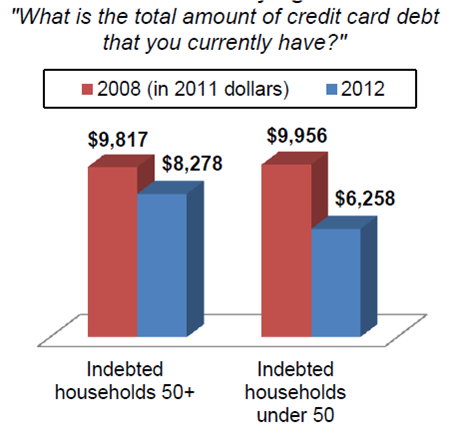
As Connecticut struggles to lift itself from a nagging recession and rebuild a shaky economy and grow jobs, new national data suggest that economic realities plus an aging population are combining to increase the credit card debt among a significant segment of the population. It has been estimated that the state's 65+ population would increase by 69 percent between 2000 and 2030. Middle-income Americans age 50 and older are carrying more credit card debt on average than younger people, according to a National Survey on Credit Card Debt of Low- and Middle-Income Households, released last month by Demos, a national policy think tank and AARP’s Public Policy Institute.

The results of the 2012 survey are a reversal of findings from a survey conducted by Demos in 2008.  It reveals a troubling picture of middle-income 50+ households carrying card debt near or in their retirement years.

The report shows that nationwide, older households carried an average credit card balance of $8,278 in 2012. For those underlogo 50, credit card debt averaged $6,258. Other key findings for middle-income households that carried credit card debt for three months or more:

  • A third of older households used credit cards to pay for basic living expenses such as rent, mortgage payments, groceries, or utilities.
  • Half of Americans age 50+ carried medical expenses on their credit cards. Prescription drugs and dental expenses were the main contributors.
  • A quarter of older households said loss of a job contributed to their credit card debt in the last three years.
  • Nearly one in five (18 percent) older Americans nearing retirement said they dipped into retirement funds to pay down credit card debt.chart
  • Older Americans were twice as likely as those under age 50 to take on credit card debt to assist other family members (23 percent vs. 11 percent).

This report suggests that credit card debt among older Americans is primarily a reflection of difficult economic times, not a lack of personal financial responsibility.  State-by-state data was not available.

The findings may help to explain the economic challenges facing Connecticut’s citizenry, which is on track to becoming one of the oldest among the states, expected to grow from 470,183 (13.8% of the total state population) in 2000 to 794,405 in 2030, constituting 21.5% of the projected total state population.


Connecticut to Receive National Support to Reduce Premature Births

With one in 10 babies born premature in the state, the National Governors Association (NGA) has targeted Connecticut and three other states for extra help in better developing and coordinating policies to reduce the rate of preterm births. NGA will convene in-state sessions with the selected states to facilitate this process and convene a networking conference for that group of states to share lessons learned and to further their respective planning processes. NGA has selected Kentucky, Louisiana and Michigan, along with Connecticut, to participate in a Learning Network on Improving Birth Outcomes. The goal is to assist states in developing, implementing and aligning their key policies and initiatives related to the improvement of birth outcomes, as measure by the incidence of preterm births and infant mortality.

Of the 41,000 babies born each year in Connecticut, about 4,000 are born preterm. The median gestational age for these babies is 35 weeks -- about a month earlier than the median 39 weeks for a full-term birth. These babies typically weigh 5.5 pounds compared with the full-term rate of 7.5 pounds.

The Learning Network will focus on demonstrated best practices of states that have improved birth outcomes. Participating states will learn about coordinating activities across agencies and options to accelerate the pace of improving outcomes and reducing costs.

The nation's premature birthrate is 11.7% of all live births — the lowest in a decade, according to figures from the National Center for Health Statistics. The March of Dimes has set a goal of 9.6% by 2020.  Nationwide, key signs of improvement in the report issued late last year:

  • Four states (Vermont, Oregon, New Hampshire and Maine) earned an "A" for meeting the 9.6% goal; in 2010, only Vermont earned the top grade.
  • Connecticut, at 10.1%, received a “B” in the report.
  • 45 states, the District of Columbia and Puerto Rico posted improved preterm birthrates from 2009march of dimes map to 2011, earning 16 of them better grades.
  • The states with the highest preterm birthrates — Mississippi (16.9%), Louisiana (15.6%), Alabama (14.9%) — are among 48 states, along with Puerto Rico (17.5%) and the District of Columbia (13.7%) that have all formally set goals to lower their preterm rates 8% by 2014 from their 2009 rates.

Connecticut's rate of pre-term births also reflect a racial and ethnic disparity. The pre-term rates are 14 percent among black/African Americans, 12 percent among Latinos and 9.4 percent among whites, according to the state Department of Public Health.

The initiative  is part of the Alliance for Information on Maternal and Child Health Services (AIM). AIM is sponsored by the Maternal and Child Health Bureau of Health Resources and Services Administration of the United States Department of Health and Human Services.

Premature birth is associated with infant mortality as well as a greater risk of learning disabilities and lifelong hearing and visual problems. Some of the major risk factors for having a premature baby are smoking during pregnancy and having a pre-existing medical condition, such as diabetes or hypertension, officials said.