CT Has 3rd Lowest Percentage of Low Income Students in Public Schools, Nationwide Numbers Exceed 50 Percent

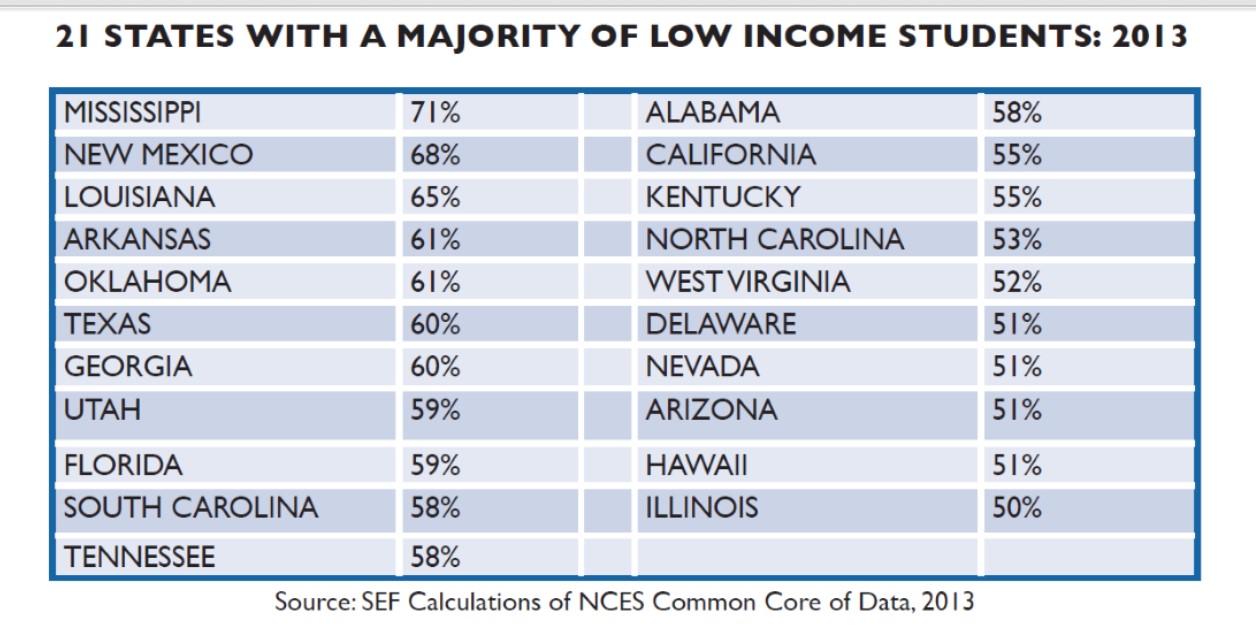
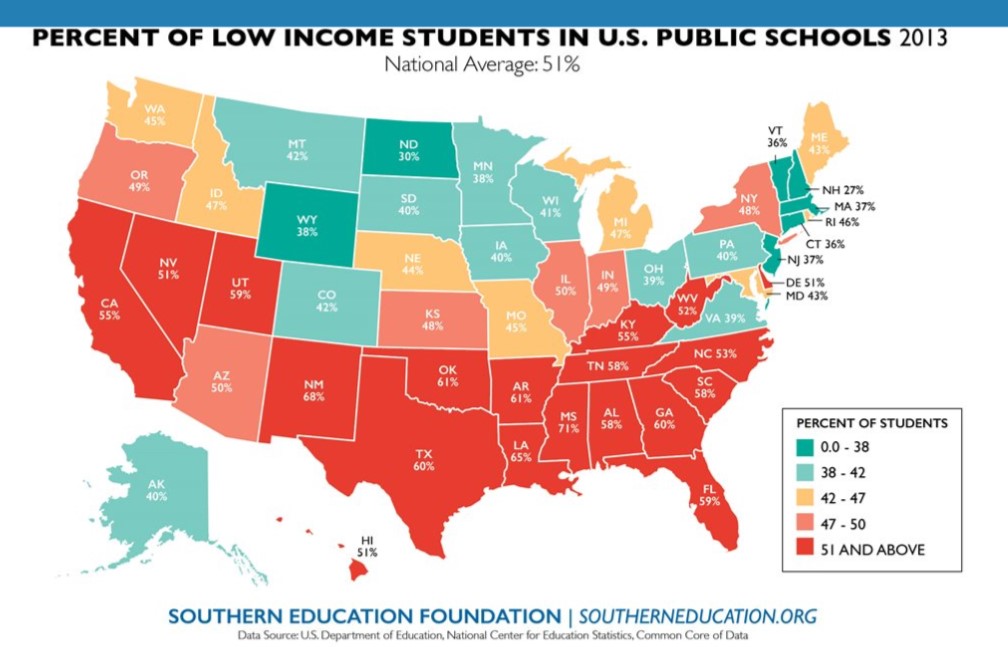
For the first time in at least 50 years, a majority of public school students across the country are considered “low-income," according to a new study by the Southern Education Foundation. While poor children are spread across the country, concentrations are highest in the South and in the West. Connecticut has among the lowest percentages in the nation. The latest data collected from the states by the National Center for Education Statistics (NCES), show that 51 percent of the students across the nation’s public schools were low income in 2013. In 40 of the 50 states, low income students comprised no less than 40 percent of all public schoolchildren. In 21 states, children eligible for free or reduced-price lunches were a majority of the students.student computers

Connecticut, which ranked tied for third, was among only ten states where the percentage of “low-income” students was below 40 percent. The states are Virginia (39%), Ohio (39%), Wyoming (38%), Minnesota (38%), Massachusetts (37%), New Jersey (37%), Connecticut (36%), Vermont (36%) North Dakota (30%) and New Hampshire (27%), which had the nation’s lowest percentage of low income (eligible for free and reduced lunches) public school students.

Thirteen of the 21 states with a majority of low income students in 2013 were located in the South, and six of the other 21 states were in the West. Mississippi led the nation with the highest rate: 71 percent, almost three out of every four public school children in Mississippi, were low-income. The nation’s second highest rate was found in New Mexico, where 68 percent of all public school students were low income in 2013.SEF
The report noted that “this defining moment in enrollment in public education in the United States comes as a consequence of a steadily growing trend that has persisted over several decades.”

In 1989, less than 32 percent of the nation’s public school students were low-income. By 2000, the national rate as compiled and calculated by NCES had increased to over 38 percent. By 2006, the national rate was 42 percent and, after the Great Recession, the rate climbed in 2011 to 48 percent, the report indicated.

The 2013 data suggests that six other states are on the verge of reaching a majority of low income students in the near future, if current trends continue. In Indiana and Oregon, 49 percent of the public schoolchildren were low income. In New York and Kansas, the rates were 48 percent. In Idaho and Michigan, rates were 47 percent.

The report concludes by stating t21 stateshat “The trends of the last decade strongly suggest that little or nothing will change for the better if schools and communities continue to postpone addressing the primary question of education in America today: what does it take and what will be done to provide low income students with a good chance to succeed in public schools? It is a question of how, not where, to improve the education of a new majority of students.”
Founded in 1867 as the George Peabody Education Fund, the Southern Education Foundation’s mission is to advance equity and excellence in education for all students in the South, particularly low income students and students of color. The organization's "core belief is that education is the vehicle by which all students get fair chances to develop their talents and contribute to the common good."
 

map


CT Ranked #41 in Climate for Small Business and Entrepreneurship

Connecticut ranks #41 in its policy environment for small businesses and entrepreneurship, according to a study that ranked the 50 states in a Small Business Policy Index.  Most of the New England states landed towards the bottom of the list, with none ranking in the top 25. The report, Small Business Policy Index 2014: Ranking the States on Policy Measures and Costs Impacting Small Business and Entrepreneurship, tracks 42 measures with 33 of them pertaining to taxes and regulations. SBE report coverIssued by the Small Business & Entrepreneurship Council, the index ranks the 50 states according to 42 different policy measures, including a wide array of tax, regulatory and government spending measurements. The index, which has been published annually for 19 years, continues to point to South Dakota as the most entrepreneurial-friendly state in the U.S., benefiting most from the lack of individual income tax, capital gains tax, corporate income tax and inheritance tax.


The top 10 states are South Dakota, Nevada, Texas, Wyoming, Florida, Washington, Alabama, Indiana, Colorado and North Dakota.  Among the New England states, the highest ranked was New Hampshire at #27, followed by Massachusetts at #31, Rhode Island at #40, Connecticut at #41, Maine at #42 and Vermont at #45.

Commenting on Connecticut, the report indicates that “Connecticut’s entrepreneurs, businesses, investors and workers benefit from a low crime rate and low consumption-based taxes. However, the state’s negatives are numerous, including high personal income, individual capital gains, corporate income, corporate capital gains, property, gas and diesel taxes, along with high levels of government spending and debt.”

Connecticut’s ranking was unchanged from last year’s Index report.  In 2012 the state ranked #42 and in 2011 was ranked at #44.  In 2010, Connecticut ranked at #41, which was a drop from #40 in 2009.

“States like Arizona, Indiana, Kansas, New Mexico, North Carolina, North Dakota, and Ohio have really stepped up their game on the policy front. In each of these cases, tax reform and relief were undertaken, which reduces the costs of risk taking and doing business. Meanwhile, top-tier policy states like Texas, Nevada, South Dakota, Florida and Wyoming continue to leverage their long-standing policy advantage, and are doing things to get better,” said SBE Council President and CEO Karen Kerrigan.sbelogo

Of the 42 measures included in the recently issued 2014 edition of the Index, 24 are taxes or tax related, 9 relate to regulations, five deal with government spending and debt issues, with the rest gauging the effectiveness of various important government undertakings, according to the report. The lowest ranked states were New York, New Jersey and California.

The report states that “most business owners understand the array of costs and burdens imposed by government. Taxes and regulations, for example, drain enterprises of vital resources, distort decision-making, and redirect resources and energies away from maintaining, improving and/or expanding a business.”

In the individual measures, among Connecticut’s highest rankings were #7 in crime rate, #10 “State and Local Sales, Gross Receipts and Excise Taxes as a Share of Personal Income,” #13 in the rankings of “Adjusted Unemployment Taxes,” and #17 in workers compensation costs.

The Small Business and Entrepreneurship Council (SBE Council) is a 501c(4) advocacy, research, education and networking organization dedicated to protecting small business and promoting entrepreneurship.  SBE Council works to educate elected officials, policymakers, business leaders and the public about key policies that enable business start-up and growth. The report, issued in December, was authored by Raymond J. Keating, chief economist for the Small Business & Entrepreneurship Council.

small bus map


Plans Unfold for National Museum Store Conference in Hartford in April

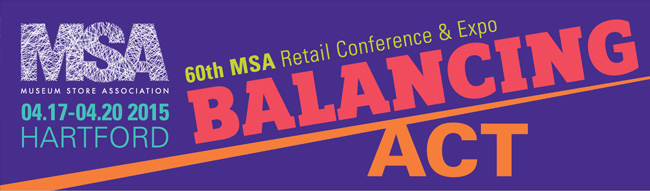
If you’ve ever made a purchase at a museum store and wondered about how the merchandise was selected or the store operates, there will be no shortage of experts from the industry in Hartford this spring.  The 60th Annual Museum Store Association Retail Conference & Expo will be held April 17-20, 2015 at the Connecticut Convention Center. The event is the only conference and expo specifically created for retailers at museums, historic sites, botanic gardens, aquariums, zoos, libraries and more. The 2015 MSA Retail Conference & Expo is designed to help nonprofit retail professionals by providing four days of education sessions featuring industry experts and opportunities to connect with vendors who offer products matched with the museum store industry.museum

It will be the first time the national conference will be in Hartford.  In recent years the host cities were Houston, Los Angeles, New Orleans and Chicago.  The national meeting in Hartford will include a “retail boot camp” and a tour of the Mark Twain House and Harriet Beecher Stowe House.

The MSA website points out that “learning sessions are presented by the leading thinkers in nonprofit retailing who share the knowledge you need to run your store, meet the needs of management, make the most out of challenges, be a leader and through retailing contribute to your institution’s brand and extend the experience of your visitors.”Balancing-Act-600x175-indd.jpg

Manager of the Museum Shop at the Wadsworth Atheneum Museum of Art, immediate past MSA Board President Stacey Stachow, said when Hartford was selected to host the conference, “Connecticut has so much to offer with its rich cultural history, so many museums and things to do that relate to our members.”   In addition to the Wadsworth Atheneum, other MSA member institutions in the area include the Connecticut Historical Society Museum & Library, Harriet Beecher Stowe House, New Britain Museum of American Art and Friends of Dinosaur State Park and Arboretum.

The opening keynote speaker will be Roderick Buchanan, director of buying and retail at the British Museum Company.  The closing keynote speaker will be Dick Durrance, an award-winning National Geographic photographer and U.S. Army combat photographer during the Vietnam War. MSA-Logo_sm

Among the industry issues that will be discussed is fair trade, which will be the focus of a panel discussion.  The conference website points out that “as consumers are increasingly interested in the origin of the goods they purchase, the fair trade movement is gaining momentum and is affecting buying in the museum store world. Expert panelists will offer insights into critical aspects of the fair trade industry, including who benefits from fair trade, why retailers should buy fair trade, and questions that should be asked about business practices in order to ensure that products are indeed fair trade.”

Other sessions include presentations on pop-up shops, museum store launches, visual merchandizing, ecommerce, the influence of various cultures, and the importance of museum stores in the overall experience of museum visitors.

The four-day event is expected to bring in 900 participants downtown utilizing an estimated 1,130 room nights, according to organizers. There will be 21 educational sessions, and more than 200 vendors on hand.  Approximately 800 institutions are part of MSA with more than 1200 individual members representing those institutions.

Stores in cultural institutions are different from typical retail operations in several ways, the organization points out. “These retail operations play a vital role in supporting the institution’s educational mission. They offer products that provide visitors with mementos and educational materials directly related to their cultural experience.’  Purchases made at museum stores provide important financial support for the institution, officials emphasize.

FCC “Enforcement Hold” of WTIC-AM License Renewal Continues in New Year

The license renewal application of WTIC-AM, filed more than a year ago, remains on “enforcement hold” at the Federal Communications Commission, as the agency’s Enforcement Bureau continues to consider “an alleged violation of FCC rules,” according to an FCC official. Until the enforcement hold is lifted, the agency’s Media Bureau cannot proceed with a decision on whether or not to renew the station’s broadcast license.  The Enforcement Bureau must first determine whether or not a violation of FCC rules has occurred.  If the allegation is substantiated, the agency has a range of options, such as warning that the violation not be repeated or imposing a monetary fine on the station, officials said. FCC

WTIC-AM, which is licensed to Hartford but operates from studios in Farmington, can continue broadcasting under the broadcast license that expired nine months ago, on April 1, 2014, until the FCC acts on its renewal application.  The renewal application was filed by the station more than a year ago, on November 27, 2013. Stations must file an application for license renewal) four months prior to the expiration date of the station's license.

Precisely what the allegation under review involves is not made known to the public, officials reiterated this week.  That information is only made available to the licensee or their attorney, according to an FCC official. The agency can, and often does, communicate with the station as part of their review process.  WTICWTIC_1080_AM_Radio_logo has declined to comment on the ongoing review process at the FCC.
Officials say it is not unusual for a license renewal to be on enforcement hold for an extended period of time.  Stations in such a status routinely continue to operate without any interruption until a decision on license renewal is made.

When the license renewal application does reach the agency’s Media Bureau, they will consider “how the allegation of violation was resolved,” as well as a range of other factors in deciding whether or not to renew the station’s license.

The other, more routine, factors include whether any other objections have been raised about the station, whether the station has been adequately serving the public in their area of license, their history of compliance with FCC regulations, and their overall performance.  License renewals for radio stations are issued by the FCC for a period of eight years.

Connecticut by the Numbers first reported the FCC’s enforcement hold last September.  Subsequently, Hartford Attorney Ken Krayeske filed an informal objection on October 1, 2014 to WTIC’s broadcast license renewal, alleging that the station “demonstrated serious malfeasance” and “helped conceal violations of federal law,” related to Rowland’s use of his radio program to promote the Congressional campaign of Lisa Wilson-Foley. Krayeske had filed a previous complaint in 2012 that did not result in FCC action against the station.

More Passengers Flying at Bradley; Atlanta Growing As Top Destination

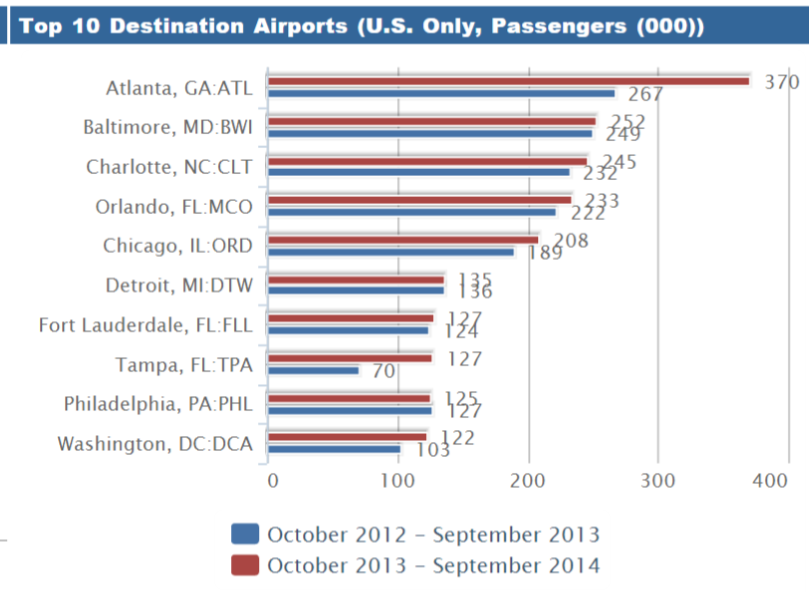
If you’re flying out of Bradley International Airport (BDL), you’re probably flying to Atlanta.  According to data from the United States Department of Transportation, the top five destinations from Bradley are Atlanta, Baltimore, Charlotte, Orlando, and Chicago. If a recent trip to the airport has left you with  the impression that the terminal in Windsor Locks has been more crowded than it used to be, you’re right. More people are flying in and out of BDL in recent months, as compared with the same period a year ago.Bradley_INTL_Logo.svg

The other destinations reaching the top ten from Bradley are Detroit, Fort Lauderdale, Tampa, Philadelphia and Washington, DC.  In eight of the top ten destinations, with the exception of Detroit and Philadelphia, the number of passengers grew during the past year (October 2013 through September 2014) as compared with the previous 12-month period.

Recent additions to their schedules by carriers operating at Bradley may be influencing the numbers.  United started daily nonstop service to Houston in October. JetBlue added flights to Tampa and Fort Myers and expanded service to Washington, DC earlier in the year and Southwest has added flights to Atlanta, heightening competition with Delta.top 10

The total number of “enplanements” has increased at Bradley in month-over-month comparisons for the first five months of the fiscal year that began on July 1, 2014, according to data provided on the Bradley airport website.  The number of passengers arriving on flights at Bradley were up 11.59 percent in July from the same month the previous year, and up 12.62 percent in August, 9 percent in September, 4.7 percent in October, 3 percent in November.  Data for December has not yet been published.

Between July 2013 and June 2014, the most popular months for travel from Bradley were the months of  April (258,756), May (257,627) and December (255,144). If recent trends continue, this spring may bring record-setting months to the airport.

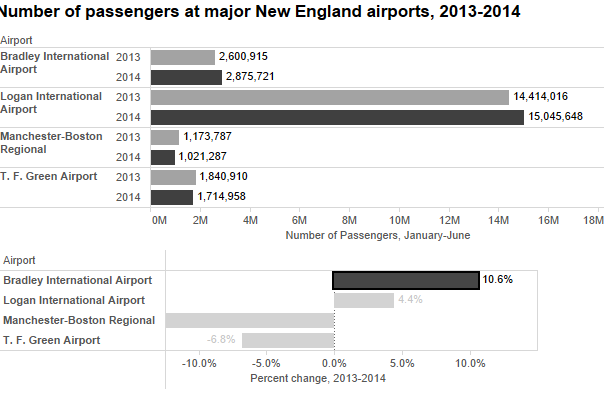
During the first six months of 2014, about 2.9 million passengers used Bradley. That was a 10.6 percent increase from the 2.6 million passengers who used the airport in the first half of 2013, according to published reports.dot logo

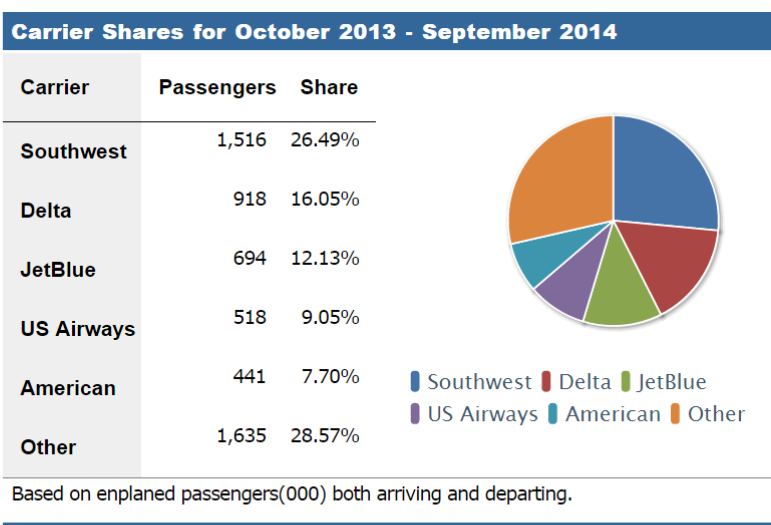
Southwest carries the largest percentage of passengers at Bradley, 26.4 percent. Delta is next with 16 percent, followed by JetBlue at 12.1 percent, US Airways with 9 percent and American with 7.7 percent.  An assortment of smaller carriers carry 28 percent of the passengers, arriving and departing, at Bradley.airlines at BDL

The on-time performance of the airlines at Bradley remained virtually identical between November 2013 and October 2014, at 81 percent, compared with 82 percent a year ago.  Among flights that have been delayed, the average duration of the delays has declined, from just over to just under an hour.

Bradley International Airport is the second largest airport in New England. According to the most recent economic impact analysis, Bradley contributes $4 billion in economic activity to the state of Connecticut and the surrounding region, representing $1.2 billion in wages and 18,000 full-time jobs.


Dashboard 1

Eight Communities to Receive Funds to Support Downtown Improvement Initiatives

Connecticut Main Street Center (CMSC), the downtown revitalization and economic development non-profit, is awarding eight organizations and municipalities a total of $80,000 in 2015 Preservation of Place grants.  The grants will be used to provide Bridgeport, Canton, Hartford, New Milford, Newtown, Putnam, Torrington, and Windsor Locks with targeted resources to increase their capacity to plan for preservation and revitalization initiatives in their downtowns and neighborhood commercial districts.preservation of place The Preservation of Place grant program provides a source of funding for new initiatives that can be integrated into, and leverage, comprehensive Main Street preservation and revitalization programs.  The funds are meant to be flexible to meet individual community need.


The 2015 recipients of Preservation of Place Grant funds are:

  • Bridgeport Downtown Special Services District for a feasibility study of the creation of a regional food hub and community supported agriculture in downtown BridgeportCT Main Street LOGO
  • Town of Canton for a comprehensive market study and brand strategy for Collinsville
  • Hartford Business Improvement District for the creation of a community vision plan for a six block area of the Asylum Hill neighborhood
  • Town of New Milford for a historic downtown New Milford branding & marketing program
  • Town of Newtown for the Sandy Hook Village Signage & Wayfinding Design Plan
  • Town of Putnam for Downtown Putnam design guidelines & standards
  • City of Torrington for a Downtown Torrington market study & branding/imaging program
  • Town of Windsor Locks for the historic train station reuse studytorrington

"Historic preservation and the revitalization of our Main Streets create jobs, bring vacant buildings back on the tax rolls and add value and vitality to adjacent buildings and neighborhoods," said John Simone, CMSC President & CEO.

"The diversity of locations, from the Northwest Corner of Connecticut to New London, matched with the diversity of projects, from creative placemaking in urban open spaces to organizational and leadership development that will improve the management function in downtown, will allow each community to respond to their greatest current need, actively creating their direction of growth," he added.

Since 2008, CMSC has awarded $446,130 through the Preservation of Place grant program to twenty four Connecticut communities, leveraging over $1 million in local Main Street initiatives.  The program receives support from the State Historic Preservation Office with funds from the Community Investment Act. A year ago, a total of $70,000 in grants were awarded to Bridgeport, Canton, Essex, New London, Norwalk, the Northwest corner, and Willimantic.

The mission of Connecticut Main Street Center is to be the champion and leading resource for vibrant and sustainable Main Streets as foundations for healthy communities. CMSC is dedicated to community and economic development within the context of historic preservation, and is committed to bringing Connecticut's commercial districts back to life, socially and economically.

Boston Will Be U.S. Hope for 2024 Olympics; CT Could Provide Assist

Boston’s selection by the U.S. Olympic Committee (USOC) as the United States representative in the sweepstakes to host the 2024 Summer Olympic Games could be good news for Connecticut. The USOC will hope to convince international Olympicsvoters to bring the Summer Games to America after a 28-year gap.  The International Olympic Committee will award the Games in 2017. The U.S. last hosted a Summer Olympiad in Atlanta in 1996; a Winter Olympics in 2002.  St. Louis hosted in 1904 and Los Angeles held the Games in both 1932 and 1984.

Boston2024_LogoUSOC board members chose Boston, with its promise of frugality and temporary, reusable venues, over Los Angeles, San Francisco and Washington.  Boston joins Rome as the only other city that has officially decided to bid. Germany will submit either Hamburg or Berlin, with France, South Africa and Hungary among those also considering bids, according to published reports.

The Connecticut Convention & Sports Bureau (CCSB), the state’s official meetings and sports event sales and marketing organization, “supports Boston’s bid for the 2024 Olympics,” Interim President H. Scott Phelps told CT by the Numbers last fall.

CCSB officials noted that if the Olympic Games decide to come to Boston, “it could be great for tourism in nearby Connecticut as well, as spectators and competitors would be encouraged to come visit our State’s attractions,” adding that “there might be opportunities for our state to host pre-Olympic competitions and … athletes.”ConnecticutConvnSports

Even before Boston’s selection by the USOC, at least one Olympics observer suggested that Connecticut may have an Olympic supporting role to play.  Rosanna Garcia, associate professor of marketing in the D’Amore-McKim School of Business at Northeastern University in Boston, who has attended the past eight Summer Olympics, sees the city turning to Connecticut and Rhode Island to host some events.

“With more than 300 events that typically occur at the Olympics, many cities around Massachusetts, and even Rhode Island and Connecticut, will need to partner with the International Olympic Committee to host these events,” Garcia points out.

“Many preliminary competition events would need to take place outside of the main Olympic Park areas so events may occur as far away as Connecticut. This also is an opportunity for more people to get involved with the Olympic Spirit,” Garcia adds.

America's last two attempts to land the Games were unsuccessful - fourth-place finishes for New York seeking the 2012 Games that went to London and Chicago which had hoped to be selected for 2016.U.S.-Olympic-Committee-logo

Boston focused on its ability to use universities throughout the area to house events and athletes.  It touted a walkable, technology-based Olympics and said as many as 70 percent of its venues would be temporary, and the schools would pay for many of the venues, then take them over after the Games, according to reports on the city’s bid.

Olympic_rings_without_rims.svgLast fall, a promotional video advocating a Boston bid was released, and a website was launched. With an eye toward innovation and efficiency, the video highlights Boston’s bid “to create a sustainable model for hosting the Olympic and Paralympic Games that can become the blueprint for future host cities.”
It is the first time that Boston has prepared a bid to host the Games, and it is being led by an organization called the Boston 2024 Partnership, a nonprofit organization formed to prepare the bid materials. The group is governed by a 36-member executive committee, and has launched a series of subcommittees aimed at master planning, fundraising, outreach, and engagement.

Organizers note that no tax dollars have been spent on Boston 2024, and tax dollars will not be used to build venues or pay for the operation of the Games. Public investment will be confined to roadway, transportation and infrastructure improvements, most of which are already planned and are needed with or without the Olympics.

“Regardless of whether or not Boston wins the Olympics, the City’s bid has helped to elevate the Boston and other New England brands to sports event planners from all over the world,” Connecticut officials added.

https://www.youtube.com/watch?v=IiNItLCJ1jI

Connecticut Ranks 33rd in College Funding, Tuition, Burden; Grade: D

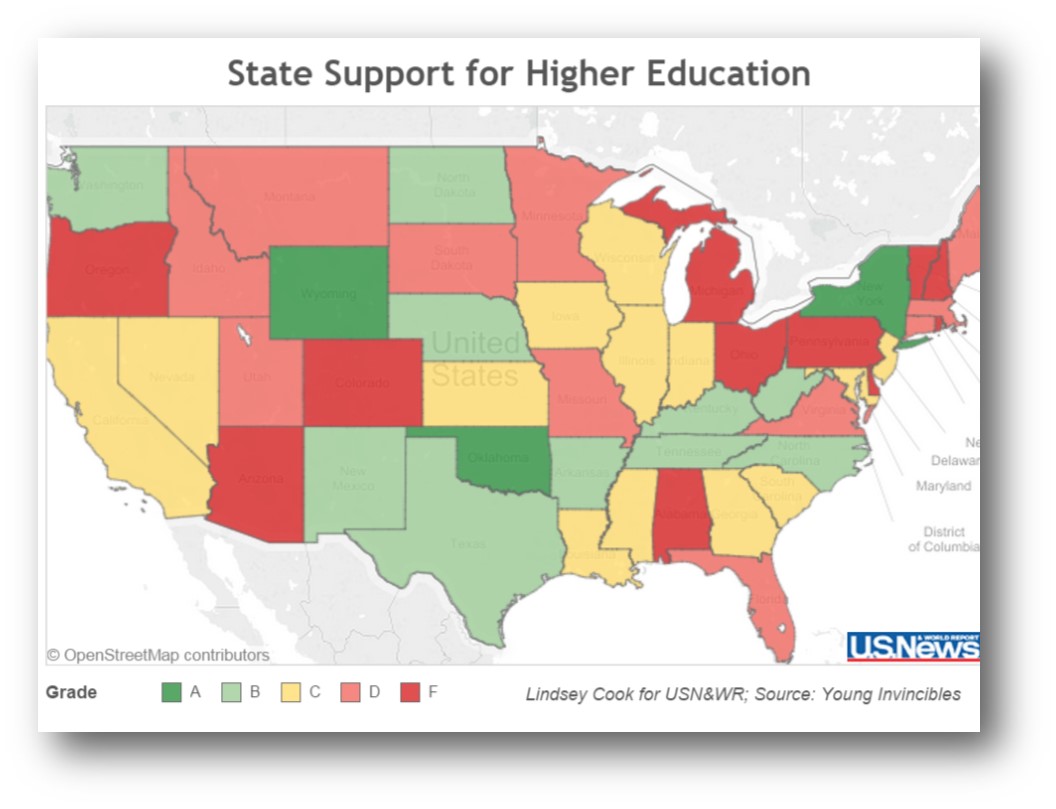
The Student Impact Project, an initiative of the youth advocacy group Young Invincibles, tracked trends in higher education finance in states across the country, and graded each state based on tuition levels, state funding per student, state aid to students, the financial burden to families and higher education spending as a portion of the total state budget.  Connecticut's report card grade:  D. In state-by-state reports published this week and reported by US News & World Report, the group found that on average, tuition at four-year public colleges and universities increased 37 percent between 2007 and 2013, which is three times the rate of inflation.  The data indicated that 47 states spend less per student today than they did before the Great Recession.map

Connecticut ranks 33rd among the nation’s 50 states in support for higher education.  Overall, just four states – Wyoming, New York, Alaska and Oklahoma – received a total grade equivalent to an A, while 10 got a B, 13 got a C, 12 got a D and 11 received an F, US News reported.

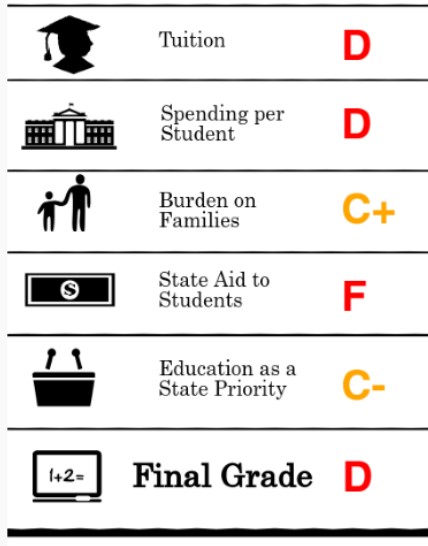
Overall, the state’s average in the five categories was 63 percent, which placed it ahead of only 16 states, including New Hampshire, which placed last, and Vermont, Colorado, Michigan and Oregon.  Connecticut received an F in the “aid for students” category, D in “state appropriation average” and “tuition” categories, C- in “Higher Ed as a Priority,” and the state's highest grade, C+, in “Burden on Families Average.”

New Hampshire, which at a 17 percent overall grade scored lowest in the country, spends the least amount of money per student than any other state ($1,708), and has cut the budget almost in half since the recession, according to the report. New Hampshire also provides no state aid to students, and spends 2 percent of its overall budget on higher education.  In Connecticut, the report indicated, that figure is 11 percent.

A report issuedCT report card last month by the General Accounting Office in Washington, D.C. for the U.S. Senate found “persistent state budget constraints have limited funding for public colleges” across the country. The result, according to the GAO report: “Students and their families are now bearing the cost of college as a larger portion of their total family budgets.”
A report by Connecticut’s Office of Higher Education in March 2014 found that for the 2013-14 academic year, “UConn’s increase of 5.8 percent for in-state commuting students compares to a national average of 3.7 percent for state flagship institutions. CSCU’s increase of 5.4 percent for in-state commuting students attending its State Universities compares to a national average of 4.1 percent for similar types of institutions; the Community Colleges’ increase of 5.5 percent for in-state commuting students compares to a national average of 4.5 percent for like institutions.”

The Connecticut report also noted that “from 2009 to 2014, tuition and fees for in-state undergraduates have increased 24.7 percent at the Connecticut State Universities, 26.9 percent at the Community Colleges, and 28.7 percent at UConn.”  Last fall, Connecticut’s largest public college system (CSCU) said it will need an 11 percent increase in its base-level state funding for the next fiscal year if they are to keep  an anticipated tuition-and-fee hike to 2 percent.  If additional state funding is not provided, steeper tuition hikes are possible.GAO report

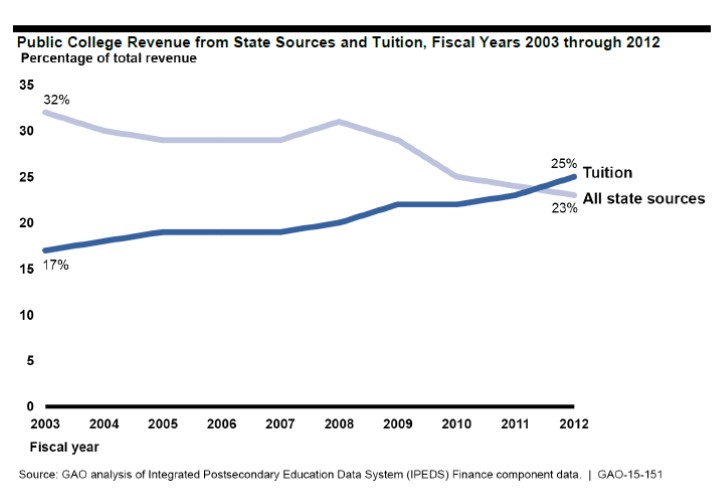
From fiscal years 2003 through 2012, the GAO report outlined, state funding for all public colleges decreased, while tuition rose. Specifically, state funding decreased by 12 percent overall while median tuition rose 55 percent across all public colleges. Tuition revenue for public colleges increased from 17 percent to 25 percent, surpassing state funding by fiscal year 2012 (see chart below).

In their report, “State Funding Trends and Policies on Affordability,” GAO identified several potential approaches that the federal government could use to expand incentives to states to improve affordability, such as creating new grants, providing more consumer information on affordability, or changing federal student aid programs. “Each of these approaches may have advantages and challenges, including cost implications for the federal government and consequences for students,” the report noted.

The report also indicates that GAO tuition state support“state grant aid directly affects students in that it can reduce their out-of-pocket expenses for college… state grant aid, both merit- and need-based, has positive effects on enrollment.”  The results of one program, in Washington State, cited by GAO “suggests that receiving the aid increased a student’s probability of enrolling in college by nearly 14 to 19 percentage points.”
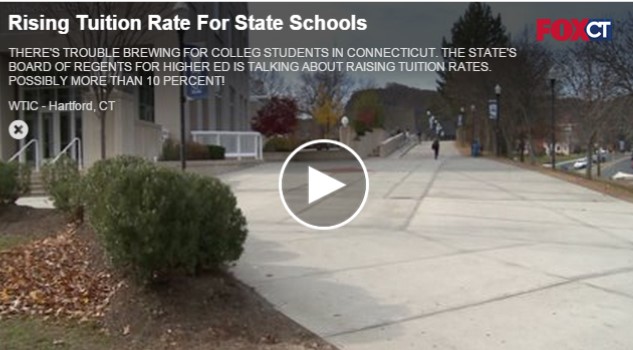
Footnote to the story: to underscore the data, US News is running a video news story broadcast on FOX Connecticut, reporting on possible tuition increases at the Connecticut State Colleges & Universities.  The story, which is not referenced by date, was aired two years ago.

FOX


Charter Oak State College Among Top 20 Online Bachelors Programs in Student Engagement; Three CT Colleges Reach Top 100 Online

Student engagement and on-line courses may seem incompatible, but Connecticut's Charter Oak State College is among the best in the nation at bringing those two concepts together effectively.  Charter Oak  ranked at #90 in the nation in the newly published U.S. News & World Report ranking of the top online bachelors programs in the country, and at #17 in student engagement.  In other categories, the online institution, based in New Britain, ranked #187 in faculty credentials and training, and #139 in student services and technology. Charter Oak State College is Connecticut's public online college offering bachelor's and associate degree completion programs for adults. The college was established in 1973, and offers degree completion programs in a number of high-demand fields including business, health care, public safety, information systems and cyber security. U.S. News indicates that all of the online classes are recorded and archived so students can access lecture material at their own convenience.generic-bachelors

The magazine ranked a total of 219 institutions offering online programs, with scores ranging from 100 (Pennsylvania State University-World Campus) to 44 (University of Wisconsin-River Falls).  Charter Oak’s score was 69. U.S. News evaluated several factors to rank the best online bachelor’s degree programs, including graduation rates, faculty credentials and support services available remotely.  Nearly 85 additional schools were analyzed but did not reach thebachelor's program rankings. Charter-oak-state-college-logo

U.S. News indicates that the new student retention rate in 2014 at Charter Oak was 82 percent, and that 63 percent of students graduate within six years.  Total enrollment is 1,898, according to the publication.

In offering the rankings of on-line programs, U.S. News noted that many schools are enriching their online degree programs ​as student interest in distance education  continues to increase.

Among private institutions in Connecticut, the University of Bridgeport ranked at #68 overall, spurred by faculty credentials and training, which ranked at #19.  Student engagement ranked at #94, and student services and technology ranked at #132.  The most popular online major, according to U.S. News, is dental hygiene and related health professions.  UB’s overall score was 74.  In addition, UB has the #13 ranked online graduate Information Technology program and #48 best online graduate engineering program.

Sacred Heart University ranked at #87 among on-line bachelors programs.  The category breakdowns for Sacred Heart were: #27 in student services and technology, #44 in faculty credentials and training, and #52 in student engagement.  Sacred Heart’s overall score was 70.  The institution also ranked #70 among best on-line graduate nursing programs.

Enrollment for each of the institutions on-line programs is predominantly female: 64 percent at Charter Oak, 84 percent at University of Bridgeport and 93 percent at Sacred Heart.

U.S. News assessed schools based on four general, weighted, categories:

  • Student engagement (40 percent): Quality bachelor's degree programs promote participation in courses, allowing students opportunities to readily interact with their instructors and classmates, as is possible in a campus-based setting. In turn, instructors not only are accessible and responsive, but they also are tasked with helping to create an experience rewarding enough that students stay enrolled and complete their degrees in a reasonable amount of time.
  • Faculty credentials and training (20 percent): Strong online programs employ instructors with academic credentials that mirror those of instructors for campus-based programs, and they have the resources to train these instructors on how to teach distance learners.
  • Student services and technology (20 percent): Programs that incorporate diverse online learning technologies allow greater flexibility for students to take classes from a distance. Outside of classes, strong support structures provide learning assistance, career guidance and financial aid resources commensurate with quality campus-based programs.
  • Peer reputation (20 percent): A survey of high-ranking academic officials helps account for intangible factors affecting program quality that are not captured by statistics. Also, degrees from programs that are well respected by academics may be held in higher regard among employers.

The reliability of the U.S. News rankings continue to be criticized by many in the higher education field for a variety of reasons, ranging from the self-reporting of institutions to the assessment criteria used.

40 Years Ago, Transportation and Fiscal Austerity Highlighted Inauguration Day

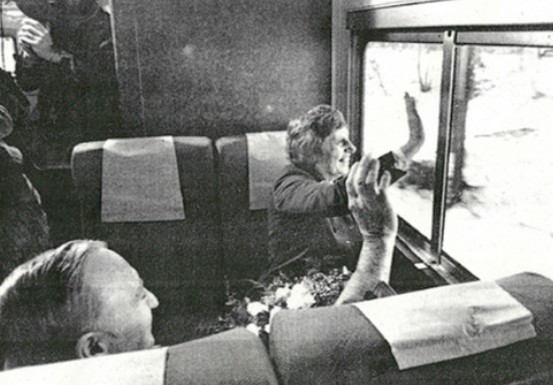
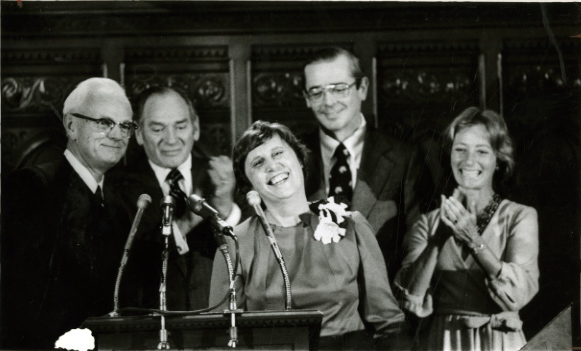
On  inauguration day, Connecticut’s incoming Governor would be “commuting by train to the Capitol for the inauguration to dramatize the need for more mass transit,” local news media reported. The Governor-elect was Ella Grasso, and the year was 1975.  She took the train from her hometown of Windsor Locks into Hartford.

Four decades later, transportation will once again be center-stage on inauguration day, as Governor Dannel Malloy has indicated in the weeks prior to taking the oath of office for a second time that transportation will be a leading issue of his second term. ella train

The Wall Street Journal has reported that a White House economic analysis from July 2014 found that 41 percent of the state’s roads were in poor condition, noting that Connecticut was tied with Rhode Island with the highest percentage of poor roads.  The state is also in the midst of improving the New Haven - Springfield rail corridor, poised to launch a revitalized "Hartford line."

Grasso, according to news reports of the day, also took the opportunity “to emphasize the need for fiscal authority in the face of projected money pr1000px-seal_of_the_governor_of_connecticut.svgoblems for the state.”

Dollars and sense were also central to the first inaugural address of Governor William A. O’Neill on January 7, 1981.

Published reports indicated “that he favored cutting spending rather than increasing taxes to eliminate a deficit in this year's budget. But he said that balancing spending with existing revenues would be even harder for the fiscal year beginning July 1.”

Speaking before a joint session of the State House of Representatives and Senate, The New York Times reported that Mr. O'Neill said: ''Government at all levels faces increasingly tough decisions, finding itself forced to do more with less. It seems we have only one choice: Curb spending and control taxation.''

O’Neill, who had succeeded to the office just a week earlier upon Grasso’s resignation due to ill health, said 'To maintain a budget balance, we can raise taxes or cut spending even further,'' he said. ''I do not want to raise taxes.''

Later in his term, O’Neill would respond to the collapse of the Mianus River Bridge on I-95 in Greenwich on June 28, 19oneill83, which exposed a poor record of road and bridge maintenance in the state, with creation of a Special Transportation Fund to set aside money to maintain and repair the state's bridges.
That same year, the legislature agreed to eliminate tolls from Connecticut roads, in part due to a horrific accident in January at the Stratford tograssoll station that killed seven people and galvanized public opinion.  The state had collected tolls at 14 locations - eight on the Connecticut Turnpike between Greenwich and Plainfield, three on the Merritt and Wilbur Cross Parkways, and at three bridges in the Hartford area. The tollbooths generated $66 million a year, The New York Times reported that year.
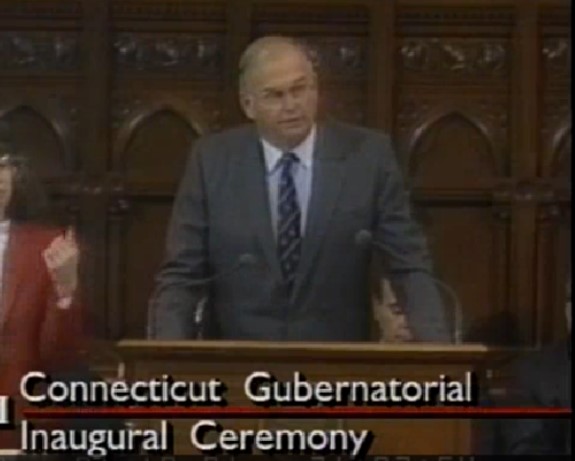
On January 9, 1991, former U.S. Senator and newly elected Governor Lowell P. Weicker said in his inaugural address that “The people of Connecticut have sent us here to do the right thing: to face up squarely to the facts of a state in fiscal trouble.'' Describing the state as ''rudderless,'' he said ''A deficit has taken control of our lives, coloring all else as it climbs beyond comprehension, sapping our confidence, humbling our visions. The past is not worth the best of our courage and creativity. That belongs to the future. 'So let's get this deficit business done, and fast.''weicker

Although he did not propose it on day one, he would soon recommend imposition of a state income tax in Connecticut, which was approved in August 1991 by a reluctant state legislature and signed into law.  Just a few weeks later, Gov. Weicker signed legislation increasing transportation fees by $6 million, clearing the way for dozens of stalled road and bridge projects.  The New York Times reported that the $6 million” will raise the state transportation fund to $63 million” and “insure enough money to pay for road projects for the next six years.”